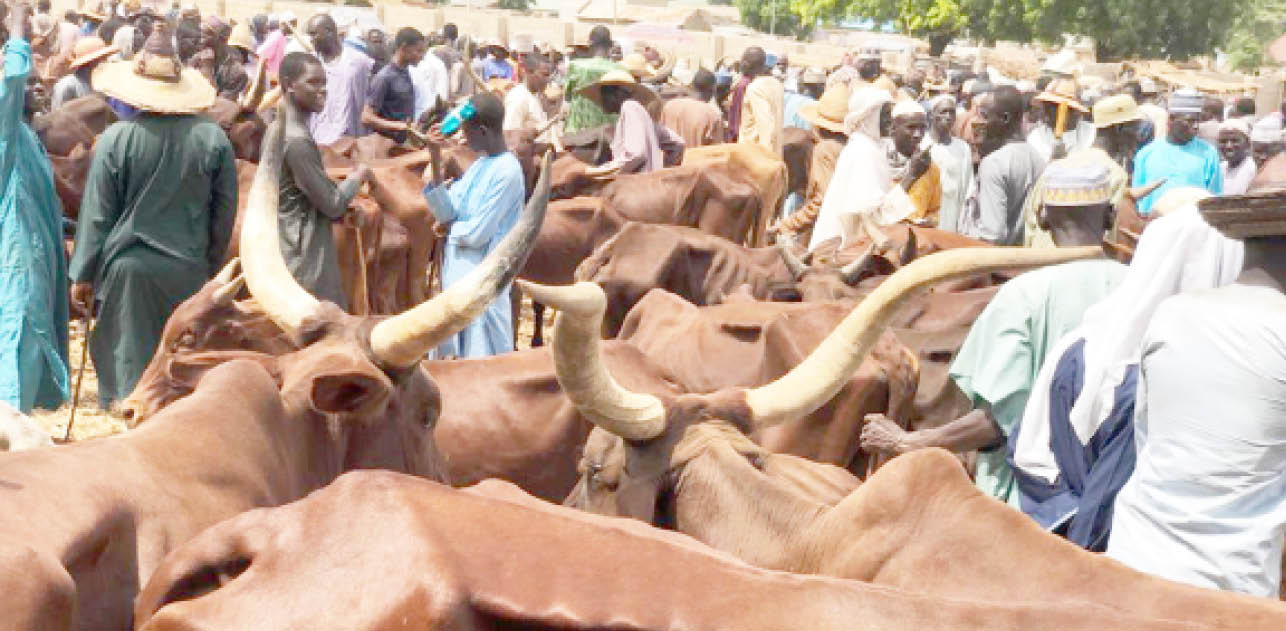

Despite the enduring challenges that have long defined Nigeria’s North East, a surprisingly robust economic narrative is emerging from its bustling livestock markets. A new study by Moniepoint Inc., Africa’s leading financial institution, reveals that livestock traders in this region experience an increase of 400 per cent in sales and income during Nigeria’s festive seasons, particularly Eid al-Adha and Christmas.
The Moniepoint report, an examination of the livestock trade, shows heightened commercial activity that peaks during these celebratory periods. At the epicentre of this trade is Kasuwan Shanu in Gamboru, a market that transforms into a nerve centre for the coordination and movement of hundreds of cattle, goats, and rams. During these high-demand windows, an astounding average of 50 trucks are dispatched daily from this hub, fanning out across Nigeria to major consumption centres such as Lagos, Port Harcourt, and Onitsha.
Prices for livestock are seen to skyrocket, delivering significant windfalls to traders. The report notes that rams, highly prized for Eid al-Adha sacrifices, see their prices rise by over 230 per cent. Goats, versatile and in constant demand, command even more significant increases, with values soaring by 400 per cent to 470 per cent, contingent on the intensity of market demand.
This festive boom is not merely a fleeting phenomenon but considered a critical component of the traders’ annual economic cycle. It allows for accumulation of capital and provides a financial cushion in a region that has faced immense economic fallout from a decade-long conflict, estimated to have cost the nation over $100 billion. Despite these macro-economic headwinds, the agricultural sector, which forms the bedrock of Nigeria’s non-oil economy, continues to be a formidable contributor, accounting for 24.64 per cent of the nation’s real GDP in the fourth quarter of 2024.
Beyond the immediate gratification of seasonal sales, the Moniepoint study uncovers a deeper, more strategic evolution among livestock traders. There is a discernible shift away from a sole reliance on quick-turnover transactions towards a more investment-minded approach. Many traders are now proactively purchasing and raising livestock well in advance of festive periods, allowing the animals to mature and gain weight, thereby increasing their resale value.
The supply chains that facilitate this massive trade are a testament to deeply embedded local knowledge and robust informal networks. Over 51 per cent of traders in Borno, the epicentre of the study, source and dispatch their goods from Maiduguri. This city functions as a major hub, serving as a conduit for livestock, grains, vegetables, and even agrochemicals, linking producers to consumers across Nigeria and neighbouring countries. Maiduguri’s strategic importance reinforces its critical role in national food security, often overlooked in broader economic assessments.
Despite the monumental scale of these operations, the study highlights that the vast majority of transactions still occur outside formal banking structures. “Our research shows that credit is mostly informal, payments are often made in person, and records are kept by memory or handwritten ledgers,” the report details.
However, it is precisely this informal nature that has fostered a remarkable degree of trust. The study vividly illustrates the deep social capital underpinning trade in Borno’s livestock markets, where high-value orders are frequently placed based solely on a phone call and a voice note. Formal contracts and documentation are often forgone, with long-standing relationships and an impeccable reputation serving as the bedrock for transactions. This trust-based system is seen not as a relic of the past but a highly effective mechanism that enables rapid, large-scale transactions across distances, particularly during the intense pressure of peak festive demand. It is a testament to the power of community and interpersonal relationships in driving economic activity where formal frameworks are less prevalent.
Tosin Eniolorunda, CEO of Moniepoint Inc., underscores the significance of these findings for financial inclusion. “Moniepoint believes financial inclusion is not just about access. It’s about dignity, about enabling people to transact on their terms.
“What’s happening in the North East today is significant. Farmers and traders who were once excluded from formal systems are now part of a national digital network, able to access capital, manage risk, and grow. This shift isn’t just tech-enabled, but it’s structurally impactful work. It’s about creating an economy where everyone can participate, no matter their location or background,” he stated.
“The story of Nigeria’s food chain is a story about people. Our role is to empower them with tools that are built for their reality. By providing secure, reliable, and instant payment solutions, we are helping to de-risk their operations and connect them to the broader national economy. “The data shows that when you build on the organic, trust-based networks that already exist, you don’t just support socio-economic development, you accelerate it. These are not just individual livelihoods, they are the hidden engines of Nigeria’s economy,” Eniolorunda added.
Interestingly, the study points to a gradual but significant shift towards digital adoption. Over 45 per cent of traders in Borno now accept digital payments, with transfers accounting for 28.6 per cent and POS usage at 17 per cent. This shift gained considerable momentum following Nigeria’s cash crunch in 2023, which starkly highlighted the vulnerabilities associated with cash-based trade. In response, tools like Moniepoint’s POS and credit alerts, alongside mobile transfers, have become increasingly vital to the operational landscape of these farmers and traders.
The tangible benefits are clear: “Digital tools have reduced theft, simplified accounting, and made payments safer. Before, we carried wads of cash. Now, I use transfers and get alerts instantly,” remarked Isiaka, a pepper farmer in Zabarmari.
The Moniepoint study, part of a series of thought leadership pieces exploring Nigeria’s informal economy, reflects a region leveraging its unique strengths and increasingly embracing digital innovation to drive economic prosperity.