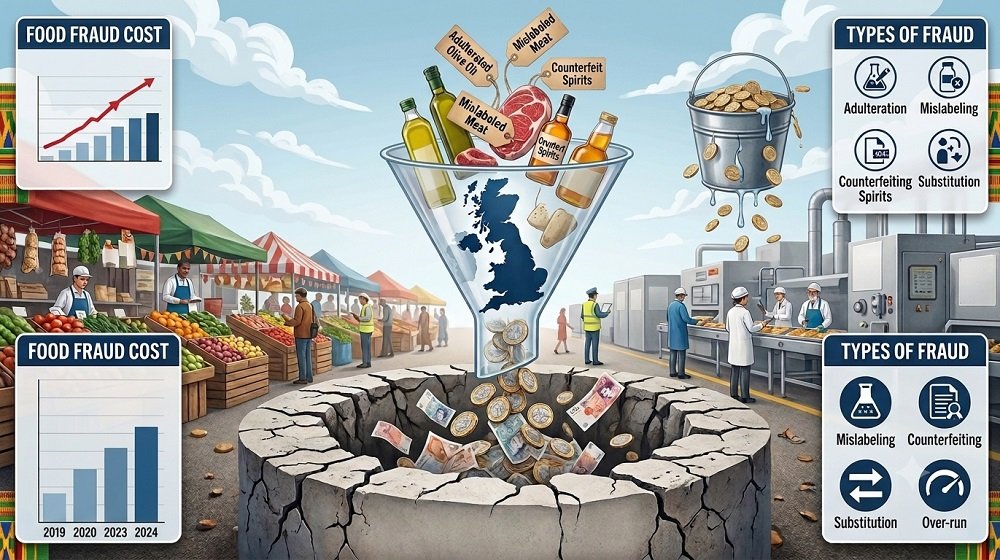
Food fraud is costing the United Kingdom economy as much as £2 billion annually, with fraudulent substitution, false labelling and document manipulation imposing huge losses on legitimate businesses and undermining confidence in food supply chains, a new study by the University of Portsmouth has found.
The research, published in the Journal of Economic Criminology, estimates the annual economic cost of food fraud at between £400 million and £2 billion, making it one of the more significant forms of economic crime in the UK.
The study provides what researchers describe as the first evidence-based estimate of the full economic impact of food fraud, going beyond the immediate losses suffered by consumers and businesses to assess how fraudulent products displace legitimate goods in the market.
According to the researchers, about three-quarters of the total economic cost comes from the direct replacement of genuine products with fraudulent alternatives.
Such practices include selling products under false descriptions or origins, substituting cheaper ingredients or commodities for those advertised, and falsifying documentation to disguise the true nature or source of food products.
One example cited in the research involved smoked salmon marketed as Scottish despite being sourced from Norway.
Fraud distorts legitimate food market
The researchers said the economic consequences extend beyond consumers who may pay for products that do not match their descriptions.
Fraudulent operators can capture market share from legitimate producers, distort competition and reduce sales for businesses that comply with food safety, quality and certification requirements.
The impact can also extend to the reputation of entire food categories and supply chains when consumers lose confidence in the authenticity of products.
In more serious cases, food fraud can create public health risks, particularly where fraudulent products contain unsafe or undeclared substances.
The study cited fake spirits containing industrial chemicals as an example of how food fraud can move beyond financial deception into a direct threat to consumers.
David Shepherd of the University of Portsmouth’s School of Criminology and Criminal Justice said the findings showed that food fraud should not be treated as a niche issue.
He said measuring its full economic cost would allow policymakers and enforcement agencies to make better-informed decisions about where resources should be deployed.
Prevention limits scale of fraud
Despite the estimated economic cost, the researchers found that food fraud remains comparatively uncommon in the UK when measured against other forms of fraud.
They attributed this partly to the extensive safeguards embedded across the country’s food supply chains.
Multiple layers of controls involving regulators, manufacturers, retailers and certification bodies create barriers that make it more difficult for fraudulent products to enter legitimate distribution channels.
Professor Lisa Jack of the University of Portsmouth’s School of Accounting, Economics and Finance said the research showed that cooperation between businesses, regulators and assurance organisations had created systems that significantly constrained fraudulent activity.
However, she warned that the existing safeguards should not lead to complacency.
She argued that continued investment in prevention and enforcement would be necessary to protect legitimate businesses and maintain public confidence in food products.
Beyond quantifying the cost of food fraud, the study also examined the potential economic value of stronger enforcement.
Based on the cases analysed, researchers estimate that prosecutions could generate a return on investment of more than 400 percent.
The researchers said the high potential return strengthens the case for targeted investment in food fraud investigations, particularly against organised criminal operations capable of generating substantial financial gains.
The study places food fraud within an economic context in which fraudulent activity can affect market efficiency even when individual consumers are unaware that they have been deceived.
When a cheaper or inferior product is falsely presented as a premium or certified product, legitimate producers can lose sales while consumers and businesses make purchasing decisions based on inaccurate information.
The resulting distortion can affect pricing, competition and investment incentives across the food sector.
The researchers therefore argue that the economic impact of food fraud should be assessed not only through direct consumer losses but also through its effect on legitimate market participants and the wider food system.