Ghana’s reputation for peace and relative security is increasingly making it a destination of choice for visitors from across West Africa, particularly Nigerians, who are drawn by its hospitality, resorts and growing range of tourism attractions.
Lanre Sanwu, one of many Nigerians who now work as ride-hailing drivers in Ghana, said the country’s peaceful environment was one of the reasons he relocated.
“The people are so nice, and since I have been driving here, I have not yet encountered any trouble with any passenger,” he said.
He is not alone in his assessment.
Another Nigerian, Joseph Garba, who was visiting Accra, said he once spent more than an hour walking around the city at night after becoming bored in his hotel in the Oxford Street area of Osu.
“When I got onto the main road, there were many people walking around, and so I just followed the street through Danquah Circle,” he said. “By the time I realised it, I had walked for over an hour. I realised I was not alone, and no one asked any questions or tried to attack me all the way to Kwame Nkrumah Circle.”
Garba said he only realised on his return journey that he had left his wallet at the hotel and that it was close to midnight.
“I stopped a taxi and explained the situation. The man just asked me to hop in, took me to the hotel and waited for me to get the money. We have since become friends,” he said.
Such experiences point to how Ghana’s reputation for stability and hospitality is helping turn it into a popular leisure destination for Nigerians, who travel to the country for weekend breaks at luxury hotels in Accra and eco-friendly resorts along the Volta River.
Visitors can engage in water sports, wildlife viewing and excursions to tourist sites stretching along the Volta River towards its estuary, where it meets the Atlantic Ocean at Ada.
Ekow Sampson, deputy chief executive officer of the Ghana Tourism Authority, said tourist arrivals from Nigeria had recorded steady growth since 2019, reaching about 136,552 in 2025.
Official figures show that 102,339 Nigerians arrived in Ghana for tourism in 2019. The number fell to 33,394 in 2020 as the coronavirus pandemic disrupted international travel, before recovering to 59,193 in 2021 and 72,786 in 2022. Arrivals rose further to 111,581 in 2024.
Sampson said Nigerians were Ghana’s largest source of tourists after the United States, adding that many visited attractions such as La Palm Royal Beach Hotel in Accra and Aqua Safari Resort in Ada.
Other major African visitor markets include South Africa, Liberia and Côte d’Ivoire.
South African arrivals reached 21,619 in 2019 before falling to 7,581 in 2021 and recovering to 12,674 in 2022. Ghana recorded 16,149 visitors from Liberia in 2022, while arrivals from Côte d’Ivoire rose to 14,282 that year from 8,413 in 2021.
Despite the growth, Ghana may be underusing its tourism potential, according to Ghanaian adventurer Princess Umul Ibrahim Mahama, who argues that the country has numerous undeveloped attractions that could make it a leading tourism destination in West Africa.
Mahama, 47, has travelled to 90 countries, including 33 in Africa. She said the continent had an abundance of tourism assets, ranging from cultural heritage and coastlines to mountains, wildlife and distinctive historical sites.
She cited the rock-hewn churches of Lalibela in Ethiopia, the dunes of Sossusvlei in Namibia and the Okavango Delta in Botswana as examples of attractions that have been successfully developed into tourism products.
“When all these sites are transformed into tourism products, they can create jobs for the youth,” she said.
Ghana, she added, had many attractions but was failing to fully exploit them.
“Ghana has a lot, but we’re not actually using what we have,” she said. That belief motivated her to undertake an ambitious journey aimed at showcasing the country’s tourism potential.
Mahama describes herself as “a mad woman who is interested in geography and interested in the value tourism brings to a nation”. She said her fascination with geography began when she was eight years old and was later reinforced by books about explorers such as Vasco da Gama.
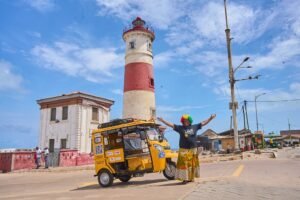
She spent 90 days travelling across Ghana’s 16 regions in a tuk-tuk, visiting 30 tourist sites. The journey took her to attractions that, she said, had received little attention, including the Gbele Resource Reserve in the Upper West Region, which she described as a “life-changing” experience.
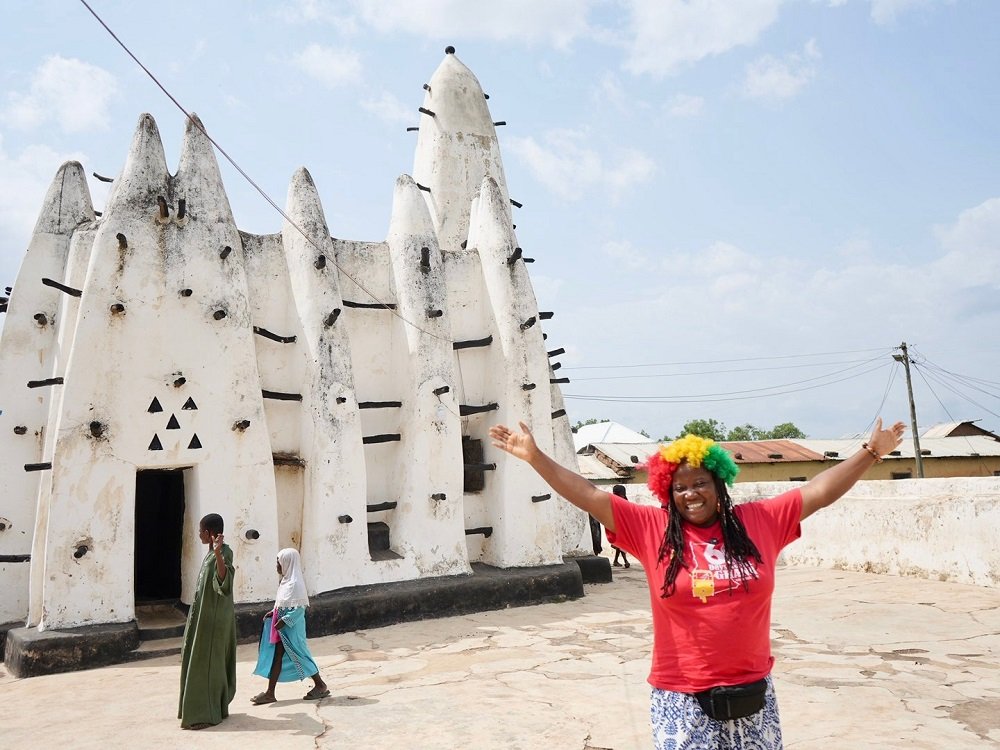
She also visited the 600-year-old Larabanga Mosque, the Salaga Slave Market, the Assin Manso Slave River and the Tongo Hills, where communities historically sought refuge from slave raiders.
The visits to sites associated with the slave trade were particularly emotional, she said.
“The slavery stories I heard were the most painful part of the experience,” Mahama said. “I think I had read it, but just to be told once again of how ancestors were brutalised, some were even killed or just whipped into line using barbaric methods was just too much for me.”
Among the attractions that made the strongest impression on her was the Ankasa Rainforest, which she described as Ghana’s wettest forest.
For wildlife enthusiasts, she recommended Mole National Park, which she said is larger in area than the Greater Accra Region.

Mahama also believes Ghana’s history of slavery should be presented more broadly than through its better-known sites such as Elmina and Assin Manso.
She cited Gwollu in the Upper West Region, where a historic defensive wall was built to protect the community during the era of slave raids.
“During the slave raids, Gwolu Kouro, who was the chief at the time, mobilised the people to construct a wall,” she said. “There were actually two walls. There was an inner wall which protected the people. There is also the outer perimeter which protects the farm.”
The defensive structures, she said, were designed to protect people, livestock and farms in the event of raids.
“That’s a part of our history I never knew about,” she said.
Mahama also pointed to other examples of resistance to colonialism and slave raids, including defensive structures associated with the chief of Nalerigu.
“Some of our ancestors fought and resisted the colonialists,” she said. “They didn’t just give up or say, ‘Come and carry our people.’”
For visitors seeking a broader experience of Ghana, Mahama said they should look beyond Accra and explore regions including Volta, Ashanti, Northern and Savannah, each of which offers distinct cultural, historical and natural attractions.
Her own life of adventure began in 2007, when she undertook her first major expedition from Accra to Marrakech in Morocco using public transport.
“I went from Accra to Ouagadougou and then boarded the next bus until I got to Marrakech in Morocco,” she said.
“After that expedition, I just knew that I had to keep on going, and I had to keep seeing more, because there’s a lot more in the world to see, appreciate and learn from.”
Her expeditions have also had a philanthropic dimension. Alongside promoting Ghana’s tourism potential, Mahama is raising funds for organisations supporting deaf people and the Ashanti and Savelugu schools for the blind.
Her efforts date back to 2009, when she rode a bicycle from Accra to Tamale and raised funds to build a six-classroom primary school.
For Ghana, the challenge is not necessarily a lack of attractions, but converting its natural, cultural and historical assets into commercially viable tourism products while maintaining the country’s reputation for peace and hospitality.
If it can do so, Mahama believes Ghana has the potential to become one of West Africa’s leading destinations for regional and international travellers.

Francis Koktuse is a free-lance journalist based in Accra. Currently, he is the local Stringer for the New York Times. He also writes for University World News, as well as Science and Development.Net. He was a Staff Writer for the African Concord, and Africa Economic Digest in London, UK.