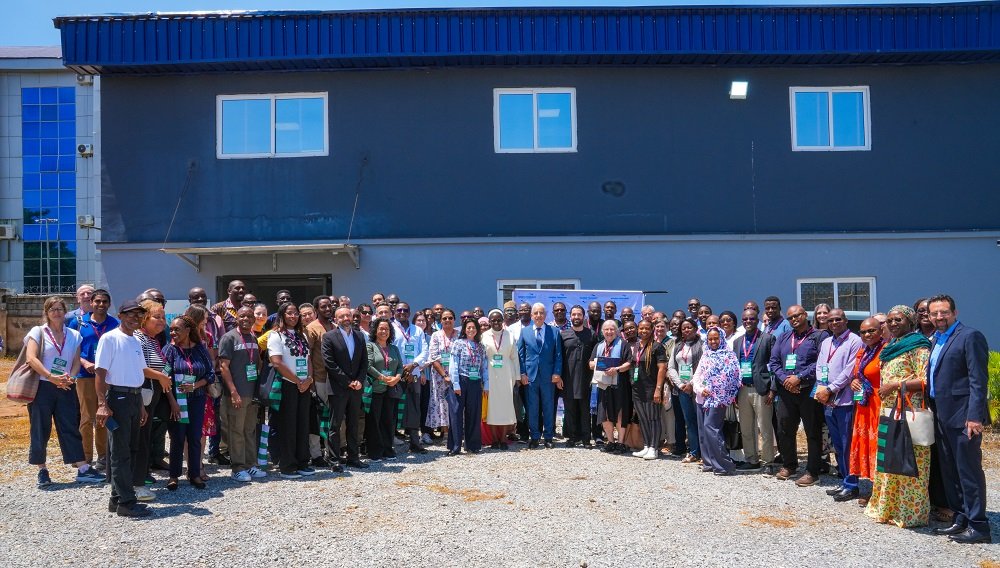
A major boost has come for efforts to strengthen Africa’s healthcare manufacturing capacity and reduce dependence on imported medical technologies, as a delegation of global health experts, scientists and policymakers from Harvard University’s malaria eradication programme praised the newly established NASENI-TROMENT Biotechnologies factory for its potential to transform disease diagnosis across the continent.
About 85 participants in the prestigious “Science of Defeating Malaria” leadership development initiative, a global programme coordinated by Harvard University in the United States, toured the multi-million-dollar NASENI-TROMENT Biotechnologies facility in Abuja and described the project as a significant step toward combating malaria and other infectious diseases across Nigeria and the continent.
The delegation, comprising medical professionals, scientists, public health specialists and policymakers from different countries, expressed particular interest in the factory’s capacity to manufacture rapid diagnostic test kits (RDTs) and polymerase chain reaction (PCR) technologies locally, a capability that has historically been dominated by foreign manufacturers.
The initiative is considered a strategic partnership between the National Agency for Science and Engineering Infrastructure (NASENI) and Troment Nigeria Limited, aimed at positioning Nigeria as a regional hub for diagnostic technology production.
According to Selim Hani, chief executive officer and co-founder of NASENI-TROMENT Biotechnologies, the factory was conceived as a response to the continent’s overreliance on imported medical diagnostic products.
Speaking during a presentation to the visiting delegation, Hani explained that the facility, completed within 18 months, was built from the ground up to manufacture a broad range of diagnostic products critical to disease detection and public health management.
“This facility focuses on the manufacturing of rapid diagnostic tests and in-vitro diagnostic products, enabling early detection of major infectious and public health diseases,” Hani said.
He noted that the company’s N-CheckUP diagnostic brand will produce test kits for malaria, hepatitis B and C, HIV 1 and 2, pregnancy testing, COVID-19 antigen detection, typhoid, syphilis and blood glucose monitoring, among other healthcare applications.
One of the most striking features of the project is its scale.
According to company officials, the factory has been designed with the capacity to produce up to 600 million diagnostic kits annually, positioning it among the largest diagnostic manufacturing facilities on the continent.
The scale of production is expected not only to serve Nigeria’s healthcare needs but also support exports to neighbouring countries across West Africa and other African markets.
The investment also aligns with broader continental objectives under the African Continental Free Trade Area (AfCFTA), which seeks to boost intra-African trade and strengthen regional manufacturing capabilities.
By producing diagnostic technologies domestically, Nigeria stands to capture greater value within the healthcare supply chain while creating opportunities for industrial development, technology transfer and job creation.
Beyond its manufacturing capabilities, the facility is being viewed as a symbol of Nigeria’s growing push toward healthcare sovereignty.
The concept has gained prominence globally since the COVID-19 pandemic exposed the risks associated with excessive dependence on external suppliers for critical medical products.
Countries across Africa have since accelerated efforts to establish local production facilities for vaccines, pharmaceuticals and diagnostic technologies as part of broader healthcare security strategies.
Hani described the project as a contribution to strengthening Nigeria’s healthcare sovereignty through indigenous production and innovation.
“This facility will reduce Nigeria’s and West Africa’s reliance on imported medical diagnostics while improving accessibility and affordability across the country and the African region,” he said.
According to Engin Narinc, technical partner at NASENI-TROMENT Biotechnologies, the facility is Africa’s first fully localised rapid diagnostic test manufacturing plant.
“From concept to full-scale launch, our end-to-end production process is designed to deliver world-class diagnostic solutions built entirely in Africa, for Africa,” Narinc said.
Leading the delegation was Dyann F. Wirth, one of the world’s foremost malaria researchers and the team lead of the Science of Defeating Malaria initiative.
Following a tour of the facility’s production lines and laboratory sections, Wirth described the project as a significant contribution to the continent’s public health ambitions.
“This is an amazing facility that would add value to the eradication of malaria and other public health diseases in Nigeria and the continent,” she said.