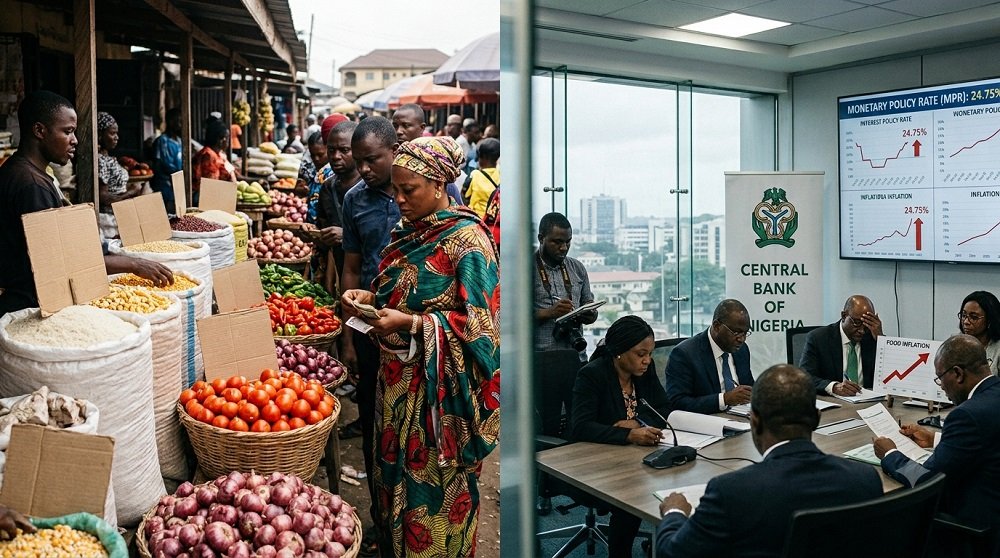
The battleground against inflation in Nigeria is undergoing a paradigm shift and with it, the limits of the Central Bank of Nigeria’s influence over prices.
For nearly two years, inflation has been driven largely by macroeconomic shocks, including exchange-rate volatility, the fallout from fuel subsidy removal, rising energy costs and successive interest-rate hikes by the CBN. However, the latest inflation data show those forces are gradually giving way to a more stubborn source of price pressure.
Today, the greatest threat to price stability appears to be rooted in Nigeria’s agricultural economy. From insecurity that keeps farmers away from their fields to flooding, poor rural roads and inefficient food distribution networks, structural weaknesses in the food supply chain are increasingly dictating inflation, raising questions about whether monetary policy alone can deliver lasting price stability.
While June’s Consumer Price Index (CPI) offered what appeared to be encouraging news, with headline inflation easing marginally, economists caution that the apparent improvement masks a far more troubling reality. The country’s inflation engine is increasingly being powered by food prices, a development that analysts believe could significantly reduce the effectiveness of the Central Bank’s conventional inflation-fighting tools.
That shift is already forcing economists, policymakers and financial institutions to reassess both Nigeria’s inflation outlook and the likely direction of monetary policy over the coming year.
A new analysis by Zrosk Equity Research argues that the composition of inflation, not merely the headline number, has become the more important indicator of where prices are headed.
According to the research house, June’s inflation report marks a structural turning point, with agricultural supply shocks replacing demand-side pressures as the dominant source of inflation across the economy.
Headline relief conceals deeper food price pressures
Data released by the National Bureau of Statistics (NBS) showed that Nigeria’s headline inflation rate slowed marginally to 15.91 percent year-on-year in June, compared with 15.93 percent in May, while month-on-month inflation moderated to 1.66 percent from 1.75 percent.
Ordinarily, such figures would reinforce expectations that the CBN’s prolonged monetary tightening campaign is gradually producing results.
Indeed, there were encouraging signals beneath the surface. Core inflation, which excludes volatile agricultural produce and energy prices, continued to soften, indicating that higher interest rates, tighter liquidity conditions and relative exchange-rate stability are beginning to curb demand-driven inflation. But those gains were almost entirely offset by a renewed increase in food prices.
Food inflation accelerated sharply during the month, with month-on-month food inflation rising to 3.75 percent, up from 2.98 percent in May.
The increase reflects higher prices for some of Nigeria’s most widely consumed staples, including fresh tomatoes, pepper, beef, crayfish, garri, yam tubers, yam flour, cassava flour, cowpea, bananas and Irish potatoes.
A new inflation channel emerges
Zrosk Equity Research believes the June numbers reveal a significant shift in Nigeria’s inflation dynamics.
According to the firm, the apparent moderation in headline inflation disguises an explosive increase in farm produce prices, which climbed 4.42 percent month-on-month in June after slowing to only 0.86 percent in May.
The research house argues that this represents more than a temporary spike.
Instead, it reflects what economists describe as an agricultural supply shock, an inflationary development arising from disruptions in production and distribution rather than excessive consumer demand.
“June’s deceleration to 1.66 percent month-on-month is not the disinflation signal it appears.
“Core cooling is genuine, but farm produce at plus 4.42 percent month-on-month opens an independent inflation channel the CBN has no monetary tool to address. The risk has shifted from services to food,” the analysts noted.
That conclusion represents perhaps the strongest warning yet that Nigeria’s inflation battle is entering unfamiliar territory.
For years, monetary authorities have relied primarily on higher interest rates to reduce inflation by slowing consumer spending, moderating credit growth and easing aggregate demand.
However, monetary tightening has limited influence over crop yields, insecurity in farming communities, flooding, transport bottlenecks or post-harvest losses.
Consequently, even if demand across the wider economy continues to weaken, food prices may continue rising if agricultural supply remains constrained.
Farm produce becomes Nigeria’s inflation heavyweight
The numbers underscore just how dominant agriculture has become in shaping Nigeria’s inflation profile.
According to Zrosk Equity Research, farm produce constitutes 95 percent of Nigeria’s food basket and 26.61 percent of the country’s entire Consumer Price Index basket.
That makes it the single largest component influencing overall inflation.
The analysts estimate that farm produce alone accounted for 1.18 percentage points of the country’s 1.66 percent monthly inflation rate.
In other words, agricultural produce generated 71 percent of all inflation recorded during June.
Only one month earlier, farm produce had contributed just 13 percent of monthly inflation. The speed of the turnaround surprised analysts.
According to Zrosk, the contribution rivals inflationary episodes seen during periods of major global supply disruptions, including the peak of the Strait of Hormuz crisis, when energy prices combined with seasonal food pressures to accelerate consumer inflation.
The difference, however, is that June’s inflation spike originated almost entirely from domestic agricultural conditions rather than global commodity markets.
“This increase came from a sub-component driven solely by domestic agricultural supply conditions,” the report stated.
Farmers identify insecurity, flooding and logistics as inflation triggers
For those closest to Nigeria’s agricultural economy, the latest rise in food prices comes as little surprise.
The All Farmers Association of Nigeria (AFAN) says the acceleration in food inflation reflects persistent production and distribution challenges that have remained unresolved despite government interventions aimed at boosting agricultural output.
Reacting to the June Consumer Price Index , Femi Oke, AFAN national secretary-general, argued that insecurity continues to be the single greatest threat to food production across many farming communities.
According to him, while the federal government has introduced several initiatives to support farmers and improve food security, insecurity in key agricultural belts continues to undermine those efforts.
“With regard to food inflation, we believe insecurity continues to play a major role in rising food prices despite the Federal Government’s efforts to support agriculture.
The federal government is trying its best to address these issues and create an enabling environment for farmers across the country. In some areas where major food staples are cultivated, farmers are still afraid to go to their farms because of the activities of bandits,” Oke said.
Beyond insecurity, AFAN identified unusually heavy rainfall and flooding in parts of the country as additional factors reducing harvest volumes and disrupting food supply.
Seasonal flooding has become an increasingly important economic risk for Nigeria’s agricultural sector, damaging farmlands, limiting access to rural communities and delaying transportation of harvested crops to urban markets.
AFAN also pointed to Nigeria’s poor rural transport infrastructure as a major contributor to food inflation.
According to the association, many states have yet to fully implement the World Bank-supported Rural Access and Agricultural Marketing Project (RAAMP), leaving thousands of farming communities poorly connected to commercial markets.
The consequence, Oke explained, is significantly higher logistics costs.
Food often spends longer periods in transit over deteriorating road networks, resulting in greater transportation expenses, increased spoilage and higher retail prices for consumers.
“If roads are not opened up, food inflation will continue to rise because transporters pass the high cost of logistics to consumers, coupled with unstable fuel prices,” he said.
To improve food movement across the country, AFAN called for stronger public-private partnerships in agricultural logistics.
Among its recommendations is the provision of dedicated utility vehicles for transporting agricultural produce in every state, arguing that lower transportation costs would translate directly into lower food prices.
The association also acknowledged ongoing government interventions, including the recent distribution of fertilisers across 26 states and the Federal Capital Territory, benefiting more than 12,000 farmers.
While welcoming the initiative, AFAN maintained that input support alone would not solve inflation unless security and rural infrastructure improve simultaneously.
CPPE: Inflation is becoming increasingly structural
The Centre for the Promotion of Private Enterprise (CPPE) shares a similar assessment but places the discussion within a wider macroeconomic framework.
In its latest policy brief, released shortly after publication of the June inflation data, the private sector advocacy organisation warned that Nigeria’s inflation challenge is now predominantly structural rather than monetary.
“The dominant concern in the report is the renewed acceleration in food inflation,” the organisation stated.
According to CPPE, although headline inflation moderated slightly, the renewed rise in food prices signals that the temporary period of easing observed in recent months may already be ending.
Muda Yusuf, CPPE chief executive officer, said sustained moderation in food prices remains the single most important requirement for easing Nigeria’s cost-of-living crisis.
He argued that while macroeconomic indicators have begun to show signs of stability, everyday living costs remain elevated because food inflation continues to outpace broader inflation trends.
According to CPPE, several structural factors now account for the bulk of Nigeria’s inflationary pressures.
These include insecurity across farming communities, rising transportation costs, expensive fertilisers, energy costs, supply chain disruptions and imported inflation arising from geopolitical tensions in global commodity markets.
The organisation estimated that food, transportation, housing, utilities and energy collectively account for approximately 72 per cent of current inflationary pressures.
That statistic reinforces the growing view that inflation can no longer be addressed primarily through monetary policy.
“The June inflation report reinforces the view that Nigeria’s inflation challenge is predominantly structural rather than monetary,” the policy brief stated.
CPPE argued that government policy should focus on expanding domestic food production, lowering logistics costs and improving productivity throughout agricultural value chains.
The organisation also expressed concern about rising inflation within Nigeria’s urban centres.
According to the June CPI report, urban inflation stood at 16.08 per cent, above the national headline inflation rate of 15.91 per cent, while month-on-month urban inflation increased from 1.99 per cent to 2.13 per cent.
Yusuf attributed part of the trend to population movements caused by insecurity in rural communities.
As violence and instability displace farming households, many migrate to cities in search of safety and economic opportunities.
The resulting increase in demand for housing, transportation, utilities, education and healthcare creates additional inflationary pressure in urban economies.
CPPE believes that restoring security across agricultural communities would help relieve pressure on both fronts.
However, the latest inflation data indicate that future progress will depend increasingly on structural reforms beyond the CBN’s direct mandate.
Both Zrosk Equity Research and CPPE argue that reducing food inflation will require coordinated action across multiple sectors.
Recommended priorities include restoring security in farming communities, expanding irrigation systems, encouraging year-round farming, accelerating mechanisation, improving access to affordable credit and farm inputs, reducing post-harvest losses through better storage facilities and modernising transportation networks linking farms to markets.
CPPE also called for greater adoption of agricultural technology, increased youth participation in farming, sustained exchange-rate stability and deeper domestic petroleum refining to moderate imported inflation.
The organisation argued that the latest inflation numbers do not justify another increase in interest rates by the CBN’s Monetary Policy Committee. Instead, it urged closer collaboration between monetary and fiscal authorities to tackle the underlying structural causes of inflation.