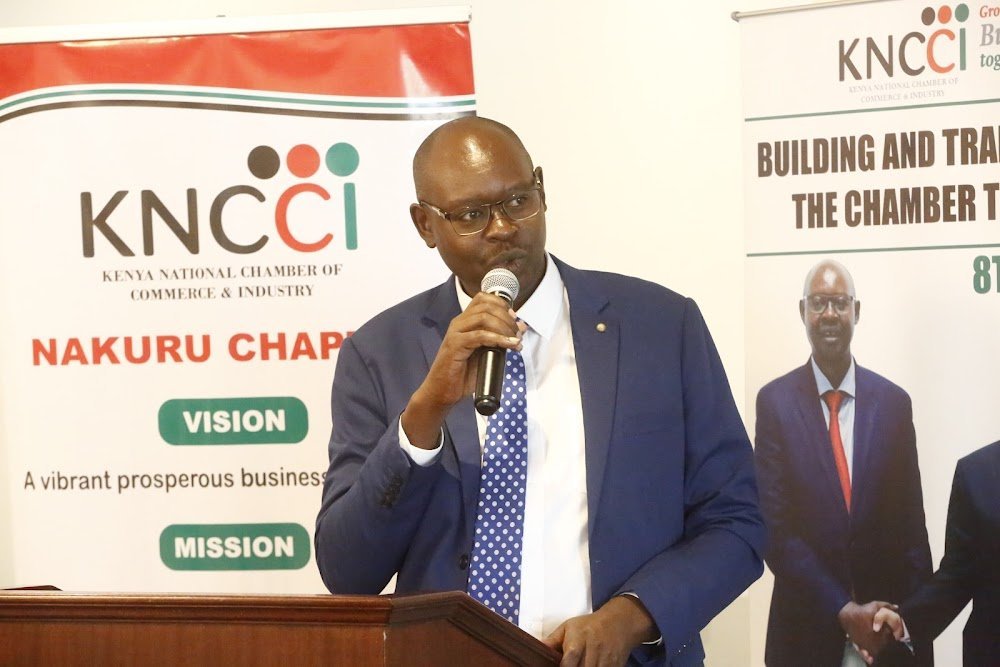
Kenya National Chamber of Commerce and Industry (KNCCI), at its newly launched annual business barometer survey and advocacy strategy, has called for data-driven policy to unlock micro, small and medium sized enterprises (MSMEs) growth.
The chamber unveiled strong business optimism alongside persistent structural challenges that continue to constrain growth across the country,
Drawing insights from 1,150 businesses across all 47 counties, the Barometer provides one of the most comprehensive, evidence-based assessments of Kenya’s business environment, reinforcing KNCCI’s role as the leading voice of private sector advocacy.
The 2026 Barometer paints a picture of a resilient and forward-looking private sector where 65.1 percent of businesses reported improved performance, upholding recovery momentum, and only 10 percent reported decline, a sharp improvement from 24 percent in 2025.
A record 86.2 percent of businesses are optimistic about the year ahead, up from 65 percent last year, the KNCC survey showed.
KNCCI president Erick Rutto described the scenario as a turning point: “This is not just recovery—it is proof of the resilience and strength of Kenyan businesses. They have adapted, innovated, and survived despite a difficult operating environment.”
Despite the optimism, the survey highlights deep-rooted constraints such as 46.4 percent of businesses cite high taxation as their biggest challenge, 36 percent face limited access to affordable finance, 26.3 percent are affected by high energy and fuel costs.
In addition, businesses are grappling with heavy regulatory burdens with over 540 licenses and permits across 61 regulatory bodies, compliance costs consuming an estimated 30–50 percent of business resources.
Rutto emphasized the urgency of reform:
“The cost of regulation is no longer just administrative it is a direct barrier to growth. We must simplify compliance and create a predictable business environment.”
The Chamber raised concern over the long-term decline of Kenya’s manufacturing sector whose contribution to GDP has dropped from 10.9 percent in 2013 to 7.2 percent in 2025. This trend signals weakening industrial competitiveness, driven by high energy costs, taxation, and import pressures.
KNCCI CEO KK Mutai underscored the importance of evidence-based policymaking:
“The Barometer transforms real business experiences into credible, actionable intelligence. When we engage government, we do so with facts from over 1,150 businesses—not assumptions.”
Former Kenyan ambassador to Belgium Bitange Ndemo, a professor, echoed this position, calling for a shift in governance:
“Kenya and Africa must make policy decisions based on data. Institutions like KNCCI must remain at the forefront of providing market intelligence that drives economic transformation.”
The survey reveals critical structural realities where 67 percent of businesses are micro-enterprises, underscoring the need for MSME-focused policies. 70 percent of businesses are not exporting, despite strong regional opportunities; exporting firms outperform non-exporters by 12.7 percentage points, highlighting untapped trade potential.
Businesses have issued a clear mandate for reform, including to improve access to affordable finance (58.3%), reduce cost of energy (47.8%), harmonise taxes and licences (47.7%), clear pending government bills (KES 600–650 billion).
Speaking on behalf of the Kenyan government Stanley Koske, director for research, policy and industrial data in the state department for industrialization welcomed evidence-based intervention by the barometer, terming the confidence business trend by entrepreneurs as a sign that the government policies were working.
“We acknowledge that our businesses continue to go through various challenges and as government several measures have been put in place to help alleviate their pain. This includes energy sector reforms, ongoing infrastructure development including extension of the SGR and various roads and industrial parks. We are also reducing duplication of licenses so as to ease regulatory compliance including the need for a one stop investment platform,” Koske said.
Meanwhile, KNCCI has launched a national advocacy strategy focused on: tax reform and simplification, including improvements to turnover tax, “one business, one license” policy to reduce regulatory duplication, prompt payment bill to unlock liquidity for MSMEs, affordable financing solutions, including credit guarantees, energy cost reduction, with emphasis on renewable energy, export promotion, leveraging AfCFTA, EAC, and COMESA markets.
The Chamber noted that Kenya stands at a critical inflection point: “The foundation for growth is strong, but without decisive policy action, this optimism may not last,” said Mutai. “If reforms are implemented, 2026 could deliver: stronger MSME growth, increased job creation, expanded exports, and improved global competitiveness.
However, failure to act risks slowing recovery and eroding business confidence.
The 2026 KNCCI annual business barometer sends a clear message: Kenyan businesses are ready to grow but they need a supportive, predictable, and data-driven policy environment.
The chamber has reaffirmed its commitment to ensuring that: business voices are heard, policies are informed by evidence and advocacy leads to measurable economic change.