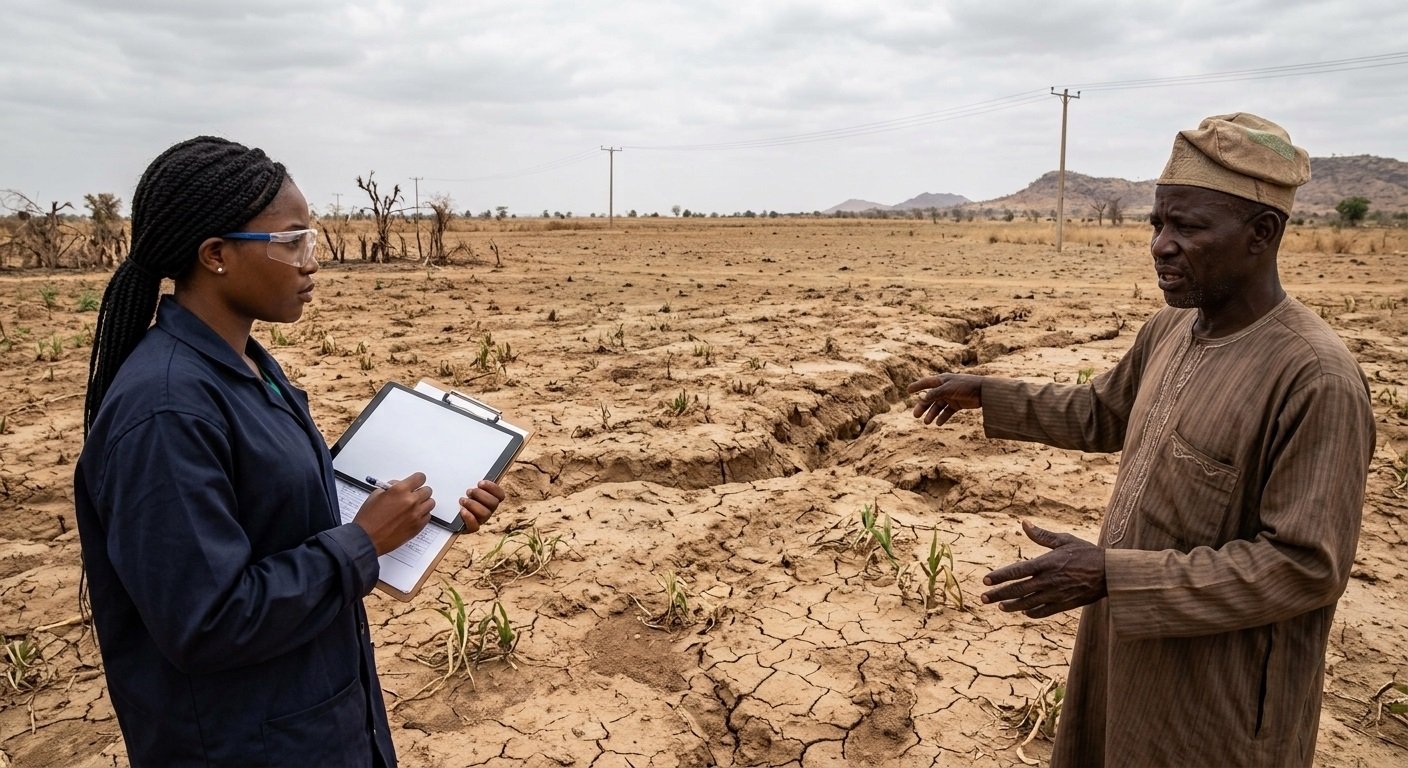
The worsening condition of the world’s soils is emerging as a major threat to food production, agricultural productivity and economic stability, with Nigeria facing additional pressure from deforestation, desertification, erosion, illegal mining and poorly managed land resources.
The Food and Agriculture Organisation of the United Nations (FAO), in its latest assessment of the world’s soil resources, warned that soil degradation is accelerating while proven measures capable of protecting and restoring soil remain inadequately adopted across countries and regions.
The warning is contained in the Status of the World’s Soil Resources 2026 report, launched at the 17th Conference of the Parties to the United Nations Convention to Combat Desertification (UNCCD) in Ulaanbaatar.
The report, based on research conducted between 2015 and 2025 and contributions from experts in 75 countries, found that sustainable soil management practices remain poorly adopted in more than half of regional assessments.
FAO said 58 percent of assessments recorded soil deterioration since 2015, while only about 10 percent reported improvement.
For an economy such as Nigeria, where agriculture remains central to food supply, rural livelihoods and employment, the deterioration of soil quality presents a risk that extends well beyond the environmental sector. It threatens the productive capacity of farmland, raises the pressure on farmers to expand cultivation into new areas, increases vulnerability to climate shocks and can intensify competition over increasingly scarce productive land.
Beth Bechdol, FAO deputy director-general, said the central problem was not necessarily the absence of solutions but the failure to deploy existing solutions at the required scale.
“Proven solutions are not being adopted at the pace and scale required,” Bechdol said, calling for countries, farmers and other land users to be equipped with the knowledge, capacity and incentives necessary to implement sustainable soil management practices.
Soil underpins global food production
The economic significance of soil degradation is underscored by the role soils play in global food production.
According to FAO, soils underpin food security and produce more than 95 percent of the food consumed globally. Beyond agriculture, healthy soils store and filter water, regulate the climate, support biodiversity and sustain livelihoods.
This makes the deterioration of soil quality a direct threat to several interconnected economic systems.
As soils lose their productive capacity, farmers may require more inputs to maintain yields, while declining productivity can increase production costs and place upward pressure on food prices. In areas where degradation becomes severe, farmers can also be pushed towards abandoning land or opening up new areas for cultivation, potentially creating another cycle of deforestation and degradation.
FAO said these pressures are becoming more acute as the world’s population and demand for food continue to increase.
Since 2015, the global population has grown by approximately 800 million people, while the harvested area of major crops has expanded by 80 million hectares.
The combination means that more people are depending on a finite and increasingly stressed natural resource base.
Urbanisation, unsustainable agricultural practices, industrial activities, conflicts and pollution are among the factors FAO identified as contributing to land degradation and declining soil functions.
The organisation warned that without a shift towards more sustainable soil management, the deterioration of soils could undermine efforts to increase agricultural production at a time when demand for food is rising.
Erosion emerges as major threat
Among the various threats to soil health, FAO identified erosion as the most severe and interconnected.
The report found that 81 percent of assessments across the seven regions studied rated erosion management as poor or very poor.
More worrying is the direction of travel, as 65 percent of assessments reported that erosion had worsened since 2015.
Soil erosion is particularly significant because it removes the fertile upper layer of soil that supports crop production. Once productive topsoil is lost, restoring the land can require substantial time, investment and management.
The problem is especially relevant to Nigeria, where deforestation and the removal of vegetation cover are exposing large areas of land to erosion.
Joseph Onoja, director-general of the Nigerian Conservation Foundation (NCF), said Nigeria’s diverse ecological zones were already experiencing significant pressure, with desertification advancing in parts of the north and forest degradation worsening the country’s vulnerability to erosion.
“Nigeria is one of the countries with a very high rate of deforestation, and when that happens, it definitely contributes to land degradation,” Onoja said.
He explained that vegetation provides an important protective cover for the land. Once it is removed, soil becomes more exposed to erosion, which strips away productive topsoil and weakens the land’s ability to provide essential ecosystem services.
A degraded soil base means that agricultural expansion alone cannot guarantee higher output. Farmers may cultivate larger areas but face declining productivity where soil fertility and structure have deteriorated.
This creates a difficult policy trade-off for a country seeking to increase food production while also protecting its natural resource base.
Nigeria’s environmental deficit
Onoja said Nigeria was not doing enough to address the scale of its environmental challenges.
The country, he noted, stretches across several ecological zones, from mangrove ecosystems in the south to savannah and semi-arid environments in the north. Each faces different forms of environmental pressure.
In the north, desertification is advancing in some areas, while forests elsewhere are under pressure from agricultural expansion, logging and other activities.
Illegal mining is also contributing to the degradation of land, particularly where mining activities take place without adequate environmental management and rehabilitation.
Onoja also identified grazing practices as another potential contributor to land degradation under certain circumstances.
Taken together, these pressures are reducing the resilience of the country’s land resources at a time when Nigeria needs greater agricultural productivity to meet domestic food demand.
The NCF chief said the problem should be viewed through the wider lens of land management rather than treated as a collection of isolated environmental challenges.
“I usually say that nature has been put in place to support us, but we have to support nature for nature to continue playing its role in supporting us,” Onoja said.
Environment ministry needs more funding
The financing of environmental management is another major concern.
Onoja criticised the level of funding allocated to the Federal Ministry of Environment, describing it as one of the country’s poorest-funded ministries despite the breadth of its mandate.
He argued that environmental management should be treated as a strategic economic investment rather than a peripheral government expenditure.
“The Federal Ministry of Environment should be one of the most funded ministries because its mandate provides the foundation upon which many other sectors depend,” he said.
The argument is particularly significant against the backdrop of Nigeria’s food-security challenge.
Agricultural policy frequently focuses on inputs such as fertiliser, seeds, irrigation, mechanisation and access to finance. But the productivity of those investments ultimately depends on the quality of the land on which crops are produced.
Land degradation and Nigeria’s conflict economy
Onoja also linked environmental degradation to wider socio-economic pressures, including conflicts between farmers and herders.
He argued that land degradation can contribute to migration as people and livestock move away from areas where productive land and natural resources have become depleted.
“When land becomes degraded in one area, people and livestock may have to move to another area. But the destination is not a vacuum. People already live there,” he said.
According to Onoja, the problem is compounded when migration occurs without sufficient time for dialogue, resource-sharing arrangements or other mechanisms for managing the arrival of people and livestock.
Great Green Wall offers policy response
Nigeria is not without interventions aimed at addressing the problem.
Onoja pointed to the Great Green Wall initiative as an important government response to desertification, particularly in frontline states in the north.
The Great Green Wall Agency is working to establish a green belt intended to slow the southward advancement of the desert and improve environmental conditions in affected areas.
Onoja said the initiative showcased political will to address land degradation, although he maintained that the scale of the challenge required significantly more action.
The Great Green Wall approach is particularly important because it links environmental restoration with land management and the protection of communities whose livelihoods depend heavily on natural resources.
Globally, FAO is advocating a more integrated approach.
The organisation said proven practices such as reduced tillage, integrated nutrient management, crop diversification, cover crops, organic amendments and agroforestry could help mitigate soil threats while sustaining or improving agricultural productivity.
The challenge is scaling these practices beyond isolated projects.
FAO said countries needed to recognise healthy soils as strategic assets and translate existing scientific knowledge into practical action.
Its guidance promotes a shift away from treating restoration as a series of isolated interventions towards the integrated management of productive landscapes.
That approach prioritises preventing degradation where possible, reducing existing pressures and restoring land and soils where degradation has already occurred.
For developing economies, the distinction is important. Restoration after severe degradation can be considerably more expensive and time-consuming than preventing degradation in the first place. Protecting soil productivity can therefore be seen as a form of long-term economic risk management.