
MUNICH – a popular city in Germany – once again, last week, lived up to its expectations of a yearly convocation of leaders from various parts of the world. The Munich Security Conference (MSC), founded in 1963, has become the world’s most influential yearly gathering of policymakers and experts as well as a platform for deliberation on international security policy.
The MSC this year, in an attempt to chart a course in apparent response to current global realities, drew from one of its publications released this year, taking a position that appears a bit putative, especially when mixtures of global issues are concurrently examined. The approach reveals an autopilot mind set sitting beneath what came upon the surface.
The 2026 Munich Security Conference (MSC), the 62nd edition since its founding, based its deliberations on Munich Security Report 2026, showcased the theme “Under Destruction.” While it rightly highlighted the symptoms of global security crises, its diagnoses of the main causes in recent time – upon which some assertions were made – were nonetheless ambiguous and misleading. Such assertions were obviously borne out of what sounded more like complacency and laidback mentality than a betrayal of trust or confidence.
The framing of opening discussions in the conference that characterised the rise of destructive political forces, the erosion of international norms, and the challenges facing the global order as a consequence of what was described as “wrecking ball politics” wrongly presupposed that global politics have been smooth sailing all along until a particular actor came on board recently to disrupt what has hitherto been so orderly. Nothing can be farther from the truth.
The global outlook of international order in the past few decades has been such that it needed a review, reset and recalibration. If an event such as the COVID-19 pandemic of the past six years and the recent emerging disclosures about it did not qualify for a theme like “Under Destruction,” or if the politics associated with it did not pass for “wrecking ball politics,” it is doubtful if the characterisation given to 2026 Munich conference was truly fitting.
Prima facie, the issues and observations raised at the opening session pointed in the direction of a shift towards treachery and a lack of trust in reform. Observations and emphasis were more on transatlantic relations, mostly focused on the global north. Discussions were heavily dedicated to the future of US-Europe ties and the perceived instability in the Western alliance as longstanding post-1945 international order is being undone. The discussion removed all veils and made direct reference to Donald Trump, the US president. The Munich Security Report 2026 report, from which two of the organisers picked talking points for reading, warned of declining trust in democratic governance and the rise of leaders prioritising destruction over incremental change.
What the Munich Security Report 2026 did not reckon with in its analyses was that the world has greatly transformed over time under the incremental changes that have led to cumulative impacts that have made today’s world unrecognisable when compared to the old time used as reference point. The report obviously ignored many clear socio-economic and political changes that are redirecting world affairs and redefining what is right and what is wrong. It apparently ignores ideologies that are reshaping the security landscape and architecture of Europe itself and North America.
The interpretation of the far-reaching consequences of the rise of political forces that favour destruction over reform requires additional interrogation, for clarity of thoughts and relevance in reality. It is true, according to the report, that there is now a trend where leaders in Western societies are abandoning long-standing rules and alliances. The report, however, did not seem to consider the cause-and-effect component of the phenomenon.
While the report notes that the US is now a key driver of this disruption to the international order, there was hardly any attempt to dig deep into probable genuine causes of such disruption. Nor did it consider some European countries – namely, Italy, Hungary and Poland – that are distancing themselves from the European political groupthink. One of the issues considered for taking a position at the conference emanated from the Munich Security Index 2026, which indicates rising fear of cyber-attacks, financial crises, and disinformation, with the US increasingly viewed as a threat.
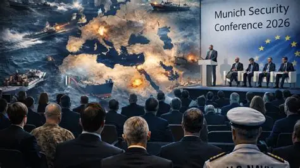
At the opening session, the conference not only emphasised what it called “elephant in the room,” but also illustrated it pictorially. The introductory remarks by the Bavarian government representative and minister, from Munich, Florian Hermann, mentioned Europe, America and Middle East but skipped Africa despite its relevance when considering the rising cases of security challenges, especially of asymmetric warfare, there. He emphasised de-escalation, dialogue and listening to find common ground. He spoke about artificial intelligence (AI) and said it could become a future security issue.
Wolfgang Ischinger, MSC chairman, acknowledged that “we have a war going on in Europe,” pointing out that the Ukraine-Russian war will, in some days’ time, enter into its fifth year. He drew attention to nuclear security, space, and the future of Hi-Tech as it concerns all aspects of security, hybrid warfare, geoeconomics, climate security, human right issues, food security and international development as relevant to security now and in the future. He said “the Russian delegation pretends to be willing to negotiate while at the same time they continue to really terrorise the civilian population of Ukraine. That, for us here in Europe, is the biggest challenge in a long time. We don’t have a very good answer yet.”
The MSC chairman added that “we have had a trust problem because of Greenland. This repair work is essentially about rebuilding trust and confidence across the Atlantic.” Probably sounding realistic, he said “the second mission I can see for the European participants in Munich is to go from lamenting about you guys – referring to the US – about what Donald Trump has said or has not said to real action, to decisions.” He then posed a question: “Can we move in Europe from little defence markets into a consolidated, more capable or more competitive defence market that is capable of sustaining the Ukrainian demands now that the United States has decided not to continue to be the number one provider directly of military supplies to Ukraine?”
The two young presenters who seemed to set the tone for the panel discussions focused on international liberal order and accused the US of rolling it back. They averred that allied nations now consider the US as a threat rather than a friend. They narrowed down to President Donald Trump as a disruptor. They complained about the US recalibration undermining the idea of seeing the US as an asset and European countries as allies that have brought enormous benefits to the US itself.
Opinion like a desire to dismantle existing domestic and international structures was made in the form of a question, as coming from where? They said Donald Trump may be the most powerful and disruptive force in world politics today but described him as part of a broader global threat. The MSC report 2026, alluded to in their summary, referred to Trump as the “demolition man.” According to their words, the “wrecking ball politics” may have short term gains but will have long term costs. They saw more of the politics of sweeping disruption, citing internal level cooperation and exiting global institutions. The report was unequivocal in its actionable advice, calling on those invested in a rules-based order to become “bolder builders” and strengthen structures against further decay.
Although his statements were going to sound controversial, Matthew Whitaker, ambassador and permanent representative of the USA to NATO (North Atlantic Treaty Organisation) was not apologetic about what the US government is doing right now. He argued passionately on, and defended, Trump’s policies on NATO. “We are not trying to dismantle NATO, an alliance of 32 strong and capable allies’. On trade, he said, post-World War 2, “the trade arrangement between Europe and the US wasn’t fair. It was built on the premise that Europe needed time to rebuild. That led to Europe taking advantage in running a huge trade surplus with the United States. And President Trump looked at it and said this is not fair. You can’t sell American cars in Europe. The term freeloading is a real term when it comes to security and trade.”
Arancha Gonzàlez Kaya, dean, Paris School of International Affairs, Sciences Po, former foreign affairs minister, EU and Cooperation of the Kingdom of Spain, countered Whitaker as she said the deterrence capacity of NATO is put into question by NATO alliance itself. She “disagreed with the idea that we were taking advantage of the US,” saying “it was a choice that we made together a long time ago, that Europe will not have its own autonomous security; that the US will be the ultimate guarantor of European security, and that the EU will buy most of its defence needs from the US. That was the compact that we’ve been with for a long time.”
She took a swipe at what she called the “posturing” of the US. “It was agreed long ago that the US will be the security guarantor for Europe. This compact needs a review. Europe will now want to be more autonomous in its defence industry. The US posture is being questioned in Europe. While Gonzàlez Kaya spoke about the fact that there are French soldiers, Spanish soldiers and other nations’ soldiers, she asked, “where are the EU Soldiers?” She added that, presently, there is “no European command.”
Representing the Islamic Republic of Pakistan, Hina Rabbani Khar, foreign relations committee chair of the Pakistan national assembly, said she was going to disappoint those who may have expected her to speak in line with what some panelists earlier articulated. She said the rules-based system worked for those who set the rules – the hegemonic countries – but not for many others who merely sat by and watched it fly away. According to her, “we have actually destroyed this order about 20 years ago … when the power structure of the world in economic or military or defence or population or demography was very different. This order was created in 1945, when the power structure of the world was unipolar. Not so now.”
Rabbani Khar was emphatic that “the situation in the world has changed. The rules seem to be working well for Europe since but the US doesn’t want to carry the burden anymore.” Europe would do well, therefore, to look at things differently. “Let’s stare the reality in the face so we can deal with it,” she advised. “At least, the US is saying what it was doing on security strategy. It wasn’t wrapping it up in fancy language of human rights, protecting democracy. If the US is now saying we don’t want to carry the burden alone, it doesn’t work for us, …” she expected the EU to understand.
Africa is a continent of 1.4 billion people. In the absence of Africa’s representative on the panel, Rabbani Khar from Asia may well have spoken for the African continent. “Since, globally, the issue such as human right[s] has been weaponised to selectively deal with countries as those liked and those disliked, extensively, excessively and carelessly weaponising the human right[s] issue such as democracies, human rights seem to be constrained within the borders of those countries. In the geography of the countries of Europe, those values are very important for their own citizens.” But when it comes to other countries, “we are very, very selective. We have been selective for a very long time.”
Altogether, despite Europe’s spatial proximity to Africa and the far-reaching implications of shared security challenges between both continents, the African side of the relationship was made to appear tangential or inconsequential at the conference. Moreover, the impact of Trump’s intervention in Africa, particularly in the sub-Saharan Sahel region, recently deserved attention at the conference. Nigeria, the largest of all African countries by population but seriously challenged by terrorism, deserved a mention and commendation on the recent intervention to deal with the terrorists by Donald Trump, the same man that the MSC organisers have chosen to refer to as “demolition man.”
- business a.m. commits to publishing a diversity of views, opinions and comments. It, therefore, welcomes your reaction to this and any of our articles via email: comment@businessamlive.com

Dr. Olukayode Oyeleye, Business a.m.’s Editorial Advisor, who graduated in veterinary medicine from the University of Ibadan, Nigeria, before establishing himself in science and public policy journalism and communication, also has a postgraduate diploma in public administration, and is a former special adviser to two former Nigerian ministers of agriculture. He specialises in development and policy issues in the areas of food, trade and competition, security, governance, environment and innovation, politics and emerging economies.







