Business A.M
No Result
View All Result
Tuesday, July 14, 2026
  • Login
  • Home
  • Technology
  • Finance
  • Comments
  • Companies
  • Commodities
  • About Us
  • Contact Us
Subscribe
Business A.M
  • Home
  • Technology
  • Finance
  • Comments
  • Companies
  • Commodities
  • About Us
  • Contact Us
No Result
View All Result
Business A.M
No Result
View All Result
Home Analyst Insight

If you must invest in commodities, here is how

by Admin
July 31, 2017
in Analyst Insight

I recently wrote about how commodities are good for traders, but bad for investors as a useful long-term buy-and-hold financial asset. A broad basket of commodities has given investors lower returns than cash equivalents with higher volatility than stocks.

That higher volatility means there will be cyclical swings where commodities see huge gains as well as huge losses. The question many investors should ask themselves is this: Is there a better way to invest in commodities since the long-term risk-reward profile is so poor?

Commodities are a hedge against much higher inflation, so the past 30 years or so of disinflation haven’t been conducive to strong performance, but there are ways to access commodities in their portfolios without investing directly in futures.

Own an index fund. The simplest way to gain exposure to commodities is to own a broadly diversified index fund. The SPDR S&P 500 ETF currently has around 6 percent of its holdings in energy stocks and another 3 percent in basic materials. Foreign stocks have an even higher commodities tilt. The iShares MSCI EAFE ETF has 5 percent in energy names and 8 percent in basic materials while the Vanguard FTSE Emerging Markets ETF has 7 percent and 9 percent, respectively.

Invest in sector ETFs. You could also invest directly in these sectors. While this is a much more concentrated bet, ETFs now make it easier than ever to make a bet at the sector or industry level. Here are the returns since 1999 for the SPDR Energy ETF and the SPDR Basic Materials ETF compared to the Bloomberg Commodities Index:
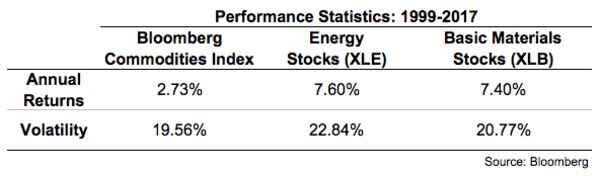
Both funds have performed much better than commodities with similar volatility characteristics. The only problem with investing in sector funds is that they still have a fairly high correlation to the overall stock market. The correlations for XLE and XLB to the S&P 500 were 0.62 and 0.88 over this time frame. Many investors put their money into commodities in hopes of finding an uncorrelated portfolio diversifier, which sector funds may not provide.

Invest in companies that mine commodities. Instead of owning the commodities themselves you could simply own equity in the companies that extract them and put them to use. The Vanguard Metals & Mining Fund does just that. Here are the stats in comparison to the S&P 500 and Bloomberg Commodities Index:
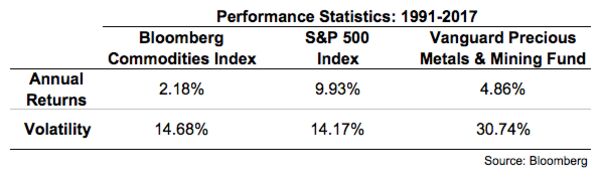
This fund had just a 0.05 correlation to the S&P 500 in this time, meaning there is virtually no relationship between the return streams. 1 It also had better returns than commodities, but it did so with much higher volatility. It also comes with bone-crushing losses that can be similar to the underlying commodities:
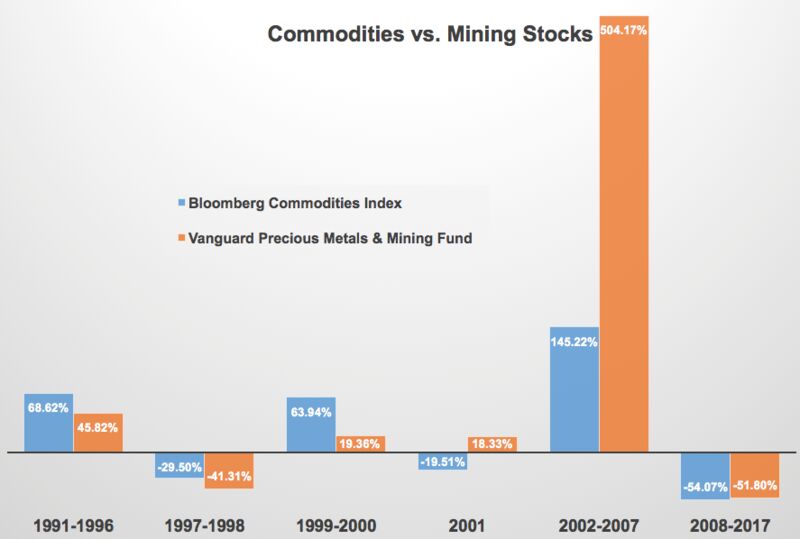
There have been periods when physical commodities decouple from the equities of the mining companies but both are still quite cyclical. When looking at the types of losses and volatility involved in precious metals and mining stocks it makes for a difficult portfolio holding, even if it ends up providing valuable diversification benefits. Very few investors have the emotional stamina to hold through this type of volatility or rebalance into the pain when necessary.

Stick to trend-following rules. Because of the cyclical nature of commodities they can work much better through the use of trend-following rules. Trend-following as an investment strategy seeks to follow the old maxim that you should allow your winners to run but cut your losers short. The goal of trend-following is to reduce volatility and the potential for large drawdowns.

The following table compares commodities, stocks and a simple commodities trend-following strategy since 1991:
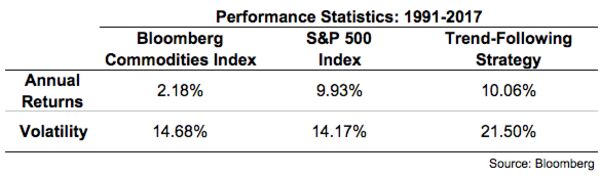
Our trend-following strategy in this example follows a simple 10-month moving average rule. Using the same Vanguard Precious Metals & Mining Fund, this strategy shows what would have happened if you would have held that fund when it was above its trailing 10-month moving average price 2 and sold it to buy bonds 3 whenever it dipped below the 10-month moving average.

Not only does a trend-following strategy cut the volatility by roughly one-third in this fund, but it also reduces the maximum drawdown in the fund from minus 76 percent to minus 33 percent by going to bonds as losses and volatility began to pile up.

This example doesn’t include taxes or transaction cost but it does show how investors can use the cyclical nature of these securities to their advantage. The basic idea is to ride the momentum up when they are rising and try to get out of the way when they are falling, with the understanding that you can’t nail the timing perfectly in either direction.

As you can see from the statistics, none of these strategies will be for the faint of heart. But investors do have options beyond investing directly in long-only commodity indexes if they would like to invest in this space.


Article By Ben Carlson, courtesy Bloomberg

Admin
Admin
Previous Post

Who cares about monetary policy?

Next Post

Miners drive South African stocks to record high as Kumba gains

Next Post

Miners drive South African stocks to record high as Kumba gains

  • Trending
  • Comments
  • Latest

CBN to issue N1.5bn loan for youth led agric expansion in Plateau

July 29, 2025

How UNESCO got it wrong in Africa

May 30, 2017
NGX taps tech advancements to drive N4.63tr capital growth in H1

Insurance-fuelled rally pushes NGX to record high

August 8, 2025

Glo, Dangote, Airtel, 7 others prequalified to bid for 9Mobile acquisition

November 20, 2017

6 MLB teams that could use upgrades at the trade deadline

Top NFL Draft picks react to their Madden NFL 16 ratings

Paul Pierce said there was ‘no way’ he could play for Lakers

Arian Foster agrees to buy books for a fan after he asked on Twitter

State

State Police by design

July 14, 2026
NAAPE moves to shield pilots, engineers with loss-of-licence insurance scheme

NAAPE moves to shield pilots, engineers with loss-of-licence insurance scheme

July 14, 2026
Global airlines are investing heavily in economy class cabins as competition for passengers shifts beyond ticket prices to the quality of the travel experience, prompting carriers to modernise fleets, redesign cabins and enhance onboard services in a bid to strengthen customer loyalty and improve long-term profitability. The renewed focus reflects a transformation in the aviation industry, where economy class, despite offering lower fares than premium cabins, remains the largest contributor to passenger volumes and an increasingly important driver of commercial performance. With millions of travellers continuing to prioritise affordability, airlines are finding that modest improvements in comfort and convenience can translate into stronger repeat business, improved customer satisfaction and higher ancillary revenues. As a result, carriers are directing substantial investment towards upgrading economy cabins through newer aircraft, ergonomically designed seats, advanced inflight entertainment systems, onboard connectivity, enhanced catering and improved cabin service. Industry analysts say the strategy is becoming a key differentiator as airlines compete more aggressively for passengers on both regional and long-haul routes. Unlike business and first-class travellers, whose numbers are relatively limited, economy passengers account for the overwhelming majority of airline traffic, making their overall travel experience increasingly central to airlines' growth strategies. Rather than relying solely on fare reductions to attract customers, airlines are seeking to build stronger brand loyalty by improving the value passengers receive throughout their journeys. "Passenger expectations have changed significantly. Travellers increasingly compare airlines based not only on ticket prices but also on comfort, reliability, connectivity and the overall onboard experience," aviation analysts note. Several of the world's leading airlines have already embraced the strategy. Carriers including Singapore Airlines, Qatar Airways, Emirates, Turkish Airlines, All Nippon Airways (ANA), EVA Air and Cathay Pacific have invested significantly in upgrading their economy cabins through improved seating, larger entertainment libraries, enhanced meal services and customer-focused cabin experiences. Although each airline has adopted different approaches, the underlying objective remains the same: making economy travel more comfortable for the largest segment of their customer base while strengthening long-term commercial competitiveness. Fleet modernisation is playing a critical role in that transformation. Next-generation aircraft such as the Boeing 787 Dreamliner, Airbus A350 and Airbus A321neo are enabling airlines to improve the passenger experience while simultaneously lowering operating costs. Compared with older aircraft, these models offer quieter cabins, larger windows, improved air quality, better humidity control and greater fuel efficiency, creating benefits for both passengers and airline operators. The newer aircraft also reduce fuel consumption and maintenance expenses, allowing airlines to improve customer experience without significantly increasing operating costs over the aircraft's lifespan. Technology has emerged as another major area of investment. Features once reserved almost exclusively for premium cabins, including USB charging ports, wireless internet connectivity, mobile application integration and personalised digital entertainment platforms, are increasingly becoming standard in economy class. Passengers are also benefiting from greater control over their travel experience, with digital services allowing them to access entertainment, communicate onboard and manage various aspects of their journeys more conveniently. The growing investment reflects changing consumer expectations in an increasingly digital travel environment. Recent international passenger satisfaction surveys consistently indicate that airlines investing in cabin comfort, inflight technology and customer service continue to perform strongly in global service rankings. While competitive pricing remains an important consideration for travellers, customer experience has become an increasingly influential factor in airline selection, particularly on medium and long-haul routes where comfort plays a greater role in purchasing decisions. The trend is expected to reshape competition within Africa's aviation industry as airlines expand their fleets to meet growing passenger demand.

Global airlines raise economy class spending to win passenger loyalty

July 14, 2026
US

How Vulnerable Are US Financial Markets?

July 14, 2026

Popular News

  • CBN to issue N1.5bn loan for youth led agric expansion in Plateau

    0 shares
    Share 0 Tweet 0
  • How UNESCO got it wrong in Africa

    0 shares
    Share 0 Tweet 0
  • Insurance-fuelled rally pushes NGX to record high

    0 shares
    Share 0 Tweet 0
  • Glo, Dangote, Airtel, 7 others prequalified to bid for 9Mobile acquisition

    0 shares
    Share 0 Tweet 0
  • Nigeria agrees with Russia on first nuclear energy plant by mid 2020s

    0 shares
    Share 0 Tweet 0
Currently Playing

CNN on Nigeria Aviation

CNN on Nigeria Aviation

Business AM TV

Edeme Kelikume Interview With Business AM TV

Business AM TV

Business A M 2021 Mutual Funds Outlook And Award Promo Video

Business AM TV

Recent News

State

State Police by design

July 14, 2026
NAAPE moves to shield pilots, engineers with loss-of-licence insurance scheme

NAAPE moves to shield pilots, engineers with loss-of-licence insurance scheme

July 14, 2026

Categories

  • Frontpage
  • Analyst Insight
  • Business AM TV
  • Comments
  • Commodities
  • Finance
  • Markets
  • Technology
  • The Business Traveller & Hospitality
  • World Business & Economy

Site Navigation

  • Home
  • About Us
  • Contact Us
  • Privacy & Policy
Business A.M

BusinessAMLive (businessamlive.com) is a leading online business news and information platform focused on providing timely, insightful and comprehensive coverage of economic, financial, and business developments in Nigeria, Africa and around the world.

© 2026 Business A.M

Welcome Back!

Login to your account below

Forgotten Password?

Retrieve your password

Please enter your username or email address to reset your password.

Log In
No Result
View All Result
  • Home
  • Technology
  • Finance
  • Comments
  • Companies
  • Commodities
  • About Us
  • Contact Us

© 2026 Business A.M