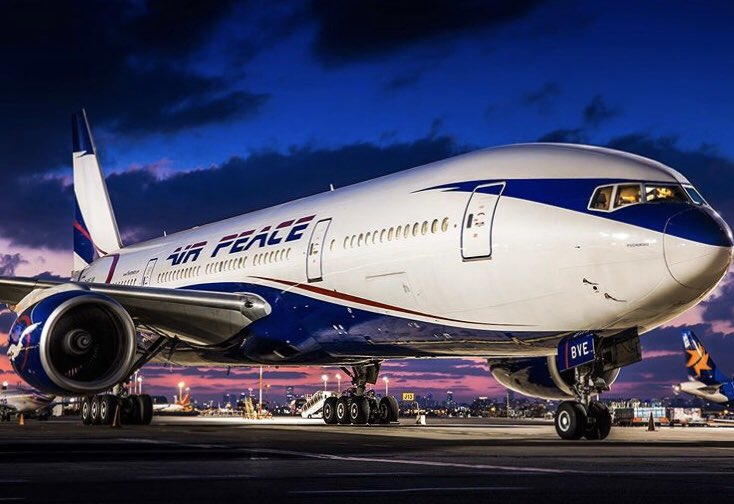
A battle over an alleged N25 billion in unpaid aviation charges has moved from negotiation tables to airport terminals, grounding flights and exposing the heavy economic cost of industrial action in Nigeria’s aviation industry.
Air Peace bore the brunt of the disruption on August 11, when aviation unions shut down about 70 of its flights over alleged non-remittance of the 5 percent Ticket Sales Charge and claims that workers were being denied freedom of association. United Nigeria Airlines subsequently suspended more than 30 flights in solidarity with the carrier.
More than 1,200 passengers were reportedly stranded in Lagos and Abuja. Air Peace said it lost more than N2 billion in revenue within 48 hours.
The unions, led by the National Union of Air Transport Employees (NUATE) and the Air Transport Services Senior Staff Association of Nigeria (ATSSSAN), with backing from the Nigeria Labour Congress (NLC) and Trade Union Congress (TUC), insist that the action was necessary after repeated attempts to resolve their grievances failed.
The dispute is anchored on an alleged N25 billion outstanding Ticket Sales Charge across airlines, with more than N15 billion attributed to Air Peace. The unions also demanded an end to what they describe as restrictions on workers’ right to join unions without intimidation or victimisation.
Those claims place legitimate questions of regulatory compliance and labour rights at the centre of the confrontation. Yet the economic consequences of the industrial action are proving harder to ignore. When the pursuit of workers’ welfare grounds aircraft, disrupts passengers, and threatens airline revenues, the aviation industry is left confronting how much economic damage is acceptable in the pursuit of a legitimate labour demand.
The unions say their action did not come suddenly. NUATE, ATSSSAN and the National Association of Aircraft Pilots and Engineers (NAAPE) said they had issued successive notices before resorting to picketing, after what they described as unsuccessful efforts to resolve outstanding issues.
On the financial side, the unions allege that airlines have failed to remit billions of naira in statutory charges collected from passengers.
They estimate the outstanding TSC across airlines at N25 billion, with Air Peace allegedly accounting for more than N15 billion. The figure is substantial enough to warrant scrutiny if established. But the dispute is complicated by the fact that the 5 percent Ticket Sales Charge is not a labour levy or union fund.
Under the Civil Aviation Act 2022, the Nigeria Civil Aviation Authority (NCAA) is empowered to collect the charge on tickets originating from Nigeria, as well as certain cargo, charter and contract operations.
The proceeds are distributed among aviation agencies, including the NCAA, Nigerian Airspace Management Agency (NAMA), Nigerian Meteorological Agency (NiMet), Nigerian College of Aviation Technology (NCAT) and Accident Investigation Bureau (AIB).
That distinction matters because the dispute is not simply between airlines and workers.
It involves airlines, aviation regulators, government agencies and ultimately passengers who pay the charge through their tickets.
If billions of naira are indeed outstanding, the question is why the regulatory system has not resolved the matter through its established enforcement mechanisms before the dispute escalated into an airport shutdown.
The cost of the shutdown
Air Peace counted the cost in billions; passengers paid in lost time and additional expenses.
The airline said the disruption cost it more than N2 billion in 48 hours. But hundreds of travellers also bore the consequences, with passengers stranded, appointments missed, connecting flights disrupted and additional costs incurred by those forced to find alternative travel arrangements.
United Nigeria Airlines was also drawn into the disruption after suspending operations in solidarity with Air Peace. The result was a disruption that went beyond the original employer-worker dispute.
Aviation is particularly sensitive to operational uncertainty because airlines sell a perishable product. An empty aircraft seat after departure cannot be recovered or resold.
The immediate revenue loss is only part of the bill. The bigger cost could be trust.
Once a flight is cancelled, the opportunity to sell that seat is lost permanently. But a passenger stranded despite holding a valid ticket may also lose confidence in the airline.
Corporate travellers may move to competitors, travel agencies may rethink their preferred carriers and businesses that depend on predictable air travel may begin looking for alternatives.
What starts as a labour dispute can therefore end as a market-share problem.
Was Air Peace singled out?
The selective nature of the action has also become part of the controversy.
The unions maintain that Air Peace was targeted first because it allegedly accounted for more than half of the N25 billion outstanding TSC and because of the dispute over unionisation of its workers.
But questions remain over why other airlines allegedly owing the balance were not subjected to comparable disruption.
Oluwatoyin Olajide, Air Peace’s chief operating officer, cited comments attributed to the NCAA director-general that airlines were complying with the authority’s directives on the applicable payments.
The controversy goes beyond the disputed payments. It also raises questions about why a regulatory disagreement was allowed to spill into a disruption of passenger operations.
If, as the NCAA indicated, airlines were complying with its directives on the applicable charges, the case for grounding flights becomes more difficult to reconcile with the regulator’s position.
The unions may have their reasons for escalating the dispute, but once airport operations became the battleground, passengers and businesses were inevitably drawn into a conflict they did not create.
The workers’ rights dispute
The second major grievance is more directly connected to labour.
The unions accuse Air Peace and other airlines of preventing workers from freely joining unions and say employees should be allowed to exercise their rights without fear of discrimination or victimisation.
Air Peace, however, has pointed to a 2024 Federal High Court judgment that it says restrained the NLC, TUC, NUATE and others from coercing its employees into union membership.
If the judgment remains valid and applicable to the circumstances of the current dispute, it introduces a legal dimension.
Workers have rights to freedom of association. But employers also have rights to operate within the law, while unions are equally bound by court orders.
The appropriate test, therefore, should be evidence and due process rather than the relative ability of one party to shut down airport operations.
Air Peace has also alleged that some of its employees were attacked and injured during the picketing.
The unions have yet to publicly address all of those allegations in detail. Francis Akinjole, ATSSSAN secretary-general said the association would respond at the appropriate time.
When passengers become collateral
The Air Peace dispute may eventually be settled through negotiation, regulatory enforcement or litigation. The unions may substantiate their claims. The airline may be required to pay whatever obligations are legally established. Workers may secure stronger guarantees over their right to organise. However, passenger confidence is one consequence that cannot be recovered through settlement.
Nigeria’s aviation industry depends on travellers believing that the ticket they purchase represents a reliable promise of transportation. When that promise is disrupted by an industrial dispute, the damage is not confined to one airline. It also affects the credibility of the wider system.
That, according to industry analysts, is why the industry needs more than strong unions, financially viable airlines and effective regulators. It needs a framework in which disputes are resolved without making passengers the unwilling financiers of industrial conflict. It is also argued that airlines must be accountable, workers must be protected, regulators must enforce the law, and passengers must not become collateral damage.
The unions may win their argument over the disputed charges. The regulator may ultimately secure the payments it believes are due. But if the dispute leaves passengers questioning whether Nigeria’s aviation system can guarantee a journey after taking their money, the sector will have paid a much larger price.