Sade Williams/Business a.m.
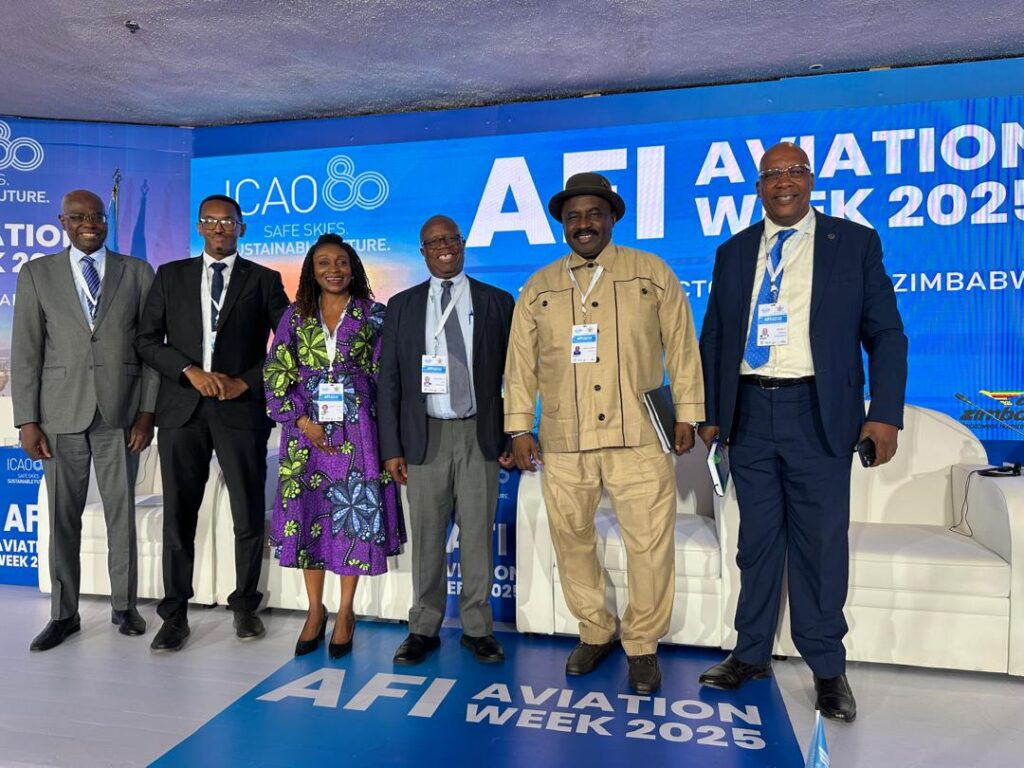
Chris Ona Najomo, the director general of the Nigeria Civil Aviation Authority (NCAA), took centre stage at the Tenth International Civil Aviation Organisation (ICAO) Africa Indian Ocean AFI region Aviation Week Symposium- Session 5, at the Elephant Hills Resort in Victoria Falls, Zimbabwe, with the theme ‘Optimizing Air Transport connectivity for Sustainable Economic Development in Africa’ where he engaged in a Q&A with delegates, enumerating the successes of the Ahmed Bola Tinubu’s administration in reshaping Nigeria’s aviation industry to make it globally competitive. Here are highlights of Najomo’s responses to delegates’ questions.
What are the challenges African states face in balancing national carrier protectionism with the need for liberalisation and regional connectivity?
African states face a number of challenges in balancing national carrier protectionism with the need for liberalization and regional connectivity. These challenges stem from political, economic, regulatory, and infrastructural factors. However, as part of the government of Nigeria policy trust, my administration, through the backing of the minister, supports the growth and sustenance of local airline businesses whilst holding them to the highest international standards in the aviation industry.
What are some of the challenges you think are still a clog in the wheel of progress for national airlines?
National airlines are national pride and identity: governments are aware that liberalisation is best for air connectivity, however governments find it difficult to embrace full liberalisation and instead practice protectionisms to shield their airline from competition. There is also the fear that liberalisation will undermine their national carrier’s market share and profitability. [Take] the slow implementation of the Yamoussoukro Decision and the Single African Air Transport Market (SAATM), [for instance]. Look at how many African states delay the implementation of SAATM because of the fear that they will lose control of certain routes which may negatively impact their national airlines. The other is the absence of economic regulations: most African states have not yet developed robust economic regulation to provide the needed assistance in balancing the needs for liberalization of the regional routes.
Also, the lack of autonomous Civil Aviation Authorities: Some states are yet to have an autonomous aviation sector. They therefore do not practice globally accepted practices in air transport liberalization.
We also have visa barriers: the benefits of liberalised air transport, especially ease in movement of passengers, are not achieved under strict visa regimes between African states. The African Union 2063 initiative of the African passport and free movement of people and goods can help foster trade and tourism whilst increasing inter African connectivity amongst member states.
There is the challenge of consumer impact and policy disconnect: Protectionism often leads to fewer carriers, poor service quality, and higher ticket prices for consumers. There is often a disconnect between aviation, tourism, and trade policies that undermines liberalisation goals.
Can you share your country’s experience on how the government prioritises investment in aviation infrastructure as part of national development and regional partnership on airlines?
The government of President Bola Ahmed Tinubu has increasingly prioritised aviation infrastructure development and regional airline partnerships as strategic tools to drive national economic growth, improve connectivity, and strengthen regional integration.
The Nigerian government in the last three years has increasingly allocated funds in its annual budget for key infrastructure projects for construction and upgrade of airport infrastructure and air navigation services such as airport upgrades and concessions. My country’s government has carried out rehabilitation and expansion of terminals at major international airports including Abuja, Lagos, Port Harcourt, Kano, Enugu; even as we speak, they are undergoing terminal expansion and modernization projects.
Under the airport concession programme, the ongoing plan by the government on Public-Private Partnerships (PPPs) concession of key international airports is aimed at improving efficiency, infrastructure, and service delivery.
The Nigerian government has also carried out the development of new infrastructure such as the cargo terminals and Free Trade Zones. The Nigeria government is focusing on expanding cargo facilities and integrating them with special economic zones (SEZs) to promote exports.
Regarding the aerotropolis projects, there are ongoing plans to develop airport cities around key airports (e.g., Lagos, Abuja) to boost logistics, tourism, and commercial activities.
Speak to us on what your government is doing regarding the safety of its airspace?
Another area my country’s government has made huge investment is in navigation and safety systems. The modernisation of air navigation services through the Nigerian Airspace Management Agency (NAMA) is also currently ongoing, including the deployment of satellite-based navigation systems (GNSS), upgrade of radar systems and communication infrastructure for better air traffic control and safety compliance.
What collaborations do you have with other bodies to strengthen interconnectivity?
Nigeria continues to support the Yamoussoukro Decision, SAATM & other multilateral agreements. As a signatory to SAATM, it is committed to opening its skies to African airlines, aligning with continental goals of liberalised air transport. Nigeria has signed BASA in line with AFCAC YD-Compliant ASA with some of the thirty-eight (38) SAATM countries, including the provisions of unrestricted first to fifth freedom traffic rights on passengers and full liberalisation on cargo.
At the recently concluded 18 Banjul Accord Group (BAG) plenary meeting in Abuja, the BAG ministers reaffirmed their commitment to the ideals of the Banjul Accord Group and full implementation of Single African Air Transport Market (SAATM). Nigeria has signed Memorandums of Understanding (MoU) with neighboring countries in the areas of Air Traffic Flow Management (ATFM) & Search and Rescue (SAR).
With its huge population and its travel potentials, what is Nigeria doing in promoting the growth of its domestic airlines?
The Nigerian government is actively promoting the growth of domestic airlines through targeted policies such as the “Fly Nigeria Act,” aimed to prioritise Nigerian airlines for government-sponsored air travel. This is designed to support local operators, ensuring their sustainability and boosting the local and regional aviation industry.
Nigeria has domesticated the Cape Town Convention in the Civil Aviation Act 2022 and has signed the Irrevocable De-registration and Export Request Authorization (IDERA) in October 2024. This has increased Nigeria’s score on the CTC Compliance Index from 70.5 percent to 75.5 percent, placing the country in the ‘high category’ and the subsequent removal of Nigeria from the Aviation Working Group (AWG’s) watchlist of non-compliant countries.
Again, the signing of IDERA has allowed Nigerian airlines to access leased aircraft more easily, thereby boosting operational capacity, international confidence that would support Nigeria airline expansion on the regional routes. Also, one of the agenda of the minister of aviation is the development of human capacity within the industry. There is ongoing discussion of regional partnership on airlines and my government supports this due to the immense benefit that it will provide the sub-region and Africa as a whole. The Nigerian government places emphasis on aviation infrastructure and positions the sector for a conducive investment environment.