
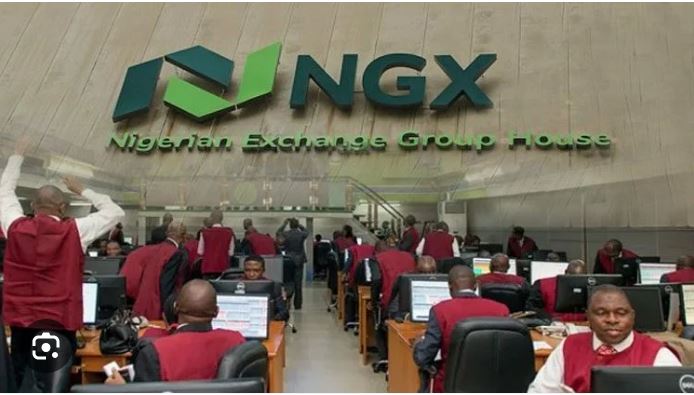
Nigeria’s equities market closed lower on Wednesday as profit-taking in select heavyweight stocks offset gains in banking counters, although positive market breadth signalled that investors remained optimistic about the market’s near-term direction.
The NGX All-Share Index (ASI) declined 0.21 percent to close at 242,366.75 points, trimming recent gains but leaving the market with a robust 55.75 percent year-to-date return.
Despite the decline in the benchmark index, investors added N390.32 billion to market value as total market capitalisation rose 0.25 percent to N156.24 trillion, reflecting price appreciation in several large-cap stocks.
Market sentiment remained firmly positive, with 31 gainers outweighing 19 losers, producing a market breadth ratio of 1.7 times. Buying interest was concentrated in FIRSTHOLDCO, THOMASWY, LEGENDINT, TRIPPLEG and MCNICHOLS, while TRANSEXPR, INTBREW, HMCALL, DAARCOMM and NGXGROUP led the laggards.
Sectoral performance was mixed, with banking stocks extending recent gains. The banking index advanced 2.20 percent, while the insurance sector gained 0.74 percent. Consumer goods and industrial stocks weakened by 0.27 percent and 0.23 percent, respectively, while the oil and gas and commodities indices closed broadly unchanged.
Trading activity, however, reflected a more cautious market mood. Total traded volume fell 24.96 percent to 476.34 million shares, while turnover dropped 44.46 percent to N29.63 billion. The number of completed deals also eased 3.53 percent to 40,992 transactions.
Market analysts expect renewed bargain hunting and portfolio rebalancing to support a recovery in coming sessions, although continued profit-taking in recently appreciated stocks may limit the pace of any rebound.
Beyond equities, money market conditions tightened despite improved banking system liquidity.
The interbank market recorded higher borrowing rates across most maturities, with the overnight Nigerian Interbank Offered Rate (NIBOR) rising 3 basis points to 22.22 percent. Longer-term rates also increased, reflecting cautious liquidity management among financial institutions.
Funding costs were mixed as the overnight lending rate eased marginally to 22.16 percent, while the Open Repo rate remained unchanged at 22.00 percent.
The Treasury bills secondary market also weakened, with yields rising across most maturities as investors adopted a cautious stance. Nevertheless, stable demand helped keep the average Treasury bill yield unchanged at 18.41 percent.
The domestic bond market similarly recorded mild weakness, with average Federal Government bond yields edging 1 basis point higher to 17.64 percent amid subdued local demand.
In contrast, Nigeria’s Eurobond market attracted stronger offshore buying interest, pushing average yields down 4 basis points to 6.89 percent, an indication of improving investor confidence in the country’s dollar-denominated sovereign debt.
The foreign exchange market presented a mixed picture.
The naira appreciated marginally by 0.06 percent at the official Nigerian Foreign Exchange Market (NAFEM), closing at N1,382.18 per US dollar, while weakening 0.15 percent in the parallel market to N1,384 per dollar.








Turning energy investment into lasting economic value in Africa