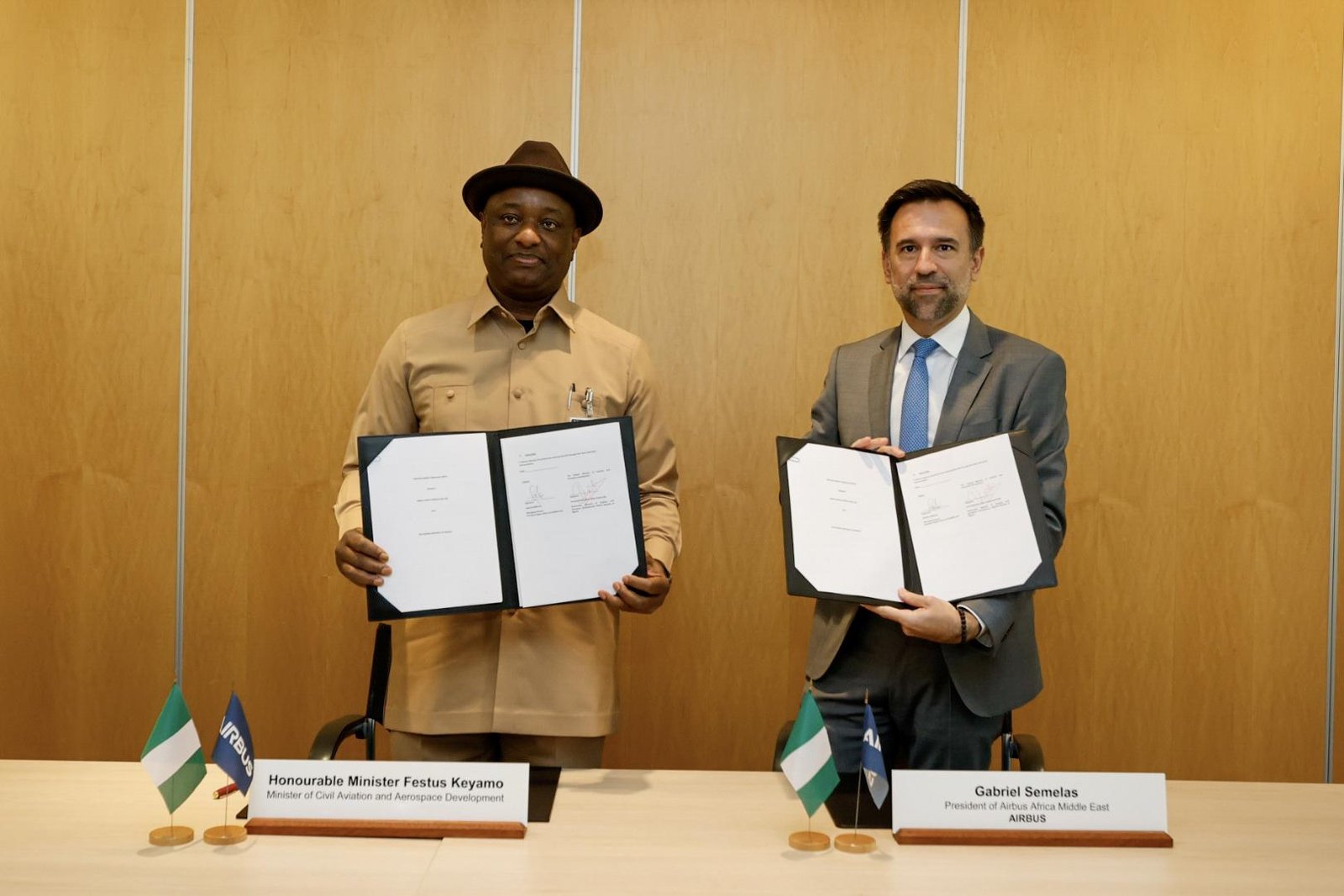
Nigeria has taken a significant step toward repositioning its aviation industry for long-term growth following the signing of a landmark agreement between the federal government and European aerospace giant Airbus.
The agreement, executed during an official visit to France by Festus Keyamo, the minister of aviation and aerospace development, alongside senior government officials and key industry stakeholders, is expected to accelerate the development of Nigeria’s civil aviation ecosystem through targeted investments in infrastructure and human capital.
The partnership is set to strengthen Nigeria’s aviation value chain, spanning technical support, capacity building, and knowledge transfer. Both parties say the collaboration signals a renewed commitment to building a globally competitive aviation sector in Africa’s largest economy.
“This visit is a clear step toward strengthening partnerships, unlocking investment and positioning Nigeria as a leader in Africa’s aviation future. Through our engagement with Airbus, we are committed to building a more innovative and globally competitive aviation ecosystem for our country,” Keyamo said.
The agreement outlines Airbus’ role in providing technical expertise across several critical segments, including aviation market intelligence, crew and maintenance training, and advisory services in maintenance, repair and overhaul (MRO), as well as flight operations. These interventions are expected to address longstanding capacity gaps within Nigeria’s aviation industry while aligning it with global standards.
In addition to infrastructure and operational support, the partnership places strong emphasis on talent development. Airbus will facilitate exchanges between its experts and Nigerian students, exposing them to opportunities within the aerospace industry and equipping a new generation with the technical competencies required to thrive in a rapidly evolving sector.
Speaking on the strategic importance of the agreement, Gabriel Semelas highlighted Nigeria’s pivotal role in Africa’s aviation growth trajectory.
“Nigeria is sitting at the heart of Africa’s aerospace opportunities, driven by its status as one of the fastest-growing nations worldwide with a population of 230 million and its thriving economy. This agreement reflects our shared ambition to scale the civil aviation ecosystem in the country. By leveraging Nigeria’s local talents and infrastructures, we are committed to fostering long term growth and human capital development to strengthen the country’s and the continent’s aviation industry,” Semelas said.
The partnership also underscores Airbus’ long-term commitment to Africa, where it currently maintains a workforce of about 3,000 employees. The company has increasingly focused on deepening local partnerships and enhancing technical expertise across the continent, positioning itself as a key enabler of Africa’s aviation growth story.
Projections from Airbus reinforce the scale of opportunity ahead. According to its latest Global Market Forecast, Africa will require approximately 1,490 new passenger and freighter aircraft by 2044, reflecting rising demand for air travel driven by population growth, urbanisation, and economic expansion.
Complementing this outlook, Airbus’ Global Services Forecast estimates that the continent will need an additional 20,000 pilots, 30,000 mechanics, and 21,000 cabin crew over the same period to support anticipated growth in air traffic.