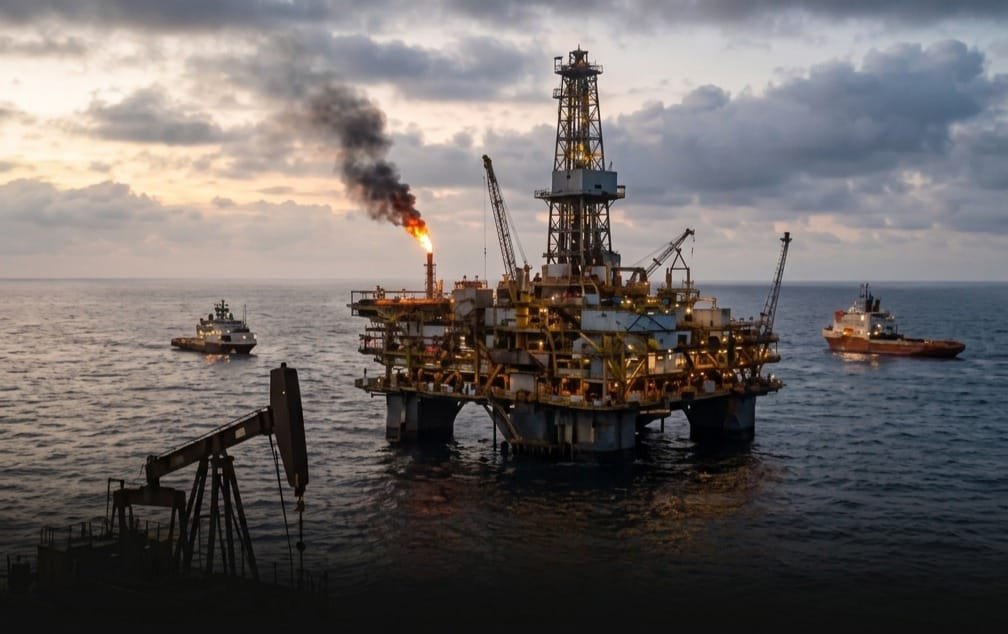
Nigeria’s ambitious $50 billion offshore oil revival by 2030 faces severe competition from frontier basins and new entrants, Namibia and Guyana, with simpler regulatory frameworks, massive recent deepwater discoveries, fewer security and infrastructure hurdles.
The African top oil producer expects to attract between $30 billion and $50 billion in offshore oil and gas investments by 2030 as 22 major deepwater projects move towards production, marking one of the country’s most ambitious attempts in years to revive an industry that has steadily lost capital to emerging rivals such as Guyana, Namibia and Brazil.
The push comes as the country tries to reverse years of declining upstream investments and production output.
According to NUPRC (Nigeria Upstream Petroleum Regulatory Commission) officials, the reforms engendered by the Petroleum Industry Act (PIA) are restoring investor confidence, with more than $57 billion in development plans already approved.
NUPRC leadership speaking at the just-concluded Society for Petroleum Engineers (SPE), said the country is making its strongest pitch yet to win back global energy investors. That the projects therefrom are expected to boost production, create jobs and strengthen Nigeria’s position in the global energy market.
However, the country now battles Namibia and Guyana for global energy investment. To wit, these new frontier basins countries (Namibia and Guyana) offer international investors simpler regulatory frameworks, massive recent deepwater discoveries, and fewer security or infrastructure hurdles, drawing capital away from Nigerian projects.
In particular, competitive pressures mount from Guyana’s rapid growth: the Stabroek block and related offshore fields attract tens of billions of dollars in fast-track capital with proven, high-yield production.
For Namibia, its frontier appeal stems from major recent deepwater discoveries off the Namibian coast, which have turned the southwest African nation into a top global exploration hotspot.
Investment divergence tests Nigeria: International energy companies prefer regions with clearer fiscal terms and lower operational risks over legacy basins. These are lacking in Nigeria’s long years of oil policy summersaults, coupled with opaque operations by the country’s petroleum upstream regulators.
Furthermore, Nigeria’s challenged regulatory and cost delays deter international energy companies to prefer Namibia and Guyana. In Nigeria, lengthy project approvals and high operating costs threaten deep offshore timelines.
In addition, infrastructure and security: onshore pipeline vandalism, fiscal uncertainty, and security issues make funding harder to secure in Nigeria compared to the newer Latin American and African entrants.
Nigeria, despite being Africa’s largest crude producer to date, has struggled for much of the past decade with declining output, delayed project approvals, oil theft, ageing infrastructure and policy uncertainty.
Those challenges have prompted several international oil companies (IOCs) to scale back their onshore operations and redirect capital to faster-growing offshore basins elsewhere in the world. Examples, Namibia and Guyana.
But in an apparent move to win back a global energy major Shell, Nigeria is offering the Anglo-Dutch giant bigger tax incentive to fast-track $20 billion oil investment
Now NUPRC at the SPE annual international conference and exhibition, says it believes the tide is turning for Nigeria.
The regulator said the 22 offshore developments expected between 2026 and 2030 could unlock up to $50 billion in fresh investment while increasing crude production, creating jobs, expanding infrastructure and improving the country’s long-term energy security.
It said it has already approved more than $57 billion worth of field development plans (FDPs) since 2024, with several projects progressing to final investment decisions (FIDs), a key milestone before full-scale investment begins.
According to the Nigerian upstream regulator, the optimism reflects a broader shift in investor sentiment following reforms introduced under country’s PIA, which sought to improve fiscal terms, licensing transparency and regulatory certainty after years of complaints from oil companies.
It argued that those reforms are beginning to translate into real investment commitments, adding that the government was also preparing another licensing round after awarding 37 oil and gas blocks to 31 companies during the 2025 exercise.
But the Nigerian renewed investment drive comes as competition for global oil capital intensifies. Countries such as Guyana have become some of the world’s fastest-growing oil producers after a series of giant offshore discoveries, while Africa’s Namibia has emerged as one of the most attractive exploration frontiers following major finds in the Orange Basin by international energy companies.
Those successes have evidently reshaped where global oil majors are spending billions of dollars.
For Nigeria, it is is betting that its deepwater reserves, existing infrastructure (though aged) and improving regulatory environment can help reverse that trend.
NUPRC clearly acknowledged that infrastructure remains one of the biggest barriers to faster development across Africa’s oil and gas sector.
The regulator said to address the challenge, Nigeria was expanding gas gathering systems, processing facilities, pipelines and export infrastructure, while encouraging operators to share facilities and use third-party access to reduce costs and shorten project timelines.
It added that the country was on track to double output to 3 million barrels per day (bpd) by 2030.