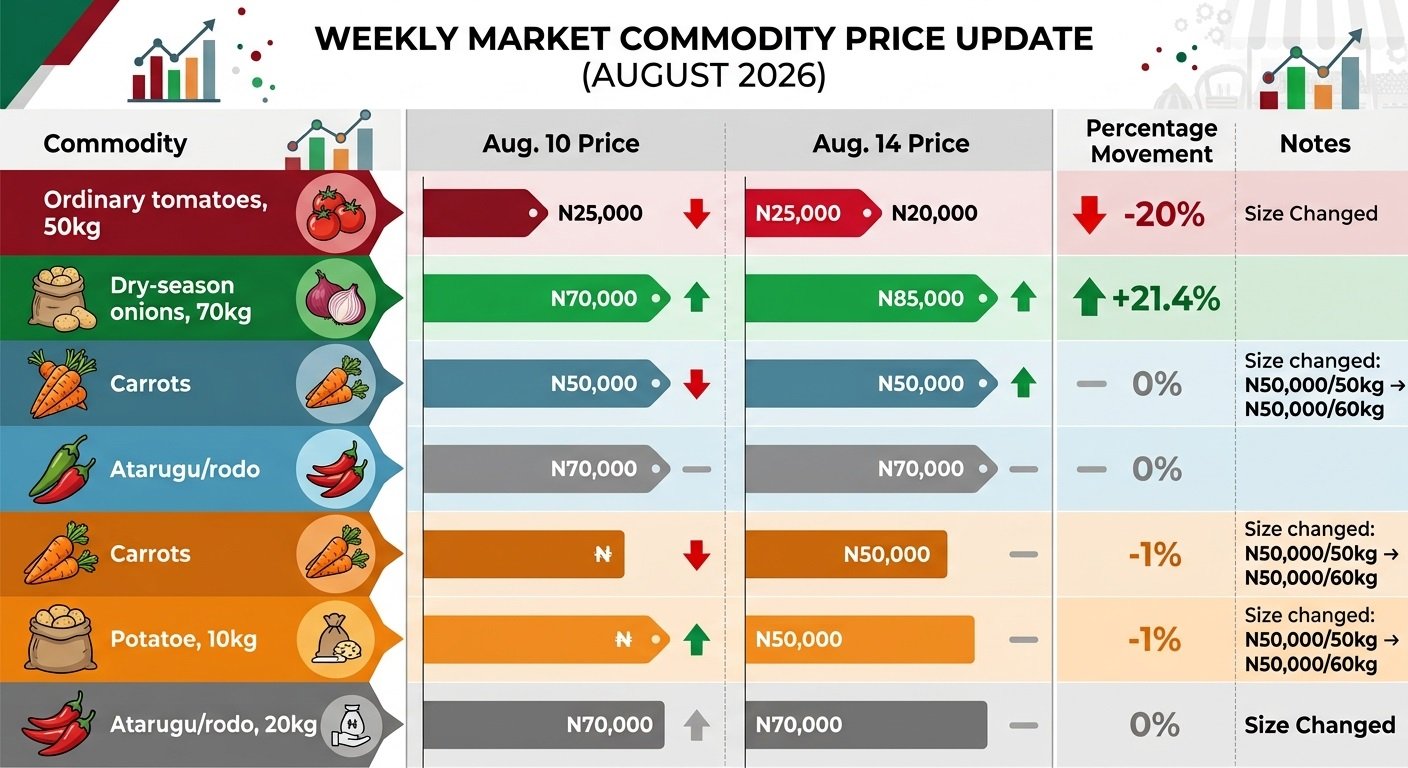
The prices of key food commodities recorded mixed movements between Monday, August 10 and Friday, August 14, with dry-season onions emerging as one of the biggest gainers, while tomatoes, peppers and Irish potatoes recorded notable declines over the same period.
Market price data obtained by Business A.M. showed that the price of a 70kg bag of dry-season onions rose from N70,000 on August 10 to N85,000 on August 14, representing a 21.4 percent increase in just four days.
Wet-season onions also recorded an increase, rising from N50,000 to N58,000 per 70kg bag, an increase of 16 percent.
The divergent movement in onion prices comes against a backdrop of growing concerns over seasonal supply constraints and the vulnerability of Nigeria’s fresh-produce markets to weather, logistics and changing harvest cycles.
The latest market data also showed significant price corrections in several vegetables, indicating that supply conditions remain uneven across commodities and producing areas.
Tomato prices ease
Tomatoes recorded some of the clearest price declines during the period.
The price of ordinary tomatoes fell from N25,000 per 50kg basket on August 10 to N20,000 on August 14, representing a 20 percent decline.
However, a new market category for big ordinary tomatoes was quoted at N30,000 per 50kg basket on Friday, indicating that quality and size differences are becoming increasingly important in determining market prices.
Hybrid tomatoes also declined from N40,000 per 25kg crate to N30,000, representing a 25 percent reduction within four days.
Pepper prices also retreat
Among the pepper varieties tracked, shombo recorded a notable decline.
The price of a 20kg bag of shombo, also known as bawa, fell from N40,000 on Monday to N35,000 on Friday, a 12.5 percent drop.
Tatashe recorded an even heavier decline, falling from N55,000 per 25kg bag to N45,000, equivalent to an 18.2 percent decrease.
Atarugu, however, remained unchanged at N70,000 per 20kg bag, making it one of the most expensive pepper varieties in the market during the period.
The contrasting movements point to commodity-specific supply conditions rather than a uniform direction across the fresh-produce market.
Potatoes record significant correction
Irish potatoes also became cheaper over the four-day period.
The price of a 50kg bag declined from N85,000 on August 10 to N75,000 on August 14, representing an 11.8 percent reduction.
Sweet potatoes, by contrast, remained stable at N55,000 per 100kg bag.
The price of carrots was unchanged at N50,000, although the quoted package size increased from a 50kg bag on Monday to a 60kg bag on Friday, making a direct price comparison less straightforward.
Okro, cabbage and cucumber also remained unchanged at N20,000 per their respective market bag sizes.
Meanwhile, the sharp increase in onion prices stands out because it occurred while several other vegetables became cheaper.
Dry-season onions increased by N15,000 per bag, while wet-season onions rose by N8,000.
The premium for dry-season onions over wet-season onions also widened during the period. On August 10, the difference was N20,000 per 70kg bag; by August 14, it had expanded to N27,000. That represents a 35 percent increase in the price gap between the two categories within four days.
Maize prices hold steady
The price of dried white maize remained unchanged at N35,000 per 100kg bag throughout the period.
The stability contrasts with the movements recorded in several fresh vegetables and indicates that not all food commodities are experiencing the same degree of short-term price pressure.
The latest data highlight the fragmented nature of Nigeria’s fresh-produce market, where individual commodities are responding differently to seasonal supply and distribution conditions.
While tomato, pepper and Irish potato prices have declined, onions have moved sharply in the opposite direction. The divergence reflects differences in harvest cycles, availability, storage and logistics across producing areas.
Of particular concern is the widening price premium for dry-season onions over wet-season varieties. If supplies tighten further as the season progresses, onions could become a more significant driver of food costs across households and the food-service industry.