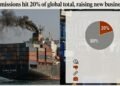
Greenhouse gas emissions embedded in international trade now account for more than one-fifth of global emissions, highlighting a growing gap between where goods are consumed and where the carbon costs of production are recorded.
Data from the European Climate Foundation (ECF) and climate consultancy Matière showed that trade-related emissions have risen 10 percentage points faster than global emissions since 1995, underscoring the increasing carbon intensity of cross-border supply chains.
The organisations said more than one tonne of carbon dioxide equivalent (CO2e) out of every five tonnes emitted globally is generated in producing a good or service that is ultimately consumed in another country.
The scale of trade-linked emissions is now comparable to the combined emissions of the European Union, United States and Brazil, according to the newly developed traded emissions tracker.
The tracker covers 45 economies, including EU member states, all G20 countries such as China and India, as well as a “rest of the world” category, with data available by country, sector and greenhouse gas for 2010 to 2023.
International trade is emerging as a major blind spot in Europe’s decarbonisation efforts, with imported emissions accounting for more than one-third of the EU’s carbon footprint in 2023.
The share has increased by seven percentage points since 2015, even as the bloc reduced its territorial emissions. Sweden, Austria and Spain recorded an even higher exposure, with imported emissions exceeding 40 percent of their carbon footprints.
The figures indicate that the environmental cost of consumption is increasingly being transferred across borders, creating new challenges for governments, businesses and investors seeking to measure the true carbon intensity of economic activity.
The ECF and Matière said the trend reinforces the need to decarbonise international trade and strengthen efforts to account for emissions embedded in global supply chains.
Richard Baron, director of industrial policy and trade at the ECF, said the tracker provides a mechanism for countries to measure the emissions generated elsewhere to satisfy domestic consumption and assess what action can be taken to reduce them.
“We’ve seen global emissions of greenhouse gases rise. We’ve seen traded emissions rise faster,” Baron told GTR, warning that governments would increasingly face pressure to account not only for domestic emissions but also for the carbon embedded in imported goods.
He described the resulting policy discussion as potentially “uncomfortable”, particularly as countries confront the environmental consequences of their consumption and supply chains.
Carbon content emerges as new trade battleground
No country has yet established a formal target for cutting imported emissions, although that position is beginning to shift.
France, Denmark and the Netherlands have announced plans to incorporate imported emissions into national climate policies, signalling a potential new phase in climate-related trade regulation.
The ECF and Matière said cooperation between trading partners could offer the greatest opportunity to reduce emissions associated with international commerce, particularly by establishing comparable methods for measuring carbon content.
A potential framework between the EU and China, for instance, could translate the carbon-accounting methodology used by one market into criteria recognised by the other.
Such an arrangement could influence trade flows responsible for around 7 percent of global emissions, the organisations said.
Baron said the absence of a common approach to measuring the carbon content of traded goods remains a major obstacle.
He argued that while domestic climate policies would inevitably differ between countries, mechanisms were needed to translate carbon measurements across jurisdictions so that the emissions embedded in exported products could be consistently understood by importing markets.
EU carbon rules raise pressure on exporters
The emerging policy response could increasingly make access to major markets conditional on the carbon content of imported goods.
The ECF pointed to the EU’s Carbon Border Adjustment Mechanism (CBAM) and EU Deforestation Regulation as existing instruments that could be expanded or built upon to strengthen climate-related trade requirements.
Baron said the nature of competition was changing as carbon content became increasingly integrated into trade decisions, potentially prompting stronger responses from financial institutions and the wider business community.
Upcoming European legislation could add further pressure.
The EU’s Methane Regulation is due to require importers, from August 5, 2028, to report the methane intensity of oil, gas and coal brought into the European market.
Meanwhile, the European Commission has proposed an Industrial Accelerator Act, aimed at ensuring manufacturing accounts for 20 percent of EU GDP by 2035.
The decarbonisation of trade is creating a new layer of commercial risk for exporters to Europe, where carbon performance could increasingly influence market access, the cost and availability of finance, and competitive positioning.
That development is likely to have consequences beyond the European market as governments seek to reconcile trade policy with increasingly ambitious climate objectives.
The direction of travel was reinforced in May when governments meeting at a global diplomatic forum in Santa Marta, Colombia, agreed to map pathways towards a fossil-fuel-free trading system amid efforts to transition away from coal, oil and gas.
The growing volume of emissions embedded in cross-border commerce indicates that climate targets can no longer be assessed solely through territorial emissions. Increasingly, policymakers will have to account for the carbon footprint of the products and services consumed across borders.