
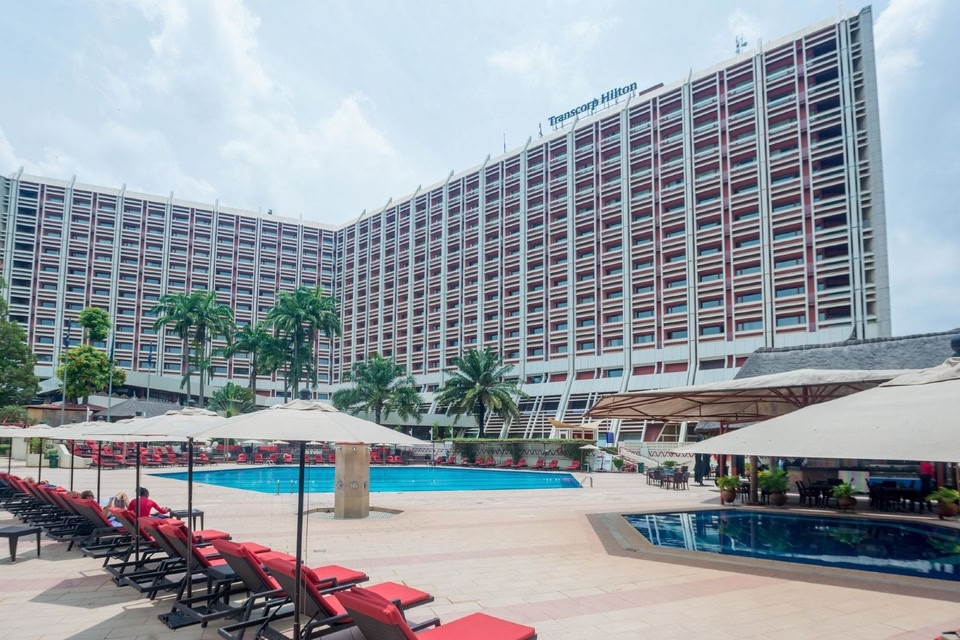
Transcorp Hotels Plc is facing its first major revenue setback after five years of strong growth, as weaker demand across rooms, food and beverages and event services pushed half-year sales down 5.3 per cent despite a rise in profit.
The hospitality company reported ₦44.4 billion in revenue for the six months ended June 2026, down from about ₦47 billion in the corresponding period of 2025.
The decline marks a reversal for a business that had sustained strong top-line growth since returning to profitability in 2021. Revenue had risen 38 per cent to ₦97 billion in full-year 2025, but momentum weakened sharply in the first half of 2026.
First-quarter revenue increased only 8.6 per cent year-on-year to ₦22.4 billion before revenue fell 15 per cent year-on-year to ₦22 billion in the second quarter.
Management attributed the softer performance to weaker market demand, particularly the impact of the Middle East crises on international travel.
The revenue slowdown has not, however, translated into weaker earnings.
Transcorp Hotels’ after-tax profit rose 21.4 per cent to ₦10.5 billion in the first half, extending the company’s profitability streak despite the contraction in sales.
The earnings performance was driven principally by aggressive cost management.
Gross profit declined 4.5 per cent to ₦34 billion as the cost of sales fell by about 8 per cent, a reduction that exceeded the decline in revenue.
The larger savings came from operating expenses, which dropped 12.8 per cent year-on-year to ₦19.4 billion.
The roughly ₦3 billion reduction in operating expenses was enough to more than offset the decline in gross profit, pushing operating profit up 7.3 per cent to ₦14.8 billion.
Financing activities provided another boost to the bottom line.
Finance income jumped from ₦325 million in the corresponding period of 2025 to almost ₦2 billion, helping reduce net finance costs from ₦1.5 billion to about ₦1 billion.
The company’s interest-bearing debt rose from ₦10.4 billion at the end of 2025 to more than ₦51 billion by June 2026, representing an increase of almost five times within six months.
Pre-tax profit rose 12 per cent to ₦13.7 billion, while a reduction in income tax expense from ₦3.5 billion to slightly above ₦3 billion provided an additional lift to net earnings.
After-tax profit consequently increased 21.4 per cent to ₦10.5 billion.
But the pace of earnings growth is already slowing compared with the company’s 2025 performance.
For the full year 2025, Transcorp Hotels increased after-tax profit by 47 per cent to nearly ₦22 billion.
Earnings per share increased to ₦1.03, from 85 kobo in the prior-year period.
The company also declared an interim cash dividend of 10 kobo per share, maintaining returns to shareholders despite the weaker revenue environment.
The dividend, however, comes at a time when the balance sheet is carrying substantially more debt, raising questions about the competing demands of shareholder distributions, capital expenditure and debt servicing.
The key question for Transcorp Hotels in the second half of 2026 is whether cost savings can continue to compensate for weaker revenue.
The company’s recent growth has been underpinned by strong increases in sales and profitability. The first-half results suggest that this formula is now being tested by softer demand and external shocks to international travel.
The decline in rooms, food and beverage and event-centre revenue also points to pressure across multiple operating segments rather than a weakness confined to a single business line.
While management has showcased an ability to protect margins through cost control, sustained earnings growth will ultimately require a recovery in revenue.
The rise in interest-bearing debt is emerging as a new pressure point for Transcorp Hotels, particularly if weaker revenue growth persists into the second half of 2026.
With sales momentum slowing, a sustained increase in financing costs could limit the company’s ability to generate further profit growth through cost-cutting alone.
Transcorp Hotels has so far managed to deliver the unusual combination of declining revenue and stronger earnings, with operating profit and net profit rising despite the top-line setback.
Whether that performance can continue will depend increasingly on a recovery in demand, tighter management of its enlarged debt position and a return to revenue growth in the second half of the year.








Worldbuilding: Your content calendar is orchestra, not theatre