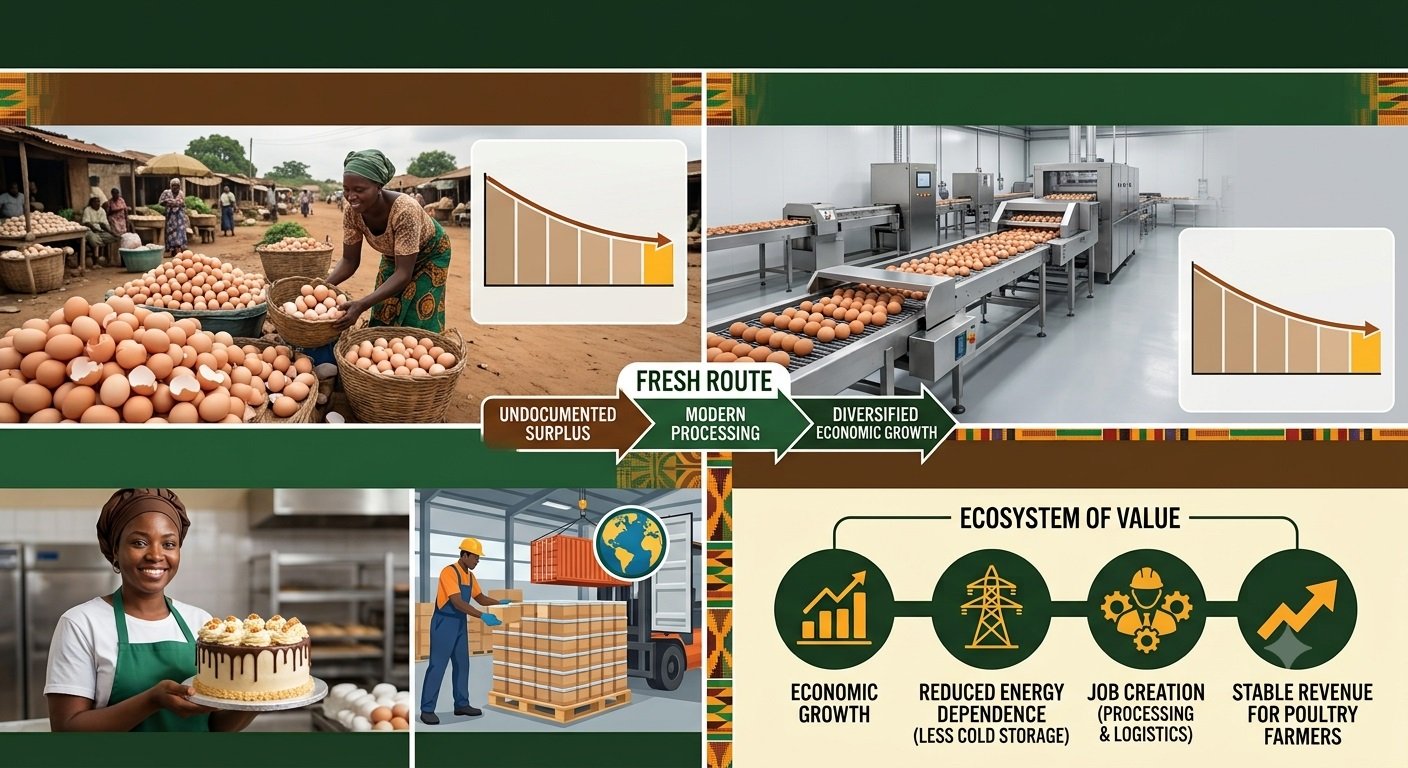
Nigeria, Africa’s largest egg-producing nation is leaving billions of naira on the table every year as inadequate investment in egg processing, weak industrial infrastructure and poor value-chain integration prevent the country’s poultry industry from transforming surplus eggs into high-value products capable of generating export earnings, creating jobs and reducing import dependence.
Despite producing more than 650,000 tonnes of eggs annually, Nigeria continues to import substantial quantities of egg powder for use in food manufacturing, pharmaceuticals, cosmetics and other industrial applications, highlighting what industry stakeholders describe as one of the country’s most overlooked agro-processing opportunities.
Industry experts argue that while poultry farming has expanded significantly over the past two decades, investment has remained concentrated at the production stage, with little attention paid to downstream processing capable of transforming eggs into products with significantly higher commercial value and longer shelf lives.
The result is an industry where farmers frequently experience seasonal gluts, dispose of unsold eggs at considerable financial losses and miss opportunities to participate in a rapidly expanding global egg powder and eggshell products market valued at hundreds of millions of dollars.
Nigeria occupies a dominant position in Africa’s poultry industry. Industry estimates rank the country as the continent’s largest producer of table eggs, supplying hundreds of thousands of tonnes annually to domestic consumers. Yet despite this production advantage, local manufacturers continue spending an estimated N1 billion annually importing egg powder used across multiple industries.
The All Farmers Association of Nigeria (AFAN) describes the situation as a significant economic contradiction.
According to the association, Nigeria possesses sufficient production capacity not only to satisfy domestic industrial demand for egg powder but also to develop an export-oriented processing industry capable of serving regional and international markets.
Instead, much of the country’s production continues to be consumed only in its fresh form, while excess supplies frequently deteriorate during periods of oversupply because of inadequate processing facilities.
Waste becomes a lost industry
Across Nigeria’s poultry value chain, millions of eggshells are discarded daily as waste despite growing international demand for processed eggshell products across food manufacturing, pharmaceuticals, cosmetics, nutraceuticals and industrial production.
According to Obaloluwa Akintola, general manager of Y2F Farms & Agro-services in Ibadan, the widespread perception that eggshells have little economic value continues to prevent the emergence of an entirely new manufacturing subsector.
He noted that eggshell powder alone possesses extensive commercial applications far beyond conventional food processing.
Produced by crushing and processing eggshells into fine powder, the material serves as a rich natural source of calcium and minerals used in food fortification.
Manufacturers incorporate eggshell powder into noodles, biscuits, cakes, doughnuts, confectioneries, ice cream and other processed foods.
Beyond food production, processed eggshells also serve as raw materials for pharmaceutical products, cosmetics, nutraceutical supplements, paper manufacturing, industrial paints and specialised chemical formulations.
Because eggshell powder possesses a shelf life ranging from five to ten years under appropriate storage conditions, it offers considerable commercial advantages compared with fresh eggs, which require continuous refrigeration and have limited storage periods.
Its portability, durability and industrial versatility have transformed eggshells into valuable export commodities in several advanced economies.
Industry observers argue that Nigeria’s failure to commercialise eggshell processing represents yet another example of untapped agricultural value addition.
Egg powder market expands globally
Global demand for egg powder continues to strengthen as urbanisation, changing consumer lifestyles and industrial food production increase worldwide.
Unlike fresh eggs, powdered eggs offer longer shelf lives, lower transportation costs and greater convenience for industrial users.
Food manufacturers, beverage producers, bakeries and confectionery companies increasingly rely on egg powder because of its consistency, ease of storage and production efficiency.
Beyond food manufacturing, egg powder has become an important ingredient across pharmaceuticals, cosmetics, animal nutrition and infant food production.
The pharmaceutical sector uses egg-derived ingredients in the manufacture of vaccines, including influenza, yellow fever and measles-mumps-rubella (MMR) vaccines.
Growing industrial demand has created an expanding international market.
Market research indicates that the global eggshell membrane market reached $190.46 million in 2025 and is projected to grow to $434.62 million by 2034, representing an annual compound growth rate of 9.6 percent.
Industry reports identify Germany, Austria, the Netherlands and South Korea among important international markets offering export opportunities for processed egg products.
From agricultural surplus to industrial raw material
Agricultural economists argue that converting fresh eggs into powder fundamentally changes the economics of poultry production.
Fresh eggs remain highly perishable and vulnerable to seasonal oversupply.
When production exceeds immediate market demand, prices collapse, forcing farmers either to accept significant financial losses or dispose of unsold inventories.
Egg powder largely eliminates this challenge.
Processing surplus eggs extends product shelf life from weeks to several years while creating access to industrial buyers operating throughout the year.
Professor Funso Sonaiya, an animal science expert at Obafemi Awolowo University, believes industrial egg processing could fundamentally reshape Nigeria’s poultry economy.
According to him, developing large-scale egg powder manufacturing would provide farmers with reliable off-take markets during periods of excess production while reducing recurring cycles of gluts.
He argues that stronger downstream demand would encourage additional investment across poultry production, processing, logistics and export activities while generating employment throughout the agricultural value chain.
The result would be higher rural incomes, increased private investment and stronger agricultural industrialisation.
Unlike many advanced manufacturing industries, egg powder production relies on well-established technologies already deployed successfully across numerous countries.
Industry experts identify spray drying as the most widely adopted commercial production method.
The process involves pasteurising liquid eggs before rapidly exposing atomised droplets to hot air, removing moisture while preserving nutritional properties.
The resulting powder retains many characteristics of fresh eggs while offering dramatically improved storage stability.
Alternative dehydration techniques also exist.
These methods remove moisture through carefully controlled heating processes that preserve the eggs’ functional properties for industrial use.
ScienceDirect also identifies freeze drying as an emerging technology.
Under this method, eggs are first frozen before moisture is removed through vacuum sublimation, producing premium-quality powder with minimal nutrient loss.
Although freeze drying remains more expensive than spray drying, it has gained popularity in advanced food-processing industries, particularly in the United States.
Industry analysts note that the technology itself no longer represents the principal barrier. Rather, the challenge lies in establishing commercially viable production facilities capable of processing sufficient volumes to achieve economies of scale.
Few processors, large opportunity
Nigeria’s industrial egg powder sector remains remarkably small relative to its poultry production capacity.
Only a handful of companies currently operate commercial egg powder facilities.
Among the most prominent are Answer Industries Limited in Ogun State and Greenfield Assets Limited in Ondo State.
Industry estimates indicate that local production currently satisfies less than 10 percent of domestic industrial demand.
Consequently, food manufacturers, pharmaceutical companies and industrial users continue relying heavily on imported egg powder.
This dependence increases production costs while placing additional pressure on Nigeria’s foreign exchange reserves.
According to Samuel Shewoniku, director of operations at Answer Industries Limited, commercial egg powder production follows rigorous quality-control procedures beginning with candling, where defective eggs are removed before mechanical cracking.
The liquid eggs are subsequently pasteurised before entering industrial dryers that convert them into powder meeting commercial standards.
He believes Nigeria possesses sufficient raw materials to expand production substantially provided appropriate investment and policy support become available.
Infrastructure constrains industrial growth
Despite the commercial potential, industry stakeholders identify infrastructure as the single greatest obstacle to expansion.
Reliable electricity remains particularly critical because egg powder manufacturing depends on continuous operation of sophisticated drying equipment.
According to Folorunsho Ogunnaike, founder of Full-Hope Farms in Ibadan, dependence on diesel-powered generators increases production costs, making many prospective investments commercially unattractive.
Energy costs already constitute one of the largest operating expenses confronting Nigerian manufacturers.
For energy-intensive food-processing industries such as egg powder production, unreliable electricity substantially reduces competitiveness relative to imported products.
Logistics, transportation infrastructure and cold-chain limitations create additional operational challenges.
Because fresh eggs remain perishable before processing, inefficient transportation networks increase spoilage risks while limiting the geographical areas from which processors can economically source raw materials.
Limited access to affordable long-term financing further constrains investment in specialised processing equipment requiring substantial upfront capital expenditure.
Lagos seeks processing solution
Recognising these challenges, poultry farmers have intensified calls for greater government intervention.
During the recent annual summit of the Poultry Association of Nigeria (PAN), Lagos State Chapter, farmers appealed to the Lagos State Government to accelerate completion of a planned egg powder processing facility.
According to Mojeed Iyiola, PAN Lagos Chairman, many farms currently destroy hundreds of eggs daily because market demand cannot absorb temporary production surpluses.
He described the proposed processing plant as an essential mechanism for stabilising prices while preserving excess production.
Rather than allowing surplus eggs to spoil, processing would create longer-lasting products suitable for domestic industrial use and eventual export.
Iyiola noted that expanded adoption of modern technologies throughout poultry farming also remains essential for improving productivity and profitability.
The association has consequently expanded farmer training programmes focusing on global best practices, mechanisation and technology adoption.