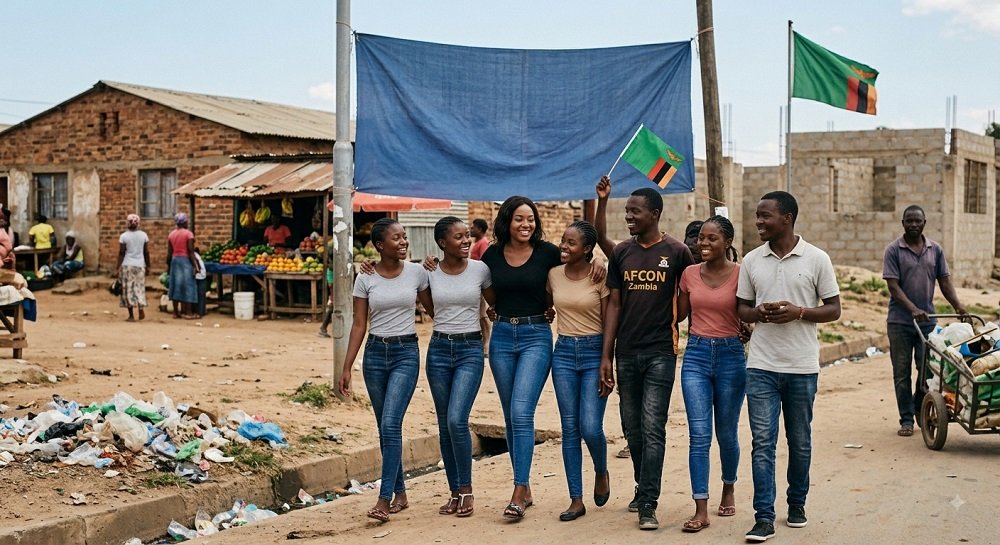
- Country’s youths exhibit high confidence, not willing to emigrate
- Prefer democracy over other government forms
- Zambia expression sharply contrasts with Nigeria’s youth with high emigration tendency
Young Zambians are becoming increasingly confident about their country’s economic and political direction, with a rise in optimism, stronger support for democracy and declining interest in emigration pointing to a potentially more favourable environment for domestic investment and entrepreneurship.
The African Youth Survey 2026, commissioned by the Ichikowitz Family Foundation and conducted by global research firm PSB Insights, found that 55 percent of Zambian youths believe the country is heading in the right direction, up from 23 percent in 2024 and just 10 percent in 2022.
Confidence in the economy has risen at a similar pace. 55 percent of respondents said Zambia’s economy was moving in the right direction, compared with 17 percent two years earlier and a Sub-Saharan African average of 45 percent.
The survey, released ahead of International Youth Day, found that only 27 percent of young Zambians are likely to leave the country within the next three years, down from more than half in 2024.
Security confidence strengthens investment outlook
Security emerged as one of the strongest areas of confidence among Zambian youths.
About 92 percent said they feel safe in Zambia, the second-highest result among the 16 countries covered by the 2026 survey and significantly above the Sub-Saharan African average of 70 percent.
Another 74 percent said they were treated fairly and with respect by police and security services.
Support for democratic government is also strong. Eighty-three percent of young Zambians said democracy is preferable to any other form of government, placing the country among the strongest performers on the measure in the 2026 survey.
Optimism meets economic pressure
The increasingly positive outlook does not mean that Zambia’s young population is insulated from economic hardship.
The survey identified the rising cost of living, cited by 37 percent of respondents, as the event that had the greatest impact on young Zambians over the past five years. Death from infectious diseases ranked second at 19 percent.
The World Bank has separately identified widespread poverty, economic vulnerability, high living costs and elevated public debt as major challenges for Zambia, with close to 60 percent of the population living below the poverty line, particularly in rural areas.
Official unemployment has nevertheless improved, with the Zambia Statistics Agency reporting a rate of 9.9 percent, down from previously recorded levels above 12 percent.
Jobs, capital become youth priorities
The survey found that young Zambians are particularly focused on economic opportunity.
Two-thirds of respondents identified job creation for young people as the single most important driver of national security, while access to basic services and well-paying employment ranked among their leading priorities for Africa’s development.
Ivor Ichikowitz, chairman of the Ichikowitz Family Foundation, said the findings reflected a form of optimism rooted in economic ambition rather than passive confidence.
“What we are seeing among young Zambians is a powerful expression of Afro-optimism.
“They are looking at their future with greater confidence, but this is not passive optimism. It is an optimism expressed through ambition — through entrepreneurship, education, technology and a desire to build their futures at home,” he stated.
The survey also points to strong expectations around access to capital and business opportunities, suggesting that the private sector could play a significant role in translating youth optimism into economic activity.
Natural resources remain central to investment expectations
Zambia’s young population also appears to be taking a pragmatic approach to the country’s natural-resource wealth.
Nearly eight in 10 respondents said they want Zambia’s natural resources to be managed responsibly.
When assessing international partners, respondents placed investment in infrastructure and the wider economy, together with respect for Zambia’s natural resources, among their most important considerations.
Ichikowitz said young Zambians wanted to participate directly in the country’s economic transformation.
“Zambia’s young people are pragmatic, ambitious and increasingly confident in their country’s future. They are not asking to be spectators in that future. They want to build businesses, create jobs, embrace technology and ensure that Zambia’s natural resources create opportunity for generations to come,” he said.
A changing African youth outlook
The 2026 African Youth Survey is the fourth edition of the study since 2020. It draws on 4,897 face-to-face interviews with people aged 18 to 24 across 16 African countries, bringing the total number of young Africans surveyed across editions to almost 19,000 in 28 countries.