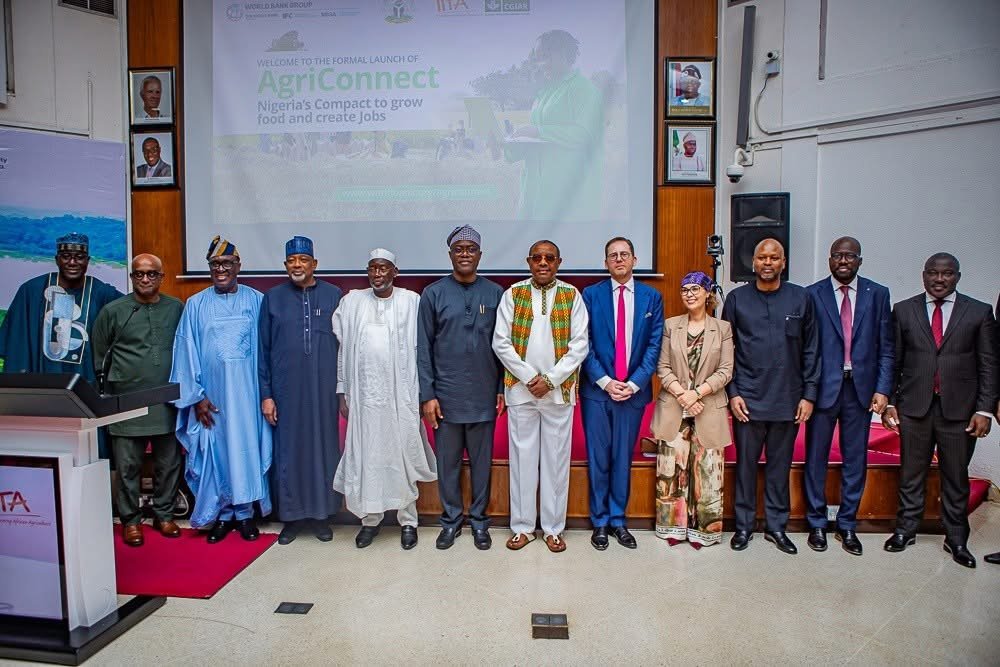
Nigeria has launched a $5 billion agricultural investment framework designed to attract private capital into priority value chains, create more than 2.5 million jobs and improve food and nutrition security for nearly three million people over the next five years.
The Nigeria AgriConnect Compact, launched by the International Fund for Agricultural Development (IFAD), the Federal Ministry of Agriculture and Food Security (FMAFS), the World Bank Group and development partners, seeks to shift smallholder farmers from subsistence production towards commercially integrated agriculture.
Under the Compact, government, development partners and private investors are expected to mobilise an estimated $5 billion over five years to strengthen smallholder productivity, advance policy reforms and expand access to credit, insurance and blended finance for farmers and agribusinesses.
Mohamed El-Ghazaly, IFAD country director for Nigeria, said the organisation would focus on strengthening farmer organisations, improving post-harvest management and building commercial connections between producers and markets.
“As the only international financial institution exclusively focused on rural transformation, IFAD brings a distinct contribution to AgriConnect by working with smallholder farmers at the first mile of food systems,” El-Ghazaly said.
He said the initiative would allow IFAD to deepen its partnership with Nigeria and expand support for smallholder farmers.
The Compact represents a move towards a more integrated financing model for Nigeria’s agriculture sector, combining public resources, development finance and private investment.
The World Bank Group’s AgriConnect initiative is designed to help smallholder farmers transition from subsistence to surplus production through stronger farmer organisations, improved market access, digital solutions, finance and increased private-sector participation.
The $5 billion financing target is therefore expected to support not only agricultural production but also the wider ecosystem required to move food from farms to markets.
This includes access to affordable credit and insurance, post-harvest management, market integration and investment across agricultural value chains.
The launch comes against a backdrop of significant food-security pressures.
About 31 million Nigerians are facing acute food insecurity, with inflation, insecurity and climate-related shocks among the factors affecting household access to food.
At the same time, about half of Nigeria’s estimated 37 million hectares of arable land is reportedly underutilised, highlighting the gap between the country’s agricultural potential and actual production.
The Compact is consequently intended to raise productivity while bringing more farmers and agribusinesses into formal value chains.
Higher agricultural output would also potentially strengthen domestic food supply, reduce pressure from food imports and improve opportunities for rural employment and incomes.
IFAD builds on $392m Nigeria portfolio
IFAD’s participation builds on an existing portfolio of agricultural and rural-development programmes in Nigeria.
Its current interventions include the Value Chain Development Programme (VCDP), the Livelihood Improvement Family Enterprises Project in the Niger Delta (LIFE-ND), and the forthcoming Value Chain Programme in Northern Nigeria (VCN).
Together, the programmes represent close to $392 million in IFAD financing commitments.
The organisation said its role under AgriConnect would focus particularly on the “first mile” of food systems, where smallholder farmers require stronger collective structures, better post-harvest systems and reliable commercial channels to participate effectively in agricultural markets.
Beyond food production, job creation is a major component of the Compact, with a target of more than 2.5 million jobs over five years.
The employment potential extends beyond farming to processing, logistics, storage, input supply, financial services, technology and other activities linked to agricultural value chains.
The strategy reflects an effort to reposition agriculture from predominantly subsistence activity towards a more commercially integrated sector capable of attracting investment and supporting economic diversification.
The success of the Compact will, however, depend on the ability to translate financing commitments into productive investment, improve access to affordable capital and resolve infrastructure, security and market-access constraints that continue to weigh on agricultural productivity.
With the government and development partners seeking to crowd in private investment, the initiative places greater emphasis on building an agricultural ecosystem in which farmers can produce at scale, access finance and sell into predictable markets.