
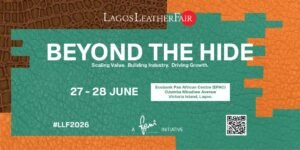
The Lagos Leather Fair 2026 (LLF2026), is set to return for its ninth edition with a renewed focus on industrialisation, value chain development, and global competitiveness, further positioning Africa’s leather industry within the continent’s creative and manufacturing economy.
Scheduled for June 27–28, 2026, at the Ecobank Pan African Centre, the event marks a significant moment for what has evolved from a niche exhibition into one of Africa’s most influential platforms for leather innovation, enterprise development, and cross-border industry collaboration.
Since its launch in 2017, the fair has recorded over 25,000 visitors and hosted more than 300 exhibitors, while participating brands have reported revenue growth ranging between 50 percent and 200 percent; metrics that signal both rising demand and the growing commercial viability of African leather goods.
A major highlight of the 2026 edition is the partnership with Ecobank Nigeria, which comes on board as the official host and partner. The collaboration reflects increasing institutional interest in the continent’s creative manufacturing sector, particularly as financial institutions expand their role in supporting small and medium-sized enterprises (SMEs) with growth potential.
Femi Olayebi, founder of the fair, described the upcoming edition as a defining moment in the platform’s evolution, noting that the industry is transitioning from promise to performance.
“LLF was born out of both frustration and possibility -frustration with the structural gaps holding the industry back, and a firm belief in the immense, untapped potential of the African leather ecosystem. For nearly a decade, we have worked to change the narrative. LLF2026 is a bold declaration that we are moving beyond raw potential into structured growth. It is a space where artistry meets strategy, where creativity is sharpened by business acumen, and where we provide our designers with the tools to not just survive, but to compete and thrive on a global scale,” she stated.
The 2026 event is themed “Beyond the Hide: Scaling Value. Building Industry. Driving Growth”. Rather than focusing solely on leather as a raw material, the fair aims to reposition it as a multi-billion-dollar value chain encompassing sourcing, processing, manufacturing, branding, and export.
LLF2026 will feature a curated selection of designers and manufacturers from across Africa, showcasing a wide spectrum of products ranging from footwear and handbags to furniture, apparel, and industrial materials. Beyond product displays, the fair will host a series of high-level conversations focused on collaboration, regulatory frameworks, and export readiness. These sessions are expected to address key barriers such as compliance with international standards, logistics constraints, and access to global markets.
Workshops will provide hands-on training in areas such as sustainable production, digital tools, and emerging manufacturing technologies, equipping participants with the technical capabilities required to compete in an increasingly sophisticated global market.
One of the standout features of the event is the Signature Piece Challenge, which invites designers to showcase their highest level of craftsmanship through original works spanning multiple categories. The initiative is aimed at elevating design standards while providing a platform for emerging talent to gain visibility among investors and international buyers.
ALSO :CBN allots N894bn in T-Bills auction as demand hits N2.36trn
The runway shows, another central attraction, will highlight both established and emerging designers, reinforcing leather’s versatility as both a functional material and a high-fashion medium.
Interactive elements such as The Maker’s Bench and the LLF Atelier will further deepen engagement by offering live demonstrations of the production process. In partnership with Ananse Centre for Design, the Atelier will function as a mini manufacturing hub, giving attendees real-time insight into how raw materials are transformed into finished goods.
The awards segment of the fair will recognise outstanding contributions within the industry, celebrating innovation, craftsmanship, and leadership.
More than an event, it has become a convening force, bringing together designers, manufacturers, suppliers, policymakers, and investors under one roof. By highlighting both the challenges and opportunities within the sector, LLF set out to bridge gaps, strengthen linkages, and position Nigerian and African leather as a competitive force on the global stage.
Beyond the immediate commercial impact, LLF2026 is expected to contribute to a larger narrative around Africa’s industrial future. As global supply chains continue to evolve, there is increasing interest in diversifying sourcing locations and supporting regional manufacturing hubs.
Register to attend for the fair at www.lagosleatherfair.com








This government must not raid investors’ money