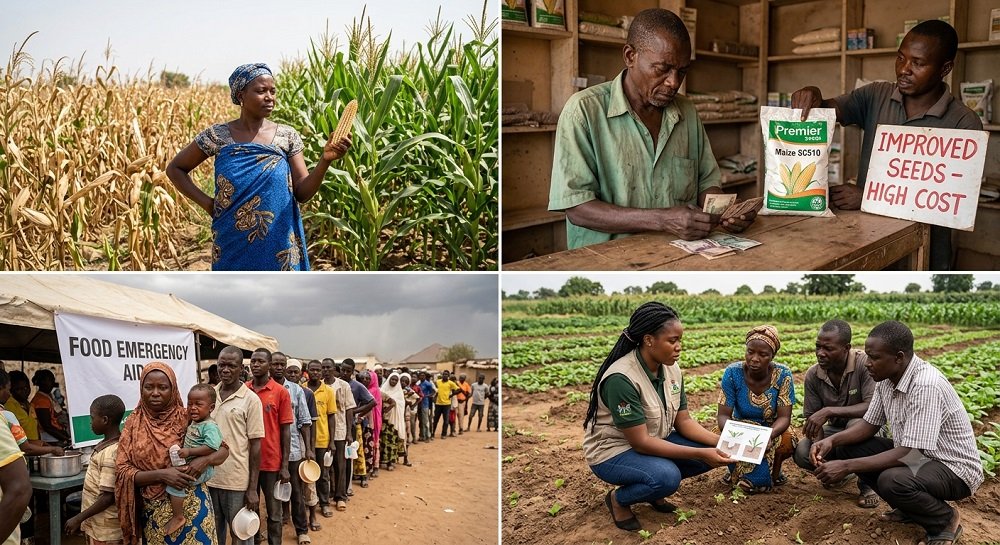
For millions of Nigerian farming households, the difference between a good harvest and another season of hardship may begin with something as small as a seed. Yet despite years of agricultural research, public investment and repeated campaigns to raise productivity, fewer than one in three farmers is estimated to be using improved seed varieties.
That low adoption rate has triggered fresh concern among agricultural experts, policymakers and farmers, who warn that Nigeria’s food security challenge cannot be solved by producing new crop varieties alone if those seeds do not reach the farmers who need them or if farmers cannot afford to plant them.
Stakeholders at a recently concluded meeting on new seed varieties and their effects on Nigerian farm households in Abuja, said improved seed adoption remains below 30 percent, a level they described as inadequate for achieving meaningful improvements in agricultural productivity, food security and rural household welfare.
The meeting placed the seed question within an economic context.
Participants argued that the consequences of low adoption extend far beyond farm yields. Where farmers are unable to access productive, climate-resilient and certified seeds, the impact can be felt in household food availability, farm income, children’s education, labour decisions and the general welfare of rural families.
The concern comes at a time when Nigerian agriculture is under pressure from rising input costs, insecurity, climate variability and a growing need to produce more food from limited resources.
Aisha Abubakar, Leverhulme early career fellow and development economist, said a research project was examining how the adoption of improved seed varieties affects the welfare of smallholder farming households in Nigeria.
She said the research was designed to generate evidence that could guide policy and improve the uptake of improved seeds among farmers.
“We are still far from achieving the level of adoption we will like to see. At the moment, it is estimated that only about 30 per cent of farmers in Nigeria are using improved seeds, which shows there is still a long way to go,” Abubakar said.
A productivity problem disguised as a seed problem
For agricultural experts, the low adoption rate reflects a deeper weakness in Nigeria’s agricultural value chain.
The country has invested heavily in agricultural research and has developed improved crop varieties designed to deliver better yields and greater resilience against pests, diseases and climate stress.
However, the existence of improved varieties has not automatically translated into widespread use.
Dahiru Rabiu, a staff member of the National Agricultural Seed Council (NASC),said discussions at the workshop had reaffirmed that improved seed adoption remained below 30 percent despite years of investment in agricultural research.
The challenge, he said, was becoming more complex as researchers faced growing pressure to develop climate-smart crop varieties capable of withstanding drought, pests and diseases.
That pressure reflects the changing risk profile of farming. Farmers are increasingly operating in an environment where weather patterns are less predictable, input costs are rising and the consequences of crop failure are becoming more severe.
Improved seeds, in that context, are not simply an agricultural technology. They are increasingly being viewed as an important component of climate adaptation and food security.
But for improved varieties to deliver that benefit, farmers must be able to obtain the right seeds, understand how to use them and have access to the complementary inputs and information required to achieve their potential.
Extension services emerge as critical missing link
One of the strongest areas of consensus at the meeting was the need to rebuild and strengthen agricultural extension services.
Kechi Amangbo, founder of Terragrow Commodities Limited, said farmers needed access to the right seed varieties, supported by effective extension services and incentives that would empower them rather than create dependence.
“I would like to see incentives that give farmers more power and greater leverage, not those that take power away from them,” she said.
Amangbo described extension services as the backbone of improved seed adoption, stressing that farmers needed direct, one-on-one engagement to understand the benefits of new technologies and how to use them properly.
That point is particularly important because improved seed varieties are not always interchangeable with traditional varieties.
Their performance may depend on planting conditions, soil characteristics, planting periods, agronomic practices and access to other inputs.
Without sufficient information, farmers may be reluctant to take the risk of abandoning familiar seed varieties, particularly where a failed harvest could threaten household income and food supply.
Stakeholders said many farmers remained cautious about replacing traditional seeds with improved varieties.
They called for more field demonstrations and practical campaigns to allow farmers to see the performance of improved seeds under local conditions.
The argument is that farmers are more likely to adopt technologies they can observe, test and understand than those introduced through information campaigns that do not sufficiently reflect their realities.
Agricultural stakeholder Zayyad Bello also called for improvements in extension services and last-mile delivery systems to ensure improved seeds reach farmers in rural communities.
He said strengthening advisory services and improving the distribution of certified seeds would significantly increase adoption rates and improve agricultural productivity.
The last-mile challenge
The distribution of improved seeds remains a major issue in a country where farming communities are often dispersed across difficult-to-reach rural areas.
Even when improved varieties are available in national or regional markets, farmers may struggle to access them at the right time and at prices they can afford.
The challenge is especially acute for smallholder farmers whose planting decisions are often determined by immediate cash availability.
A seed may be agronomically superior, but if it is unavailable when the planting season begins or costs significantly more than the farmer’s traditional alternative, adoption is likely to remain limited.
Stakeholders therefore argued that improving adoption would require more than producing additional seed varieties.
Affordability remains a major barrier
The cost of agricultural inputs was also identified as one of the factors discouraging farmers from investing in improved seeds and other productivity-enhancing technologies.
Household and food security specialist Chimaobi Okoye said insecurity, the rising cost of farm inputs and the influx of cheaper imported food products were major constraints discouraging investment in agriculture.
For farmers, the economics of seed adoption are straightforward.
The improved variety must offer a sufficiently attractive return to justify the additional cost and perceived risk.
Where farmers are already dealing with high fertiliser prices, expensive transportation, insecurity and uncertain market prices, the decision to purchase improved seeds can become difficult.
This is particularly true for subsistence-oriented farmers who have limited access to credit and may prioritise reducing immediate production costs over investing in technologies that could deliver higher returns later.
Stakeholders therefore called for policies that would make improved seeds more affordable without creating long-term dependence on government support.