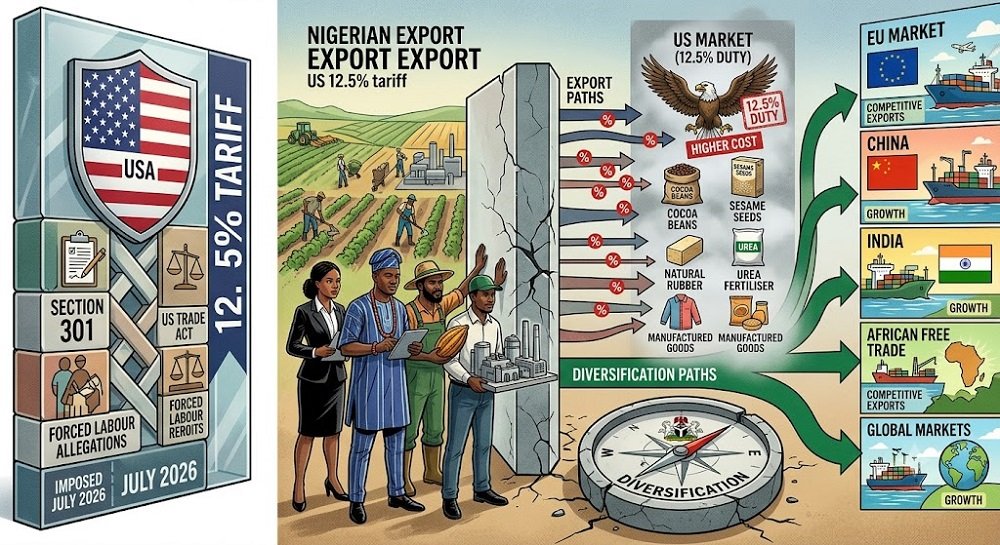
Nigeria’s exporters have been handed a fresh commercial headache as the United States imposes an additional 12.5 percent tariff on Nigerian imports, and analysts warn that the measure could squeeze business margins, weaken competitiveness and deepen uncertainty across the global trading system.
The tariff, which took effect on July 24, 2026, places Nigeria among 54 economies that the United States says have failed to establish and effectively enforce a prohibition on the importation of goods produced wholly or partly with forced labour.
For a country that is trying to expand exports, attract investment and reduce its dependence on crude oil, the timing of the measure could hardly be more sensitive. The US remains a significant destination for Nigerian petroleum products, agricultural commodities and processed foods, while Nigeria is simultaneously seeking to build new export capacity through investments in refining, manufacturing and agro-processing.
The measure was announced by the office of the United States Trade Representative (USTR) following a Section 301 investigation into the trade practices of 60 economies and their enforcement of restrictions on imports associated with forced labour.
Alongside Nigeria, the affected African countries are Algeria, Angola, Egypt, Libya, Mauritania, Morocco and South Africa.
The USTR said the countries had either failed to establish or effectively enforce laws preventing goods produced with forced labour from entering their domestic markets.
Unlike previous tariff measures aimed at reducing trade deficits or responding to perceived trade imbalances, the latest action is specifically tied to labour-related trade practices.
The USTR argues that countries that permit goods produced with forced labour to enter their markets gain an unfair competitive advantage because such goods can be produced at lower cost. According to the agency, this undermines fair competition, disadvantages American workers and businesses, and can divert goods produced without forced labour away from foreign markets and into the United States.
Jamieson Greer, US trade representative ambassador, defended the action as both a human rights measure and a trade enforcement instrument.
“President Trump recognises that decades of moral suasion have not eradicated forced labour from global supply chains.
“The United States has had a forced labour import ban for nearly a century, and rigorously enforces it; it’s well past time for our trading partners to do the same,” Greer stated.
Greer said the action would address what Washington considers both a human rights abuse and a distortive trade practice.
But in Nigeria, the response from analysts has been sharply critical, with the tariff being interpreted not merely as a labour enforcement measure but as another layer of uncertainty in the trade policy of President Donald Trump’s administration.
The analysts have raised questions about the economic rationale for the measure, its implications for Nigeria’s export earnings and the potential impact on businesses, especially small and medium-sized enterprises.
They have also pointed to a wider strategic challenge, as Nigeria may need to strengthen its labour and supply-chain enforcement systems while simultaneously reducing its dependence on any single export market.
Tariff rationale cannot be supported by data
Muda Yusuf, chief executive officer of the Centre for the Promotion of Private Enterprise (CPPE), said the justification for the new tariff was not adequately supported by data.
He described the latest measure as part of what he sees as a deliberate strategy by the Trump administration to penalise countries that maintain significant commercial relationships with China.
China is Nigeria’s largest source of non-oil imports, and Yusuf said that commercial relationships should be considered when assessing the implications of Washington’s tariff policies.
He said the new tariff could affect Nigeria’s trade position because a significant portion of the country’s exports, particularly oil and gas, is destined for the United States.
According to Yusuf, the central problem with the tariff is that it interferes with the commercial logic that ordinarily determines international trade.
Businesses, he said, make import and export decisions based on price, demand, quality and competitiveness. A government-imposed tariff changes those calculations by increasing the cost of access to a market.
He warned that the impact of the tariff on Nigerian exports could ultimately affect the country’s balance of trade.
Yusuf also said Nigeria should consider retaliatory measures against the United States, although he emphasised the need for the country to continue seeking alternative export markets.
“Our own approach should be to continue to look for multiple sources of export markets for our products. It is a question of diversifying our export destinations, he said.
Akpan Hogan Ekpo, chairman of the Foundation for Economic Research and Training in Lagos, described the tariff as another manifestation of what he called President Trump’s obsession with tariffs.
Ekpo said Trump appeared to be looking for new ways to sustain his tariff campaign after earlier measures faced legal challenges in the United States.
“The tariff does not make sense. It will only compound global uncertainties that were stoked by Trump’s war in Iran,” Ekpo said.
He warned that Nigeria could face additional revenue pressure because crude remains the country’s major export.
The Nigerian economy, he said, is still attempting to recover from earlier global shocks, and a new trade barrier could add another layer of pressure.
“Crude is our major export, so it will affect in a way that may create revenue problems for our economy that is trying to recover from earlier global shocks caused by Trump,” he said.
The implications, according to Ekpo, extend beyond large exporters and government revenue.
“It will increase the cost of doing business for the MSMEs, which are the engine for economic growth and job creation,” he added.
The concern is significant because small and medium-sized businesses generally have less financial capacity to absorb unexpected costs.
A large exporter may have the ability to renegotiate a contract, shift the destination of a shipment or absorb part of a tariff increase. A smaller exporter may have none of those options.
Ekpo therefore called for government intervention. “The government needs to step in and bridge that gap by providing a cushion for the MSMEs to ensure that the economy does not run aground,” he said.
Hope Uweja, vice president and chief engagement officer of the Africa Economic Forum, identified precisely this issue as one of Nigeria’s most significant vulnerabilities.
He said Nigeria’s challenge was not limited to determining whether forced labour was involved in the production of goods exported from the country.
The country must also be able to prove that goods entering Nigeria are not themselves produced with forced labour.
“The problem we have in this aspect for Nigeria is that you are looking not just at exports, but you also have to look at imports. Nigeria’s ability to track imports into Nigeria is a very difficult case for us to handle, and that can easily be capitalised on,” Uweja said.
Uweja further stated that the latest action must be viewed against the direction of Trump’s second-term economic policy.
According to him, the administration’s approach is driven by economic nationalism, reciprocity and efforts to reduce the US trade deficit.
“In his second term, it’s been driven by national economic nationalism, an attempt to reciprocate what other countries have been giving the United States in tariffs, and then, of course, it has been positioned in the United States to reduce their trade deficits,” Uweja said.
He observed that the Trump administration moved quickly after taking office, introducing tariff reviews and using US trade law to investigate the practices of foreign countries.
The application of Section 301, he said, creates uncertainty for trading partners because investigations can ultimately be shaped by the strategic interests of the United States.
“It is still left to the trade representative to determine the outcome, and once it reports to the United States, many times it takes into consideration the interest of the United States, not the interest of other countries,” he added.
That assessment raises an important question for Nigerian policymakers on whether the forced-labour issue is the entire reason for the tariff or whether it is part of a restructuring of US trade relationships.
The USTR insists that the measure is focused on forced labour and the distortion of competition. But critics argue that the tariff must be understood within the broader context of Trump’s use of trade policy to pursue economic and geopolitical objectives.
Yusuf, for example, believes the policy could be linked to the Trump administration’s efforts to pressure countries that maintain close commercial relationships with China.
Nigeria’s growing economic relationship with China is therefore relevant to the debate.
China is Nigeria’s largest source of non-oil imports, while Asian markets have become increasingly important destinations for Nigerian exports.
That makes Nigeria vulnerable to the competing economic interests of the United States and China.
Dough Brooks, international analyst and vice president for government relations at FGI Solutions, questioned the breadth of the forced-labour rationale used to justify the tariff.
He argued that the definition of forced labour could be interpreted too broadly and used to justify measures that go beyond the original labour concern.
“Labour, whatever he wants to describe as forced labour, and he’s hit much of the world with his 12.5 percent tariff. It’s kind of crazy. This will probably also be struck down by the courts at some point,” Brooks said.
He added that labour conditions should not automatically be classified as forced labour simply because wages are low or working conditions do not meet a particular standard.
“Labour is not necessarily forced labour simply because the minimum wage isn’t high enough in a country. There are different terms or different ways you can sort of spin this thing to justify a tariff, but it’s way too broad,” he said.
Brooks believes the wider issue is the expansion of presidential power over economic policy.
“Trump is trying to control, let’s say, more things than presidents have in the past. It’s something of an imperial presidency,” he remarked.
According to Brooks, decisions that would traditionally have been subject to broader congressional scrutiny and expert input are increasingly being made through executive action.
He said the political balance could change after the US midterm elections, particularly if Democrats gain control of one or both chambers of Congress.
“If the other party takes control of Congress, I think all these executive or imperial decisions, like the tariffs that Trump has been getting away with, all of a sudden the Congress is going to challenge him, and quite rightly so,” Brooks said.
A test for Nigeria’s trade policy
The new US tariff has forced a difficult question to the centre of Nigeria’s trade agenda: Can the country expand its exports without first fixing the regulatory weaknesses that increasingly determine access to global markets?
Nigeria wants more investment, greater export earnings and deeper integration into international supply chains. But its trading partners are demanding more than competitive prices and reliable supply.
Labour standards, traceability, environmental compliance and corporate governance are now becoming part of the price of entry.
For exporters, that could mean higher compliance costs and tighter margins. For the government, it means stronger enforcement systems are no longer simply regulatory ambitions but increasingly commercial necessities.
Uweja warned that Nigeria’s weak ability to track imports could expose the country to further scrutiny. Yusuf called for a challenge to the tariff and greater diversification of export markets. Ekpo urged the government to shield MSMEs from the impact of rising costs.
Tijani said exporters must strengthen labour-standard compliance if they want to qualify for better trade treatment, while Brooks warned that the US tariff regime could face further legal and political challenges over the growing concentration of executive power.