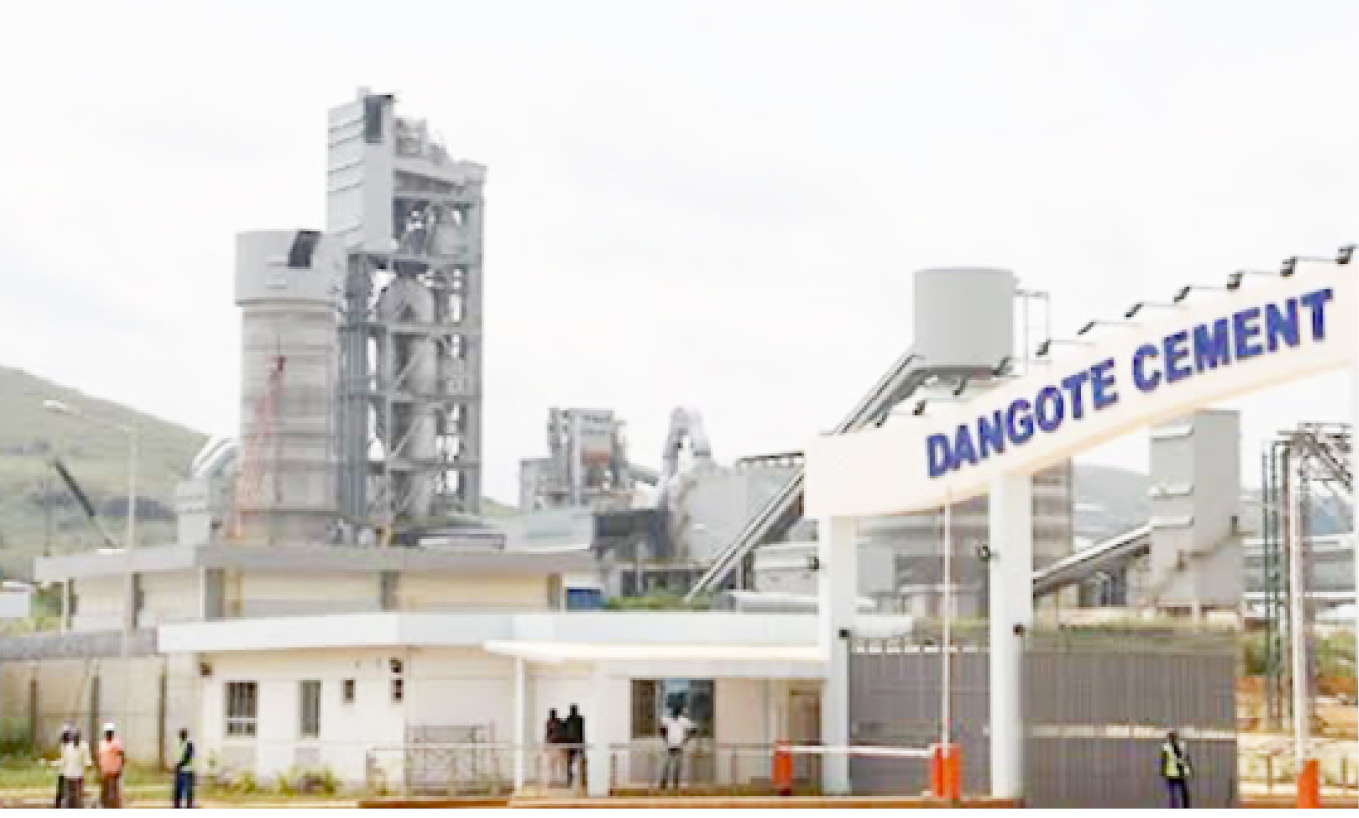
Dangote Cement Plc., Africa’s largest cement producer, converted lower financing costs into a powerful earnings boost in the first half of 2026, posting profit growth that outpaced sales despite continued pressure from fuel, power and haulage expenses.
The company’s unaudited financial statements filed with the Nigerian Exchange Limited (NGX) showed that profit before tax rose 34.43 per cent to N981.39 billion for the six months ended June 30, 2026, while net profit climbed 22.69 per cent to N638.53 billion, supported by robust domestic demand and easing foreign exchange-related financing costs.
The stronger bottom-line performance came as net finance costs almost halved to N112.11 billion, down from N216.16 billion in the corresponding period of 2025, reflecting lower foreign exchange losses and reduced interest expenses. The improvement amplified gains from higher sales across Nigeria and the company’s Pan-African operations.
Group revenue rose 21.35 per cent year-on-year to N2.514 trillion, compared with N2.072 trillion recorded in the first half of 2025, as sustained demand and operational efficiency continued to underpin growth across its markets.
Nigeria remained the company’s earnings engine, with domestic revenue increasing 25.17 per cent to N1.805 trillion from N1.442 trillion a year earlier. Local operations accounted for 9.70 million metric tonnes of the group’s total cement sales of 14.94 million metric tonnes, generating N1.086 trillion in earnings before interest, taxes, depreciation and amortisation (EBITDA).
Outside Nigeria, Dangote Cement’s Pan-African business maintained steady growth, posting revenue of N775.35 billion, a 13.67 per cent increase over the prior year, while contributing N136.57 billion to group EBITDA.
The strong top-line performance translated into broad-based earnings expansion. Gross profit increased 30.51 per cent to N1.590 trillion, while operating profit advanced 30.66 per cent to N1.060 trillion, underscoring the company’s ability to preserve margins despite inflationary pressures on input costs.
The performance extended into the second quarter, with revenue rising 22.19 per cent to N1.316 trillion between April and June, compared with N1.077 trillion in the same period last year. Quarterly profit before tax climbed 34.01 per cent to N560.22 billion, while net profit closed at N317.44 billion.
Although operating costs continued to rise, the pace remained well below revenue growth, allowing profitability to improve.
Cost of sales increased by 8.29 per cent to N924.31 billion, largely driven by fuel and power expenses of N384.49 billion and raw material costs of N225.41 billion. Selling and administrative expenses also reflected higher logistics costs, with haulage expenses climbing to N318.60 billion amid elevated transportation and energy prices.
The company also strengthened its financial position during the period. Total assets expanded 9.62 per cent to N6.622 trillion, while net assets rose 21.00 per cent to N3.170 trillion, reinforcing its balance sheet and enhancing capacity to fund future expansion.
Basic earnings per share rose 24.33 per cent to N38.22, reflecting the improvement in shareholder returns and reinforcing investor confidence in the company’s ability to sustain earnings growth despite a challenging operating environment.