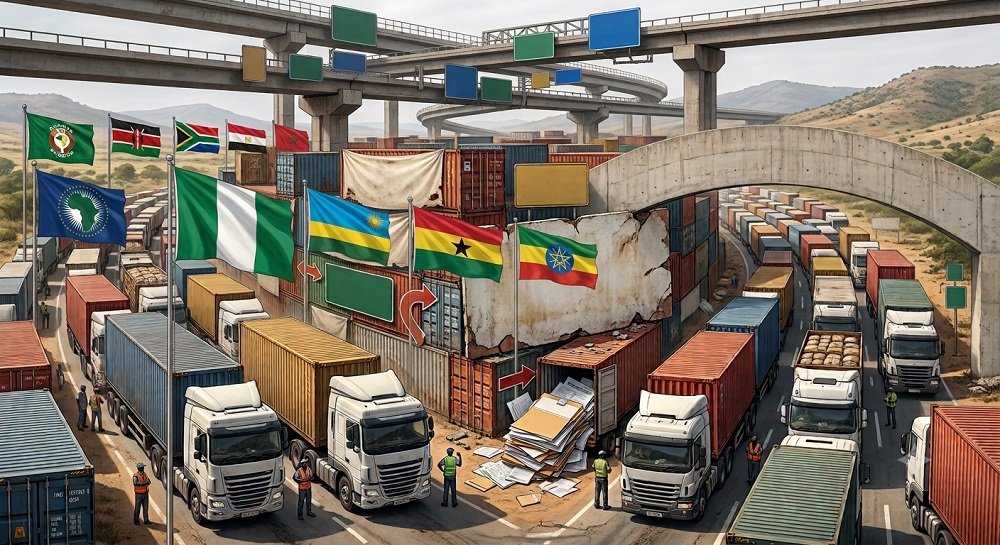
The promise of a borderless African market is colliding with the reality of Africa’s borders. While tariffs are gradually coming down under the African Continental Free Trade Area (AfCFTA), businesses still face a patchwork of permits, customs procedures, professional restrictions and legal uncertainties that threaten to slow the continent’s biggest economic integration project.
The AfCFTA promises access to a market of more than 1.4 billion people with a combined gross domestic product of about $3.4 trillion. Yet businesses seeking to take advantage of that opportunity continue to encounter a fragmented operating environment in which goods face cumbersome customs procedures, professionals struggle to obtain recognition across jurisdictions, and cross-border transactions remain exposed to insurance and legal uncertainties. The result is an African free trade project that is advancing on paper faster than it is integrating on the ground.
For Nigeria, Africa’s third largest economy and one of the continent’s biggest trading nations, the implications are particularly significant. This is as Nigerian manufacturers, exporters, service providers and small businesses seeking customers in neighbouring markets are finding that the cost of crossing borders extends well beyond tariffs.
The challenge is compounded by the limited implementation of the African Union’s Free Movement Protocol, which is intended to facilitate the movement of people across the continent.
Africa is opening its borders to more goods while keeping many of the people needed to move those goods across them constrained by permits, professional restrictions and regulatory barriers.
The disconnect is exposing a major fault line in the continent’s AfCFTA ambitions, where progress towards freer trade in goods and services is running ahead of efforts to enable the movement of workers, professionals, capital and expertise that make cross-border commerce possible.
The missing link in Africa’s free trade ambition
The AfCFTA is designed to reduce barriers to trade and create a single continental market. But trade integration cannot function efficiently if businesses remain unable to move employees, professional advisers and capital with comparable ease.
Africa may be moving towards a single market, but for many small businesses, the paperwork required to enter that market remains a formidable barrier.
Data cited by the Nigerian Export Promotion Council (NEPC) show that more than 65 percent of SMEs seeking to export goods or services within Africa consider legal and regulatory barriers their biggest constraint.
From customs clearance and export licences to product standards and compliance documentation, SMEs face layers of administrative requirements that can quickly raise the cost of cross-border trade. Large corporations can spread those costs across specialist legal, customs and compliance teams; smaller firms often cannot.
The regulatory squeeze does not stop at physical goods. Lawyers, consultants and other professionals face another layer of barriers as national qualification and licensing regimes restrict their ability to provide services across borders.
Nigerian-trained lawyers, for example, are likely to face additional qualification or accreditation requirements before they can provide services in another African jurisdiction, even where the countries share elements of their legal traditions.
This creates a cost and time barrier for companies seeking to operate across borders. For a Nigerian manufacturer expanding into another African market, the inability to quickly obtain local legal advice, negotiate contracts, establish a compliant business structure or resolve disputes can increase the cost and risk of investment.
Evans Ufeli, executive director of Cadrell Advocacy Centre, said Africa’s fragmented legal systems remained a major obstacle to deeper regional integration.He noted that the continent operates across common law, civil law and customary law traditions, with each country maintaining its own rules governing trade, taxation, employment and investment.
“The lack of harmonisation of laws creates unpredictability for both lawyers and SMEs involved in cross-border transactions,” Ufeli said.
Without appropriate legal support, he added, SMEs can struggle with customs procedures, compliance obligations and access to dispute-resolution mechanisms.
A Lagos Chamber of Commerce and Industry (LCCI) study found that only about 20 percent of SMEs involved in cross-border disputes successfully enforce contracts within a reasonable timeframe. For a small exporter operating on thin margins, a prolonged commercial dispute can effectively destroy the economics of a transaction.
Free movement is also an economic issue. The debate over the AU Free Movement Protocol is therefore increasingly becoming an economic rather than purely political question.
Insurance emerges as the next trade bottleneck
One of the less visible constraints to Africa’s trade ambitions is the ability to insure the growing volume of economic activity that AfCFTA is expected to generate.
Speaking at the recent 52nd Conference and Annual General Assembly of the African Insurance Organisation in Cairo, Kanayo Awani, executive vice president, Intra-African trade and export development at Afreximbank, warned that Africa could not achieve its single-market ambition without a stronger insurance industry.
“No nation can trade beyond the limits of its own capacity to carry risk,” Awani said.
She explained that cargoes need insurance before they can move, receivables need protection before they can be financed, while political and currency risks must be capable of being priced before major projects can reach financial close.
This becomes particularly important as African countries seek to expand infrastructure and regional value chains.
A factory supplying customers across several countries faces transport, political, currency, credit and operational risks that may not exist at the same scale in domestic commerce.
If local insurance companies cannot underwrite those risks, businesses must either pay higher premiums to foreign insurers or find other ways to absorb the exposure. Neither option strengthens Africa’s domestic financial system.
Insurance penetration across Africa remains only about two to three percent, well below the global average of 6.8 percent, according to figures cited by Awani.
The gap points to both a vulnerability and an opportunity. A deeper continental insurance market could mobilise more domestic capital, lower risk-management costs and provide financial support for infrastructure and trade projects. But achieving that requires regulators to address the fragmentation that currently characterises African insurance markets.
Awani warned that Africa could not build a single market while maintaining what she described as fragmented and undercapitalised pools of risk.
Different national insurance regulations can prevent insurers from operating seamlessly across borders and limit their ability to achieve the scale necessary to underwrite major projects. This is particularly problematic for infrastructure.
A continental railway, power project, logistics corridor or industrial value chain can involve several jurisdictions, each with different insurance rules, regulatory requirements and risk pools. Without greater harmonisation, businesses may face duplicated compliance requirements and fragmented coverage.
The problem also has a capital dimension. African countries have historically ceded substantial portions of their insurance risks to international reinsurance markets.
While reinsurance remains an important component of a functioning global insurance system, excessive dependence on foreign markets means premiums and investment income that could contribute to developing African financial markets leave the continent.
Awani therefore called for greater domestic underwriting capacity and stronger regional cooperation.
According to her, the objective is not simply to keep premiums within Africa. It is to build financial institutions capable of supporting the scale of investment that deeper intra-African trade will require.
Digital infrastructure offers a breakthrough
Technology is emerging as one of the areas where Africa can bypass some of the limitations created by fragmented physical and institutional systems.
The Pan-African Payment and Settlement System (PAPSS), developed with Afreximbank, is already connecting 27 countries and more than 180 banks and fintechs.
By enabling cross-border transactions in local currencies, the platform is designed to reduce settlement costs and shorten payment times.
That matters for SMEs, which are often disproportionately affected by the cost and complexity of international payments.
A trader who can receive payment more efficiently from a customer in another African country faces fewer financial barriers to expanding the business.
The same principle applies to digital legal services and online dispute resolution.
Analysts argue that technology could allow African professionals to provide services across borders while governments work towards more comprehensive frameworks for professional mobility.
Virtual legal consultations, digital document management and online dispute resolution platforms are also considered as viable factors capable of reducing some of the physical barriers associated with cross-border commercial activity.
Technology, however, cannot replace regulatory reform. A digital platform can transmit a contract across borders in seconds, but it cannot by itself determine which country’s laws apply, whether a professional is licensed to advise a client or how a court will enforce a judgment.
This, according to analysts, requires governments and regional institutions to align the underlying rules.
Nigeria’s AfCFTA opportunity
Nigeria occupies a strategically important position in this transition.
Its large economy, manufacturing capacity and pool of professional talent provide a strong foundation for regional expansion. Nigerian companies already have significant interests across African financial services, telecommunications, consumer goods, energy, logistics and professional services. AfCFTA could widen that footprint considerably.
On the flipside, continental integration will also expose Nigerian companies to greater competition. Businesses operating in countries with lower logistics costs, faster customs systems and more predictable regulatory regimes could gain an advantage over Nigerian exporters.
The implementation of AfCFTA, analysts agree, should therefore be treated as a competitiveness programme for Nigeria.
This is especially important for SMEs, which represent a large potential source of regional exports but often lack the resources required to operate within complex cross-border regulations.
Turning market size into market access
Africa’s economic opportunity is substantial. Afreximbank figures show merchandise trade at about $1.35 trillion, intra-African trade at $206.6 billion and foreign direct investment at $97 billion. But aggregate market size is not the same as commercial accessibility.
Industry experts say the $3.4 trillion AfCFTA market will only become economically meaningful when businesses can access it at a cost that makes cross-border trade commercially viable.
For exporters, that means predictable customs procedures, faster border clearance and efficient payment systems. For SMEs, it means reducing the cost of compliance. For professionals, it means recognition of qualifications across jurisdictions. For insurers, it means the ability to price and underwrite risks across multiple markets.
Workers need practical mobility, while investors require enforceable contracts and reliable dispute-resolution mechanisms.
The next phase of AfCFTA will therefore be determined less by high-level trade commitments and more by the institutional systems that support everyday commerce.
As it stands, Africa has built the framework for continental integration. Its next challenge is to build the legal, financial, digital and regulatory structures that make integration commercially usable. Achieving this will require sustained coordination among the African Union, regional economic communities, national governments, regulators and the private sector.
Analysts assert that if that coordination succeeds, AfCFTA could evolve from a trade agreement into the operating architecture of a more integrated African economy. If it fails, Africa could end up with wider market access on paper while businesses continue to face the transaction costs that make that access difficult to exploit.