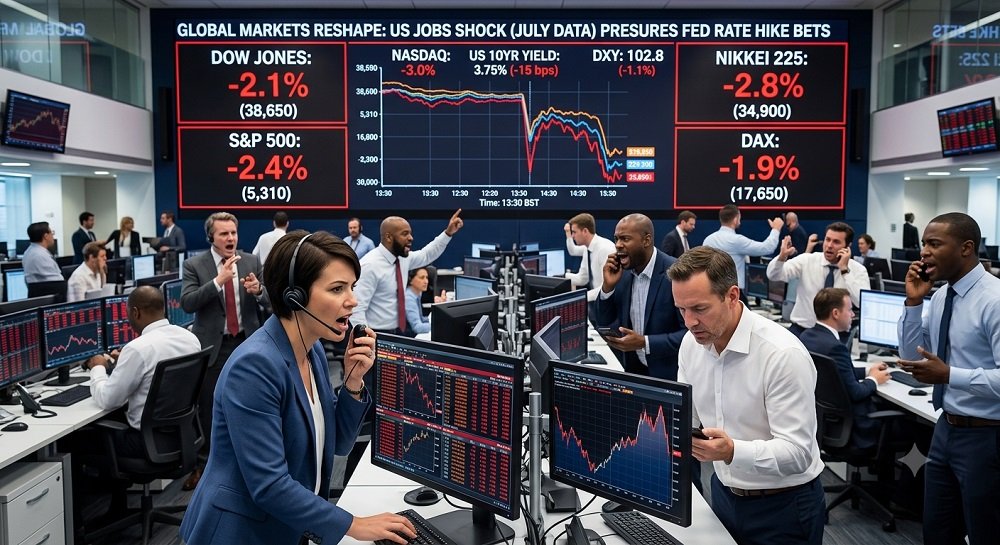
Weak July payrolls and steep downward revisions to previous data have sharply reduced expectations of a September US rate increase, with implications for currencies, bonds, equities and emerging markets
A deterioration in the US labour market has forced investors to reassess the path of Federal Reserve interest rates, weakening expectations of a September increase and setting the stage for broader shifts across global financial markets.
US nonfarm payrolls fell by 23,000 in July, according to the latest employment data, sharply undershooting forecasts for an increase of roughly 80,000 to 95,000 jobs. The surprise was compounded by substantial downward revisions to the previous two months, challenging the view that the US economy had maintained enough labour-market momentum to justify further monetary tightening.
The unemployment rate edged down to 4.1 percent from 4.2 percent, but that modest improvement did little to offset the broader weakness in the report.
June’s employment gain was revised down to 20,000 from 57,000, while May’s increase was cut to 66,000 from 129,000. The revisions mean the recent trajectory of job creation was considerably weaker than initially reported.
The immediate consequence was a sharp repricing of expectations for the Federal Reserve’s next move.
Markets had entered the period around the Fed’s July meeting with a meaningful possibility of a September rate increase. That prospect has weakened significantly following the jobs report, with investors now placing greater weight on the risk that a slowing labour market could make further tightening unnecessarily restrictive.
The shift matters well beyond the United States.
US interest rates remain a central anchor for global borrowing costs and asset valuations. Changes in expectations for the Fed influence Treasury yields, the dollar, equity valuations and the flow of capital into and out of emerging markets.
A lower probability of a US rate increase can ease pressure on global financial conditions by reducing the expected return on dollar-denominated assets. It can also weaken the dollar, potentially improving the relative attractiveness of emerging-market currencies, local-currency bonds and equities.
However, the benefits will not be evenly distributed. Countries with high dollar-denominated debt or large external financing requirements could benefit from a softer dollar and lower US yields, while commodity exporters and economies facing their own inflation pressures may experience different effects.
The dollar was among the first markets to reflect the changing outlook. A less hawkish Fed reduces the yield advantage supporting the US currency, although the direction of the dollar will also depend on the relative strength of the US economy and monetary-policy expectations in Europe, Asia and other major economies.
Gold has also been in focus.
The precious metal was already trading near a seven-week high ahead of the employment release and was on course for its strongest weekly performance since January. A combination of lower rate expectations, a potentially softer dollar and demand for defensive assets could provide further support.
“When a currency loses support at the same time a safe-haven asset gains it, that combination tells you plainly which way sentiment has shifted,” said Nigel Green, chief executive of financial advisory group deVere in a note to Business A.M.
Green’s assessment marks a sharp reversal from his earlier position, when he warned investors that markets were underpricing the possibility of a September Fed increase.
At that time, he pointed to rising market expectations for a quarter-point hike and argued that investors who had positioned themselves for lower rates risked being caught off guard by a more hawkish Federal Reserve.
The employment report has changed his view.
“A jobs report this weak, layered on top of two months of substantial downward revisions, makes a hike next month almost impossible to justify,” Green said in the note.
“Three consecutive months of softening data is not noise. It’s a labour market losing momentum in a way policymakers cannot responsibly ignore.”
The change in expectations comes against a complicated policy backdrop for the Federal Reserve.
At its July meeting, the Fed kept its benchmark interest-rate target unchanged at 3.5%-3.75%. Three governors — Beth Hammack, Neel Kashkari and Lorie Logan — dissented in favour of a quarter-point increase, highlighting the degree of disagreement within the central bank over whether inflation risks still warranted tighter policy.
The dissenters’ position had helped strengthen expectations that the Fed could move in September.
But monetary policy is now facing a more difficult trade-off. Inflation remains a concern, while the labour market is showing signs of losing momentum. Raising rates into a weakening employment environment could increase the risk of unnecessarily slowing economic activity.
Keeping rates unchanged, meanwhile, would allow policymakers more time to determine whether the deterioration in hiring is temporary or part of a broader economic slowdown.
That distinction will be critical.
A single weak employment report is unlikely to determine the Fed’s September decision. Policymakers will have additional inflation, wage, consumer-spending and employment data to consider before the September 15-16 meeting.
For global investors, however, the repricing has already begun.
Lower US rate expectations can reduce borrowing costs across international markets and potentially support risk assets. They can also alter the relative attractiveness of developed and emerging markets, particularly where valuations and capital flows are highly sensitive to US yields.
Emerging-market policymakers will be watching the dollar particularly closely. A sustained decline in US yields and the dollar could provide greater room for some central banks to ease monetary policy without facing the same degree of currency pressure that can accompany lower domestic rates.
For borrowers, the implications could be equally important. Governments and companies with dollar liabilities may face less pressure if the US currency weakens, while lower global yields can reduce refinancing costs and improve access to international capital.
But the opposite risks remain if the US economy deteriorates more sharply than expected. A disorderly slowdown could trigger a flight to safety, sending capital towards US government bonds despite lower rate expectations and creating renewed volatility across risk assets.
The jobs report therefore presents investors with two competing interpretations.
The first is that the labour-market weakness gives the Fed room to hold rates steady or eventually ease policy, supporting bonds, gold and selected risk assets.
The second is that the weakness signals a broader deterioration in US economic growth, in which case the initial relief from lower rates could eventually be overwhelmed by concerns about corporate earnings, credit quality and global demand.
That distinction will become clearer as further data emerge.
For now, the direction of travel in rate expectations has changed markedly.
“Downward revisions of this size change the entire narrative around the labour market’s recent strength,” Green said. “This is not a one-month blip. It’s an economy that has been losing jobs momentum for a season while the data initially suggested otherwise.”
His conclusion is a warning to investors who had positioned portfolios around a tighter US monetary-policy outlook.
“Investors who spent recent weeks preparing portfolios for a September increase now need to unwind that positioning fast,” he said.
The broader lesson for global markets is that the Fed’s next move cannot be viewed in isolation. US employment data can alter the dollar, Treasury yields and global liquidity almost immediately, with consequences that extend from Wall Street to London, Tokyo and emerging-market financial centres.
Six weeks ago, investors were preparing for the possibility that the Fed might resume raising rates. After the latest employment shock, the central question has changed: not whether the US central bank can justify another increase, but whether the weakening labour market is becoming strong enough evidence that further tightening would carry greater economic risk than inflation risk.
For investors across developed and emerging markets, that shift in the balance of risks may prove more consequential than the September decision itself.