Host-community development is entering a new phase in which compliance alone may no longer be enough, with investors and oil operators facing growing pressure to demonstrate measurable economic and social returns from mandated community investments. The challenge will be a key focus of the inaugural Host Community Summit, HostComm, in Lagos next year.
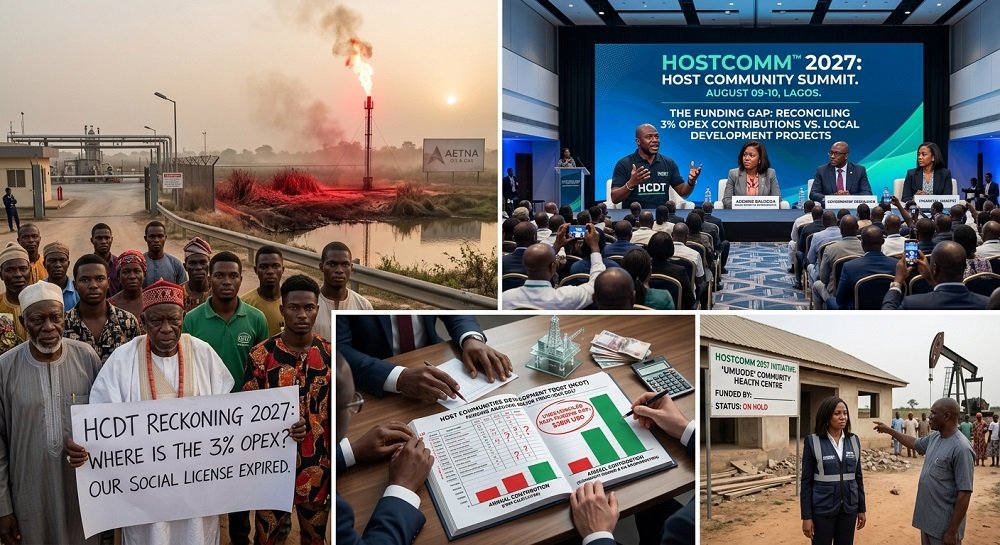
The two-day summit, scheduled for August 9-10, 2027, will bring together oil and gas operators, regulators, host community leaders, financial institutions, traditional authorities and service companies to address the gap between regulatory compliance and meaningful development in host communities.
Convened by Caritas Communications Limited, Africa Oil+Gas Report (AOGR) and Pedestal Africa, the summit will be held under the theme, “Building Trust, Creating Shared Value and Sustaining Development.”
The organisers say the forum is designed to move the host-community conversation beyond policy discussions towards practical solutions for conflict resolution, accountable governance and bankable development projects.
The effectiveness of the Host Communities Development Trust framework under the PIA 2021 will be a central issue at the summit, as stakeholders assess how the mandated 3 percent of operators’ annual operating expenditure can deliver measurable and sustainable benefits to host communities.
The framework is intended to provide a structured mechanism for funding development in communities hosting petroleum operations while improving relationships between operators and their host communities. However, the effectiveness of the system will depend increasingly on how the funds are governed, deployed and translated into measurable economic and social outcomes.
The organisers argue that Nigeria’s energy industry now needs to move from simply meeting the letter of the PIA to showcasing that host-community investments are producing sustainable value.
“Sustainable energy production requires more than capital and hardware; it demands absolute alignment with host communities,” the organisers said, adding that the summit would seek to “de-risk investments, hold stakeholders accountable, and ensure the 3 percent OPEX capital allocated to trusts in the PIA yields measurable, long-term impact.”
Weak host-community governance carries costs for both sides of the industry equation. Operators face the prospect of production disruptions, additional security expenditure, infrastructure damage and project delays, while communities risk becoming trapped in a cycle of mistrust when development structures fail to deliver visible economic benefits.
HostComm is therefore being positioned as a platform to bring both sides of the relationship, alongside government and financial institutions, into a common conversation on how the HCDT framework can deliver better outcomes.
A major focus of the summit will be unlocking development capital for host communities.
Organisers plan to bring financial institutions, private equity investors, development finance institutions and ESG specialists into discussions around scalable financing models for community infrastructure.
The objective is to shift community development projects away from fragmented, short-term interventions towards initiatives capable of generating lasting economic value.
The summit will also examine governance and regulatory challenges surrounding HCDTs, with operators, regulators, traditional institutions and community leaders expected to participate in what organisers describe as a “quadpartite dialogue.”
The forum will seek to improve clarity around roles and responsibilities while reducing the risk of disputes arising from weak governance, unclear expectations or poor communication.
This is particularly important as implementation of the PIA continues to reshape relationships between petroleum operators and communities across Nigeria’s upstream, midstream and downstream segments.
HostComm will also place the energy supply chain at the centre of the host-community development debate.
Service companies, engineering, procurement and construction contractors and local vendors are expected to examine ways of integrating host-community businesses and skills into the wider energy value chain.
The approach could potentially expand the economic impact of petroleum operations beyond direct community projects by connecting local businesses to contracts, procurement opportunities, skills development and longer-term commercial relationships. For operators, organisers say, stronger local participation could also contribute to more sustainable community engagement by giving residents an economic stake in energy projects.
The summit is expected to attract senior decision-makers across the energy ecosystem, including chief executives, asset managers, external affairs and sustainable-development executives from upstream, midstream and downstream companies.
Government policymakers and industry regulators, host community leaders, HCDT trustees and traditional institutions are also expected to participate.
Other target participants include ESG specialists, legal practitioners, energy consultants, development finance institutions, commercial banks, investment managers, engineering and procurement companies and oilfield service providers.
The organisers say the diversity of participants is intended to ensure that discussions translate into practical solutions involving the institutions responsible for financing, regulating, operating and hosting energy projects.
The summit comes as Nigeria seeks to attract fresh investment into its oil and gas industry while managing the environmental, social and governance challenges associated with petroleum production.
The host-community question ultimately sits at the intersection of investment risk and development outcomes. Stable community relations can protect project economics by reducing disruption and uncertainty, while effective HCDTs could determine whether the PIA delivers the tangible economic and infrastructure benefits promised to communities.
Against this backdrop, organisers see HostComm as more than a conference. The summit is intended to provide a national forum for testing community-development models, identifying why some initiatives fail and exploring ways to make successful projects attractive to additional sources of capital.
With sponsorship, exhibition, speaking and strategic partnership opportunities expected to form part of the summit programme, organisers are inviting companies and institutions to participate in shaping the agenda.
Full registration details, delegate packages and the official programme are expected to be released ahead of the event.
HostComm 2027 is scheduled for August 9-10, 2027, in Lagos, with the venue to be announced in due course.