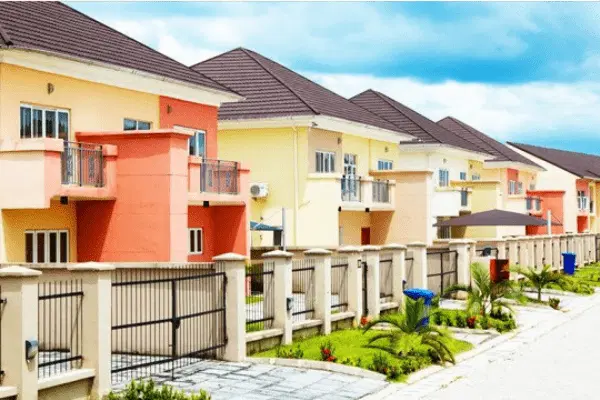
For the average Nigerian worker, getting onto the property ladder may require something closer to a lifetime project than a conventional savings plan.
A global housing affordability analysis estimates that a worker earning Nigeria’s average gross income would need 364 months — or 30 years and four months — of income to accumulate a 20 percent deposit on an average-sized home.
The figure places Nigeria among the world’s least affordable housing markets and exposes a stark gap between what property costs and what ordinary workers earn.
The calculation is theoretical and assumes that a worker can save 100 percent of gross income. It does not allow for food, rent, transport, taxes, children, debt, healthcare, mortgage costs or any other household expenditure. In reality, the period needed to accumulate such a deposit would therefore be considerably longer.
But that is precisely what makes the comparison revealing: it measures the size of the housing deposit against earning power, rather than simply asking whether homes are expensive.
Nigeria’s numbers tell the story
The study by BestBrokers, using property data from Numbeo and income data from WorldData, puts Nigeria’s average gross monthly income at €98, or about $113 at the August 14, 2026 euro-dollar rate. That translates to roughly ₦154,000 a month, using an indicative exchange rate of about $1 = ₦1,362. Annual gross income comes to approximately €1,176, or $1,360 — about ₦1.85 million.
Against that income, BestBrokers estimates the price of a 108-square-metre Nigerian home at €178,090, equivalent to about $206,000 or ₦280 million.
A 20 percent deposit would therefore be approximately €35,618, or $41,200 — about ₦56 million.
The Central Bank of Nigeria (CBN) publishes the naira-dollar exchange rate through its Nigerian Foreign Exchange Market data; currency conversions used by Business A.M, in this story are indicative and can move with the market.
The numbers can be summarised this way:
Nigeria | Original euro figure| Approx. US dollars| Approx. naira
Gross monthly income | €98 | $113 | ₦154,000
Gross annual income | €1,176 | $1,360 | ₦1.85m
Ave home price | €178,090 | $206,000 | ₦280m
20% deposit | €35,618 | $41,200 | ₦56m
Ave price per sq. metre | €1,637 | $1,893 | ₦2.58m
The currency conversions use approximately €1 = $1.157 and $1 = ₦1,362 for illustration. Exchange rates fluctuate, so the underlying affordability ratio — 364 months — is the more important measure.
Nigeria is bad. Much of Africa is worse.
Nigeria’s position is striking, but the broader African picture is even more unsettling.
BestBrokers ranks Gambia at 363 months, virtually level with Nigeria, while Ethiopia requires 331 months and Madagascar 295 months under the same theoretical methodology.
Further down the ranking, the numbers become extraordinary.
Ghana requires 245 months — more than 20 years — while Uganda requires 259 months and Tanzania 273 months.
In Ghana, the report estimates an average home at about $269,000, against a 20 percent deposit of approximately $53,800.
In Uganda, the corresponding figures are about $121,000 for the average home and $24,100 for the deposit.
Tanzania’s average home comes to roughly $145,000, requiring a deposit of around $29,000.
Kenya, meanwhile, records 138 months, or 11½ years. The average home is estimated at about $127,000, with a theoretical 20 percent deposit of roughly $25,300.
Ivory Coast is at 139 months, while Cameroon stands at 212 months.
The disparity is remarkable:
African country| Months to save 20% deposit| Approx. home price| Approx. 20% deposit
South Africa | 39 | $103,000 | $20,600
Algeria | 41 | $99,000 | $19,800
Cape Verde | 45 | $106,000 | $21,100
Egypt | 48 | $66,000 | $13,200
Namibia | 53 | $95,000 | $19,000
Botswana | 58 | $179,000 | $35,600
Zimbabwe | 64 | $71,000 | $14,300
Morocco | 79 | $143,000 | $28,500
Kenya | 138 | $127,000 | $25,300
Ivory Coast | 139 | $162,000 | $32,400
Cameroon | 212 | $164,000 | $32,800
Ghana | 245 | $269,000 | $53,800
Uganda | 259 | $121,000 | $24,100
Tanzania | 273 | $145,000 | $29,000
Nigeria | 364 | $206,000 | $41,200
Dollar figures are approximate conversions of BestBrokers’ euro-denominated data using €1 ≈ $1.157.
The data comes from the BestBrokers analysis, whose underlying country figures are based on Numbeo property prices and WorldData income estimates.
The extremes are almost difficult to comprehend
Beyond Nigeria, the housing affordability problem becomes even more dramatic.
In Senegal, the theoretical period is 477 months, or almost 40 years. The average home is estimated at about $353,000, with a deposit of roughly $70,600.
In Angola, the figure rises to 497 months, more than 41 years. The average home price is about $592,000, requiring a deposit approaching $118,000.
Djibouti reaches 617 months, equivalent to more than 51 years of gross income. Its model home costs approximately $1.02 million, with a 20% deposit of about $204,000.
In Rwanda, the figure is 726 months — more than 60 years. The estimated average home costs about $349,000, requiring a deposit of nearly $70,000.
The Democratic Republic of Congo reaches 846 months, or 70½ years, while Zambia reaches 1,260 months — 105 years.
Mozambique is at 1,420 months, or more than 118 years.
And then there is Burundi. The country records the world’s most extreme result in the study: 2,595 months, equivalent to more than 216 years of gross income to accumulate a 20% deposit.
The average home in the Burundi calculation is estimated at about $260,000, with a 20 percent deposit of approximately $52,000. But the report itself cautions that Burundi’s property estimate is based on a relatively small number of Numbeo submissions and may be skewed toward more expensive properties.
The figures are therefore best understood as an illustration of the enormous gap between reported incomes and property values, rather than as a literal prediction of how long a particular household will take to buy a home.
South Africa offers a striking contrast
The African data also shows why the problem cannot simply be described as a continent-wide shortage of housing.
South Africa records 39 months, or three years and three months, to accumulate the theoretical 20 percent deposit — less than one-ninth of Nigeria’s 364 months.
Its average model home is estimated at about $103,000, with a 20 percent deposit of approximately $20,600.
Algeria is at 41 months, Cape Verde at 45 and Egypt at 48.
That creates an important question for policymakers: why are housing markets with very different income levels producing such dramatically different relationships between earnings and property prices?
The answer lies in more than construction
Land prices, urbanisation, building costs, interest rates, mortgage availability, informal employment, currency movements and the structure of household income all influence whether property can actually be purchased by ordinary workers.
Nigeria’s housing problem is also a finance problem
For Nigeria, the affordability gap is particularly important because the country is simultaneously trying to stabilise its macroeconomy and raise household living standards.
The World Bank says Nigeria continues to face weak job creation, limited economic opportunities and widespread poverty. It estimates that more than 60 percent of Nigerians lived below the national poverty line in 2025, with food inflation particularly damaging to poorer households, which can spend up to 70 percent of their income on food.
That leaves little room for the kind of long-term saving required by the BestBrokers model.
A household cannot accumulate a property deposit by setting aside its entire income if most of that income is already required for basic consumption.
And even if a family manages to assemble a deposit, the mortgage can present another barrier.
The World Bank has previously identified high fees and other structural obstacles in Nigeria’s housing-finance system, while its housing-finance work has focused on deepening mortgage markets and improving access to housing finance.
That means Nigeria’s housing challenge has at least three dimensions: the price of the property; the income available to households; and the cost and availability of long-term finance.
Solving only one of them is unlikely to solve the underlying problem.
The danger for a generation of Nigerians
The implications extend well beyond whether a young Nigerian can buy a house.
For many families, property is the principal long-term store of wealth. It provides security in retirement, can be transferred between generations and can sometimes be used as collateral to finance businesses or other investments.
If younger workers are unable to enter the property market until much later in life — or never enter it at all — the consequences could be felt across the economy.
The result could be a widening divide between households that already own property and those dependent on wages and rents.
That divide matters because housing wealth can compound over decades.
Someone who buys a home early in their working life can potentially build equity as property values rise and mortgage principal falls. Someone who spends those same decades renting while trying to accumulate an increasingly distant deposit may be left further behind.
In that sense, the housing affordability crisis risks becoming a wealth-accumulation crisis.
The macroeconomic contradiction
Nigeria’s economic reform programme is designed in part to restore stability, attract investment and improve the foundations for sustainable growth.
The World Bank says recent reforms have strengthened macroeconomic stability, including improvements in inflation management, government revenues, reserves and exchange-rate flexibility. But it also stresses that those gains need to translate into better living conditions and stronger job creation.
Housing provides an unusually clear test of whether that transition is happening.
If incomes rise, but house prices rise substantially faster, affordability can deteriorate even while headline economic indicators improve.
Likewise, lower inflation does not automatically make houses affordable. What matters to a prospective buyer is the relationship between income, property prices, the deposit requirement and the cost of borrowing.
For millions of Nigerians, that relationship remains deeply unfavourable.
A warning hidden inside the 364-month figure
The most important thing about the Nigerian number is not that someone would literally need 30 years to save for a house.
They would need much longer if they had to pay for food, rent, transportation and everything else along the way.
The significance is that the 20 percent deposit alone is equivalent to more than 30 years of average gross income under an intentionally generous theoretical assumption.
That puts the scale of the affordability gap into perspective.
It also explains why informal housing, family assistance, inherited property and joint household financing are so important across many African markets. Traditional mortgage-led homeownership models can simply be beyond the reach of households whose earnings are too low relative to formal property prices.
The policy challenge
For governments, developers and financial institutions, the lesson is straightforward but difficult.
Africa does not simply need more houses. It needs more houses that households can afford to finance.
That means increasing the supply of lower-cost housing, reducing construction and land costs where possible, improving infrastructure, expanding access to long-term mortgage finance and creating jobs capable of supporting higher and more predictable household incomes.
Nigeria’s housing market also needs financial products designed around the realities of its workforce, including households whose income is irregular or partly informal.
The World Bank has identified housing finance as an important part of expanding access to homeownership in Nigeria and across Africa.
Without progress on both sides of the equation — income and affordability — simply increasing the number of properties on the market may not solve the problem.
A continent confronting a generational divide
The figures tell a sobering story. In South Africa, the theoretical deposit is equivalent to just over three years of gross income. In Kenya, it is nearly 12 years. In Ghana, more than 20 years. In Nigeria, more than 30. In Senegal and Angola, more than 39 and 41 years respectively. In Zambia and Mozambique, the calculation stretches beyond a century.
And in Burundi, it reaches more than two centuries. The differences are too large to dismiss as a conventional property-cycle problem.
They point to a deeper structural disconnect between the price of formal housing and the earning power of ordinary Africans.
For Nigeria, the message is particularly stark: an economy of more than 200 million people cannot build broad-based household wealth if ownership of a basic long-term asset remains financially inaccessible to a large part of its working population.
The 364-month figure should therefore be read not as a forecast, but as a warning.
If the average Nigerian worker cannot accumulate the capital needed to enter the housing market within a realistic working lifetime, homeownership stops being a normal stage of economic progress and becomes a privilege increasingly determined by inherited wealth, family support or exceptional income.
That is the real story behind Nigeria’s 30-year deposit.
And across much of Africa, the numbers suggest that the problem is only beginning to be fully understood.
Methodology and currency note
BestBrokers calculated the theoretical number of months required to cover a 20 percent home deposit by comparing average gross monthly income with the estimated price of a 108-square-metre home. Property prices were sourced from Numbeo and income data from WorldData. The company explicitly warns that its calculation assumes 100 percent of gross income can be saved and excludes taxes, living expenses, debt, mortgage costs, interest, property taxes and transaction fees.
Dollar figures in this article are approximate conversions using €1 ≈ $1.157. Nigerian naira figures use approximately $1 ≈ ₦1,362. Exchange rates fluctuate, so the original euro figures and the 364-month affordability ratio remain the primary figures from the study. The CBN identifies its NFEM rate as the official daily exchange rate derived from the volume-weighted average of transactions.