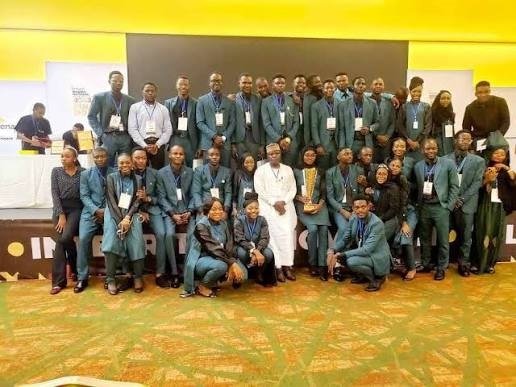
Two Nigerian universities have emerged at the forefront of youth-led innovation after the Federal University of Technology, Owerri (FUTO) and Ahmadu Bello University, Zaria (ABU) won top honours at the 2026 Enactus Nigeria National Competition, securing places to represent the country at the Enactus World Cup in Brazil later this year.
FUTO secured a double victory, winning the Enactus Early Stage Final with its biofuel project and the Julius Berger Innovation Challenge with ALTAR, a robot designed to detect structural and construction failures.
ABU, meanwhile, emerged winner of the Enactus Advanced Stage Competition Final with NeemPest, an IAR-certified multi-modal biopesticide designed to eliminate Tuta absoluta within 48 hours, alongside TomPa, a tomato-processing brand developed to convert surplus tomato harvests into longer-lasting powder and puree.
The projects emerged from a field of innovations presented by 33 universities at the national final held in Lagos, where they were assessed by professionals, technical experts and business leaders on relevance, innovation, scalability, profitability potential and sustainability.
The winning teams will now take their projects to the Enactus World Cup, where they will compete against winning innovations from 35 countries for the global title.
The results highlight the growing emphasis on turning university-based research and ideas into commercially viable solutions to some of Nigeria’s most pressing economic and social challenges, ranging from agricultural losses and energy access to construction safety and infrastructure resilience.
Michael Ajayi, country director, Enactus Nigeria, said the innovations demonstrated the potential of Nigerian students to develop solutions capable of creating economic and social value beyond the classroom.
“The projects showcased at the Final represented far more than an academic exercise. They reflect the ingenuity, resilience and determination of a generation committed to building a better Nigeria,” Ajayi said.
He said the competition represented the culmination of 12 months of work across 33 tertiary institutions, during which students identified social and environmental challenges and developed business-oriented solutions aimed at addressing them while creating value for communities.
From campus ideas to commercial solutions
The emergence of FUTO and ABU underscores the role of university innovation programmes in developing solutions with potential applications across key sectors of the economy.
FUTO’s biofuel project addresses the need for alternative energy solutions, while ALTAR applies robotics to the construction and built-environment sector by seeking to identify structural and construction failures.
The Julius Berger Innovation Challenge was created to encourage students to develop practical responses to challenges within Nigeria’s construction industry, with sustainability and fresh thinking increasingly becoming important considerations for the sector.
Shakira Mustapha, risk and sustainability officer, Julius Berger Plc, said collaboration between industry and educational institutions was critical to developing solutions capable of addressing Nigeria’s infrastructure challenges.
She said Julius Berger’s partnership with Enactus Nigeria was designed to support youth innovation and sustainable development by giving students opportunities to develop practical solutions for the construction and built-environment sectors.
“Achieving true change in the construction industry requires fresh ideas that are environmentally sustainable,” Mustapha said.
For ABU, the winning projects focus on two major agricultural challenges: pest management and post-harvest losses.
NeemPest is designed to tackle Tuta absoluta, a pest that affects tomato production, while TomPa seeks to preserve surplus tomato harvests by processing them into powder and puree with longer shelf lives.
The combination highlights the commercial potential of innovations that address both agricultural productivity and food value-chain inefficiencies.
By converting excess produce into processed products, TomPa is also aimed at reducing losses that occur when farmers are unable to sell perishable tomatoes quickly enough.
Employability and entrepreneurship
Beyond the individual projects, Enactus Nigeria said the competition was designed to develop students into entrepreneurs, innovators and future business leaders capable of applying academic knowledge to real-world problems.
Ajayi said the organisation’s objective was not simply to produce winning projects but to develop young people capable of building sustainable enterprises and contributing to economic development.
“In the process of inspiring change, we transform the minds of participating students and prepare them for future success, whether as entrepreneurs or individuals,” he said.
He added that Nigerian youths could become highly productive and globally competitive when provided with the right inspiration, motivation and support.
Casey Bonfield, deputy public affairs officer, US Consulate General, Nigeria, also commended the initiative, saying its emphasis on applying classroom knowledge to practical challenges could better prepare students for participation in the global economy.
He said exposing young people to real-life problems and enabling them to develop practical solutions would help equip them for future opportunities, stressing that “building a future starts with building people.”