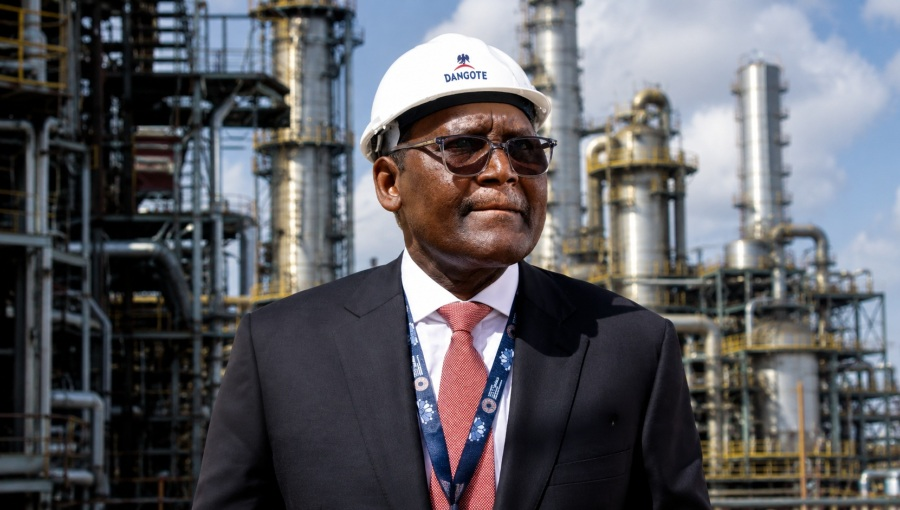
Africa’s richest man, Aliko Dangote has continued to play deeper to consolidate in his multi-billion-dollar investment bite in Kenya’s oil trade as his company, Dangote Industries Ltd has acquired a 25 percent stake in the country’s pipeline company, the Kenya Pipeline Company (KPC) for $327 million (or Ksh42.5 billion).
Dangote, speaking during the 13th annual Financial Times Africa Summit in London, said: “We bought 25 percent of the [Kenya Pipeline Company, KPC] pipeline network for the distribution of petroleum products”.
However, he did not identify which company in his business group completed the acquisition.
According to Bloomberg, Dangote’s announcement identifies the buyer behind a block trade involving 4.5 billion KPC shares reported by the Nairobi Securities Exchange (NSE) on Monday, October 19.
The 4.5 billion shares were sold at prices ranging from 9.02 to 9.36 Kenyan shilling (Ksh9.02 to Ksh9.36) each, generating approximately 42.46 billion Kenyan shilling (Ksh42.46 billion) in the transaction.
Under Kenya’s capital markets rules, acquiring 25 percent or more of a listed company’s voting shares triggers a mandatory takeover procedure requiring formal notification to the Capital Markets Authority (CMA).
KPC, previously wholly owned by the Kenyan government, sold 65 percent of its shares through an initial public offering (IPO) that opened on January 19, closed on February 19 this year, and saw the company listed on the country’s Nairobi Security Exchange, NSE, on March 9.
KPC transports, stores, and distributes refined petroleum products—such as petrol, diesel, and jet fuel—from the Port of Mombasa to inland markets across Kenya and neighboring East African countries.
It operates roughly 1,342 kilometers of pipeline network moving fuel from Mombasa through Nairobi, Nakuru, and Eldoret to Kisumu.
The pipeline company manages strategic fuel storage and loading facilities across key regional depots with an annual handling capacity of about 14 billion litres, serving domestic Kenyan markets as well as transit countries including Uganda, Rwanda, South Sudan, and the Democratic Republic of the Congo.
It has diversified, expanding from energy logistics, to offering fiber optic data connectivity along its right-of-way, and runs the Morendat Institute of Oil and Gas for specialized industry training.
Kenyan President William Ruto said private investors acquired the shares from public entities but did not disclose the identities of the buyers or the institutions that sold their holdings.
Major public investors in KPC following the IPO included the National Social Security Fund (NSSF), the Unclaimed Financial Assets Authority (UFAA) and state-backed pension schemes, although there was no confirmation on which institutions participated in the latest sale.
The development comes amid further questions by some members of Kenyan parliament alleging that public pension funds were directed to purchase KPC shares before some of the holdings were sold to a private investor. Ndindi Nyoro, representing Kiharu alleged that the shares were sold at a loss after accounting for transaction costs and alleged that the investor and the investment bank involved had links to the President.
“The other week, I was suspended from Parliament for stating the obvious. That the Kenya Pipeline IPO was a failure, subscription being below 3 percent at the last day of the IPO. And that President William Ruto called the CEOs of NSSF, PSSF, Unclaimed Assets, CPF, and others to risk pensioners’ savings against professional advice,” Nyoro wrote.
As KPC eyes a proposed Ksh35 billion petroleum trading hub on 377 acres owned by its subsidiary, Kenya Petroleum Refineries Ltd, questions remain over how the project and Dangote’s latest purchase will align with the planned $16 billion (or Ksh2.2 trillion) Dangote’s East Africa Refinery.