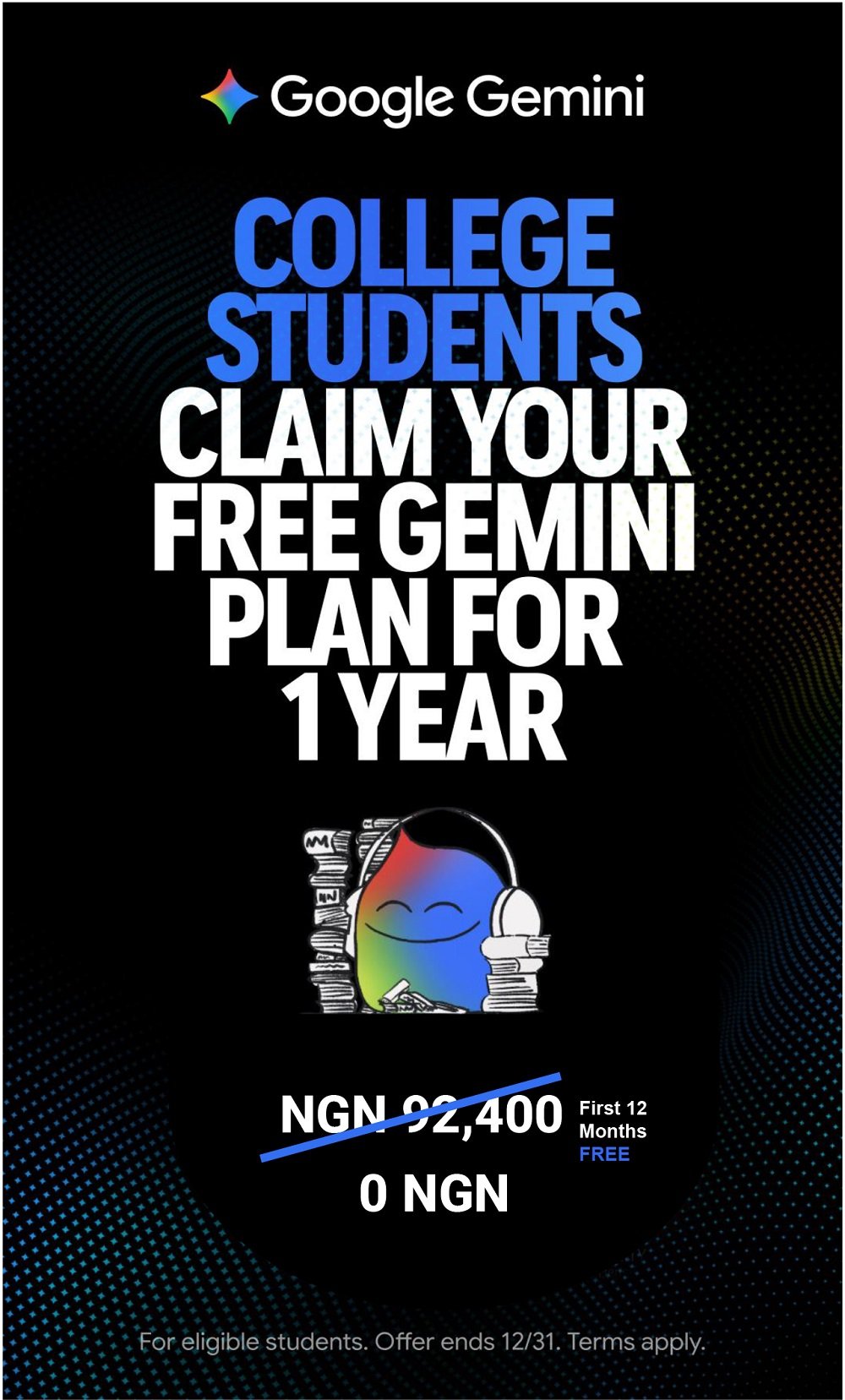
Google is expanding access to artificial intelligence tools in Nigeria’s higher education sector, offering students 12 months of its Google AI Plus subscription at no cost as technology companies compete to establish AI as a mainstream tool for learning and skills development.
The offer, valued at N92,400 per student, is available to students aged 18 and above enrolled in accredited Nigerian universities, polytechnics and colleges of education.
The initiative comes as universities and employers increasingly confront the need to equip young people with practical AI skills, while the cost of accessing advanced digital tools remains a barrier for many students.
Nigeria is among 27 countries in Sub-Saharan Africa where the student offer is now available.
Students who accessed the offer during the previous academic year can also renew their free subscription for another 12 months after re-verifying their student status.
The subscription gives students expanded access to Google’s Gemini AI ecosystem, including higher usage limits, Gemini Omni, Gemini Live for real-time voice interactions and Deep Research for academic projects and term papers.
Students also receive access to custom practice quizzes, unlimited file uploads and 400GB of cloud storage.
Other tools include Gemini Study Notebooks, which can convert lecture notes and course materials into study resources such as practice quizzes and lesson plans.
The package also includes interactive 3D visualisations for complex subjects and Google’s Lens Homework Helper, which allows students to photograph equations or diagrams and receive guided assistance.
Olumide Balogun, director, West & East Africa at Google, said the company viewed AI as an opportunity for Nigeria to accelerate digital skills development.
He said the free subscription was intended to reduce financial barriers that could prevent students from accessing advanced AI tools and help them develop skills relevant to the global economy.
“AI is the defining technological shift of our generation, and for Nigeria, with one of the youngest and most entrepreneurial populations in the world, it is an immediate leapfrog opportunity.
By offering 12 months of free Google AI Plus for the second consecutive year, we are removing financial barriers so that Nigerian students can master complex subjects, build in-demand digital skills, and compete confidently in the global economy,” said Balogun
Google tackles AI cheating concerns
The expansion of AI into education has raised concerns that students could use generative AI to complete assignments rather than develop their own understanding.
Google is seeking to address that concern through Guided Learning, a Gemini feature designed to operate more like a tutor than an answer generator.
The system uses questions and hints to guide students through problems instead of immediately providing solutions.
Google said a DeepMind study involving 1,763 students in West African schools found that students using Guided Learning achieved learning progress equivalent to 1.2 to 1.7 years over an eight-week period.
More than 90 percent of interactions in the study focused on understanding concepts, while direct solutions were provided in only 2 percent of interactions, according to Google.
The company has also introduced controls through Google Classroom that allow lecturers to lock Gemini into Guided Learning mode, limiting the opportunity for students to use the tool simply to obtain answers.
Google said student and classroom data would not be used to train its AI models.
Competing for the next generation of AI users
The student programme forms part of a wider effort by technology companies to accelerate AI adoption among younger users while positioning their platforms as essential productivity and learning tools.
For Nigeria, the potential economic impact extends beyond academic performance.
The country’s large youth population represents a significant future workforce for sectors increasingly requiring proficiency in AI, data analysis, software development and other digital capabilities.
Google’s strategy therefore places access to AI tools alongside skills development, potentially giving students practical exposure to technologies they are likely to encounter in the workplace.
The company is also incorporating AI into other parts of the student digital experience.
YouTube, another Google platform widely used by students, has introduced study-oriented safeguards including Take a Break reminders, bedtime alerts and limits on Shorts to reduce distractions.
Google said 74 percent of teenagers rely on online video for schoolwork, highlighting the scale of the platform’s role in education.
Access to AI becomes a skills question
The immediate value of the offer is the removal of subscription costs for eligible students. But the larger question is whether free access translates into meaningful improvements in learning and employability.
The availability of tools such as Deep Research, Gemini Live, Study Notebooks and Guided Learning could give students access to capabilities that previously required paid software or significant research time.
For institutions, however, the challenge will be ensuring that AI adoption complements teaching rather than substitutes for it.
Google’s inclusion of lecturer controls and Guided Learning reflects that tension.
The company is effectively pitching AI not simply as a productivity tool, but as an additional layer of academic support that can help students understand difficult concepts, conduct research and practise skills.
With the new academic year approaching, the 12-month offer gives Google an opportunity to make that proposition at scale across Nigeria’s higher education system, while building familiarity with its AI ecosystem among a generation entering an increasingly AI-driven labour market.