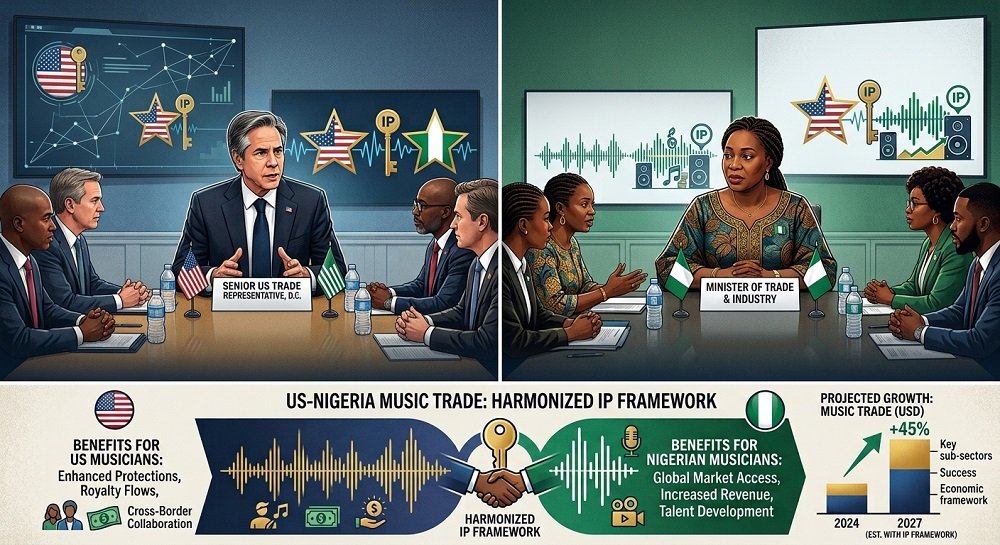
The United States is seeking deeper commercial engagement with Nigeria’s fast-growing music industry, with intellectual property (IP) protection emerging as a critical condition for attracting investment, expanding revenues and scaling Nigerian music businesses into international markets.
The U.S. Consulate General in Lagos convened more than 120 policymakers, intellectual property lawyers, music executives, artists, producers, distributors and other creative-industry stakeholders for a three-day workshop focused on strengthening the legal and commercial foundations of Nigeria’s music economy.
The workshop, titled “IP for Growth in Africa: Lagos Music Industry Workshop,” brought together Nigerian and American industry participants to examine how stronger copyright protection, effective royalty systems, licensing, contracts and enforcement could unlock greater commercial value from the country’s music industry.
Brandon Hudspeth, U.S. consul general in Lagos, said the growing relationship between American music companies and Nigerian artists represented an important trade and investment opportunity.
“The United States sees Nigeria’s music industry not only as a powerful cultural force, but as a significant trade and investment opportunity,” Hudspeth said.
He noted that American record labels including Universal Music Group, EMPIRE, Sony and Warner Music Group, alongside platforms such as YouTube, Meta and Apple Music, have contributed to expanding the international reach of Nigerian artists while creating revenue and employment opportunities.
As Afrobeats reaches larger global audiences, Hudspeth said more American companies were expected to pursue partnerships with Nigerian artists, labels, publishers, platforms and other creative businesses.
The discussions centered on the argument that Nigeria’s ability to attract more international capital into music will depend increasingly on the strength and predictability of its intellectual property regime.
For investors, uncertainty over copyright ownership, royalty collection, licensing arrangements and enforcement can increase the risks associated with financing artists and music catalogues.
Hudspeth said stronger IP protection would provide international investors with greater certainty while giving Nigerian creators greater control over their work.
“Strong IP protection gives U.S. investors greater confidence, gives creators greater control over their work, and creates the conditions for businesses on both sides of the Atlantic to invest, partner, and grow,” he said.
Participants examined the commercial implications of copyright ownership, royalty systems, IP enforcement, licensing, contracts, music monetisation, streaming, publishing and access to international markets.
The discussions also highlighted the need to build stronger systems capable of ensuring that value generated by Nigerian music reaches creators and rights holders.
Existing partnerships between American music companies and Nigerian businesses were cited as examples of how cross-border commercial relationships can expand the reach and earning potential of Afrobeats.
Among those highlighted were the Universal Music Group-Mavin partnership and the EMPIRE-YBNL relationship, which participants described as models of U.S.-Nigeria commercial collaboration.
Such partnerships are increasingly important as Nigerian music moves from being primarily a cultural export to becoming a commercial asset with global audiences.
The workshop was organised in partnership with the U.S. Patent and Trademark Office (USPTO), the U.S. Mission in Geneva and Nigerian alumni of the American Music Mentorship Program (AMMP), a U.S. government exchange programme implemented in partnership with the Recording Academy, organisers of the GRAMMY Awards.
Ten Nigerian alumni of the AMMP programme participated in the discussions, bringing experience and professional networks developed through exposure to the U.S. music industry.
The programme also formed part of the U.S. Mission’s activities marking 250 years of American independence, providing an opportunity to showcase the country’s experience in building a globally competitive music industry while drawing lessons from Nigeria’s rapidly expanding creative economy.
Nigerian policymakers and industry leaders also participated, including Obi Asika, director general of the National Council for Arts and Culture; John Asein, director general of the Nigerian Copyright Commission; Tobi Moody, director of the World Intellectual Property Organization Nigeria Country Office; and Folashade Ambrose-Medebem, Lagos State commissioner for commerce, cooperatives, trade and investment.
Representatives of major American music companies operating in Nigeria also contributed to the discussions.
The U.S. Mission said continued bilateral and multilateral initiatives would be necessary to bring together creators, businesses, policymakers and industry professionals around the development of a sustainable music industry underpinned by strong intellectual property protection.