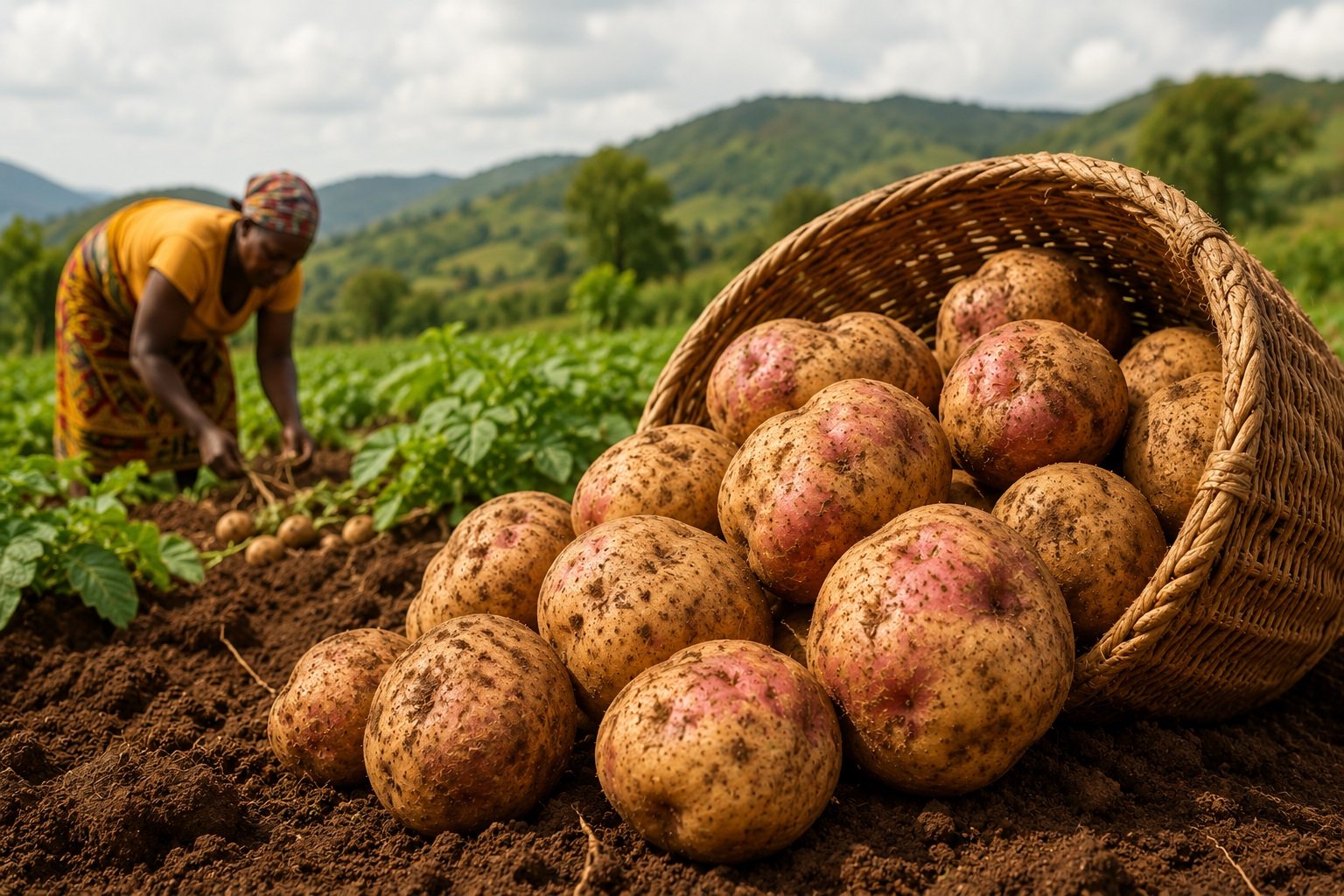
The push to reduce food import dependence and strengthen domestic agricultural value chains is bringing greater attention to underutilised African crops. Among them is Frafra potato, a traditional tuber in northern Ghana that could offer farmers, processors and food manufacturers a new avenue for economic activity.
Scientifically known as Solenostemon rotundifolius, Frafra potato, also called Hausa potato, Sudan potato and Zulu potato, is a tropical African crop with particular importance in northern Ghana and other parts of West Africa. It is also cultivated in parts of southern Africa and tropical Asia.
The case for indigenous crops extends beyond preserving agricultural heritage. For Ghana’s savannah communities, scaling up their production could provide a practical strategy for diversifying farm economies, strengthening local food systems and cushioning farmers against climate and market shocks.
Information on the crop and its emerging potential was gathered by Whitney Asor Adade, Project Support Officer at the Forum for Agricultural Research in Africa (FARA), and Shaquille (Allan Harvey) Pennaneach, Knowledge Management, Digital Media Associate and Social Media Manager at FARA, with courtesy of the Food and Agriculture Organisation of the United Nations (FAO) and FARA.
The findings point to a crop whose commercial potential may extend considerably beyond the traditional kitchen.
The opportunity surrounding Frafra potato is increasingly linked to what can be done with the crop after harvest.
Research has explored its conversion into flour and other value-added food products, potentially creating opportunities for processors to develop new ingredients and consumer products around an indigenous crop.
A 2024 study examining flour produced from 10 different Frafra potato types found significant differences in their nutritional, physical and functional characteristics. The research identified minerals including iron, calcium, zinc and phosphorus, alongside 19 amino acids, seven of which are essential amino acids.
Such findings are important from an agricultural development perspective because they indicate that Frafra potato is not a uniform raw material. Different accessions could potentially have different applications, creating opportunities for research-driven breeding, product development and specialised food processing.
Research has also examined the use of Frafra potato flour in gluten-free bread, showcasing how an indigenous crop could move from traditional consumption into modern food manufacturing.
This creates a potential value chain stretching from farmers and seed systems to aggregators, processors, food manufacturers, retailers and consumers.
The commercial proposition, therefore, is not simply about selling more Frafra potatoes. It is about determining whether the crop can support a viable ecosystem of higher-value products.
A diversification play for farmers
Agricultural diversification has become increasingly important as African countries grapple with food insecurity, climate-related production risks and dependence on a relatively narrow range of staple crops.
Frafra potato already forms part of local food systems in northern Ghana, giving it an advantage that entirely new crops may not have: existing farmer knowledge and consumer familiarity.
For farmers in the region, expanding production could provide an additional crop option and potentially reduce dependence on a limited number of staples.
Its tropical African origin also gives the crop strategic significance.
Across the continent, indigenous and underutilised crops have historically received less research, investment and commercial attention than globally dominant staples. Bringing these crops into modern agricultural and food systems could expand Africa’s production base while preserving agricultural biodiversity.
However, unlocking Frafra potato’s economic potential will require more than enthusiasm for indigenous crops.
One of the biggest constraints is the limited availability of current, standardised information on the crop.
The available complete Frafra potato nutritional dataset used for comparison dates back to 1968. While the historical data provide a useful reference point, they cannot necessarily be treated as representative of all varieties currently grown.
More recent research has begun identifying differences among Frafra potato accessions, underscoring the need for updated research into their nutritional, agronomic and functional characteristics.
That research could prove commercially important.
Understanding which varieties perform best under different growing conditions, which have the strongest nutritional characteristics and which are most suitable for flour, baking or other processing applications could help move the crop from an underutilised food source towards a more structured commercial value chain.
Innovation beyond the farm gate
The crop’s prospects become more convincing when viewed through the lens of food manufacturing.
Frafra potato is primarily an energy-giving food, with carbohydrates forming the core of its nutritional profile. According to the FAO’s Food Composition Table for Use in Africa, 100 grammes of raw Frafra potato provides 94 kilocalories, 21.9 grammes of carbohydrate, 1.3 grammes of protein and 1.1 grammes of fibre, alongside calcium, iron and several B vitamins.
But its potential does not depend on being declared nutritionally superior to Irish potato, sweet potato or other established tubers.
Rather, its commercial value could lie in differentiation. That distinction matters in an agricultural economy increasingly seeking opportunities to process more raw materials domestically and move farmers higher up the value chain.
If research can identify varieties with desirable functional properties, processors could potentially develop products such as flour and specialised food ingredients, while entrepreneurs could build consumer brands around an indigenous African crop.
Such a transition could create demand beyond the farm and generate economic activity across transportation, processing, packaging, marketing and retail.
From forgotten crop to strategic asset
The Frafra potato story exposes a larger opportunity in Africa’s agricultural economy, consisting an array of indigenous crops that remains commercially underdeveloped, with limited research and investment standing between traditional food systems and potentially lucrative modern value chains.
Africa possesses a wide range of indigenous crops adapted to local environments, yet many remain marginal in formal markets. Their commercialisation, where agronomically and economically viable, could complement, not necessarily compete with, major staples.
For Ghana and extensively, West Africa, Frafra potato offers an opportunity to connect agricultural heritage with contemporary food innovation.
For farmers, it could provide another avenue for production diversification. For processors, it offers a potential new raw material. For researchers, it presents an opportunity to investigate varieties, breeding and applications. And for policymakers, it reinforces the case for investing in crops that can strengthen local food systems.
The opportunity, as the FARA-sourced information suggests, is not to turn Frafra potato into another Irish potato or sweet potato.
It is to understand and commercialise what makes Frafra potato distinctly African.
According to analysts, with the right mix of research, investment and market development, Frafra potato could graduate from an overlooked traditional crop into a commercially relevant component of Africa’s food and agricultural economy. Its real promise lies not simply in producing more tubers, but in building the value chains, processing capacity and markets capable of turning indigenous agricultural diversity into economic value.