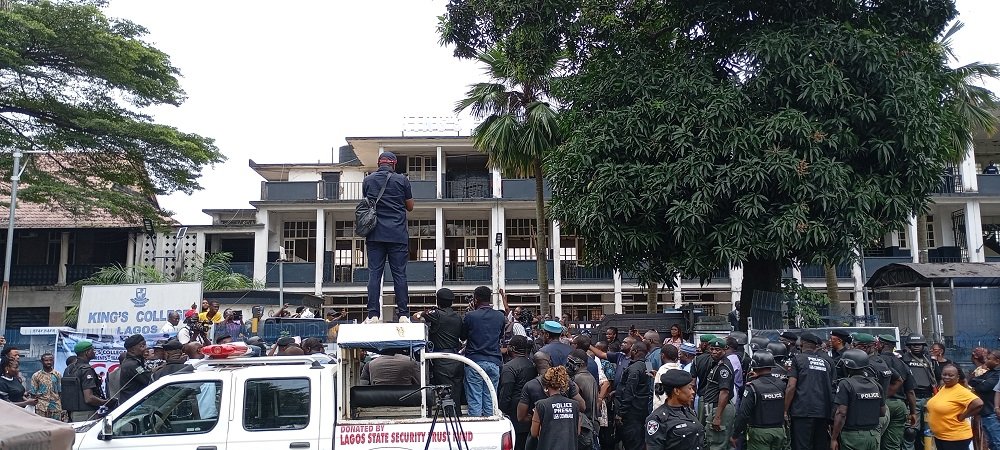
A confrontation at the gates of King’s College,Lagos, has brought a wider debate over private financing and public control into focus.
Parents recently blocked members of the King’s College Old Boys Association (KCOBA) from entering the Lagos school, where the alumni group had planned to explain a proposed management arrangement for the 117-year-old institution. Police officers led by Tijani Fatai , Lagos State commissioner of police attempted to persuade the protesters to open the gate, but the effort failed and KCOBA officials addressed journalists outside.
The dispute centres on whether private capital can be deployed to modernise a public institution without giving its financiers substantial influence over its management.
KCOBA says it is seeking to mobilise private resources and professional expertise to rehabilitate the school, rather than acquire it. Critics argue that transferring management responsibilities to an alumni-backed trust could amount to a substantial change in operational control even if the federal government retains legal ownership.
The disagreement has turned King’s College into a test of how Nigeria manages the intersection of public education, private capital and institutional governance.
According to the federal government, the arrangement is a concession under which KCOBA will finance, rehabilitate, modernise, operate and maintain the college, while the government retains legal title and statutory oversight. The government has repeatedly stressed that King’s College has not been sold or privatised. KCOBA has made essentially the same argument.
Femi Okunnu, chairman of the Board of Trustees of the King’s College Education Trust, in a statement, described the initiative as a “rescue mission” and rejected the allegation that the alumni association was taking ownership of the school.
“King’s College is not being sold. There is no sale. There is no transfer of ownership to KCOBA. The College remains, today and always, a public national institution,” Okunnu stated.
Kashim Ibrahim-Imam, the KCOBA President was equally emphatic.
“The federal government is not selling King’s College to anybody. The old boys are not interested in buying King’s College. Our objective is to develop the college,” he told journalists.
However, for parents and organised labour, the distinction between legal ownership and operational control does not settle the matter.
If an alumni-backed trust finances the infrastructure, runs the institution, maintains the facilities and becomes responsible for its day-to-day operations, opponents argue, the practical balance of power has changed even if the title documents remain in government hands.
The capital problem behind the controversy
King’s College was founded in 1909 by the colonial government, initially to train manpower for government establishments. After independence, it became part of the federal secondary-school system and one of the institutions that came to define Nigeria’s Federal Unity Colleges. Its importance, therefore, extends beyond its physical campus.
It is a public institution with a national mission, a historic brand and an alumni network that includes influential figures across Nigerian public life, business, law, medicine, diplomacy, academia and other professions. Those characteristics create both an asset and a liability.
The asset is the strength of the King’s College name and its alumni network. The liability is the cost of maintaining an institution whose physical infrastructure and educational requirements have evolved dramatically since its founding.
KCOBA’s proposed response is unusually ambitious. The association has announced a N100 billion endowment fund intended to support scholarships, infrastructure rehabilitation, digital transformation, laboratories, libraries, hostels, STEM and robotics education and sports facilities. The association says the programme is designed to provide a long-term financial base rather than simply fund a short-term refurbishment exercise.
KCOBA has also promised that the transformation will not increase school fees and that teachers’ welfare will be prioritised.
“At no time did the old boys imply that we are going to increase school fees. Our objective is to develop the college,” Ibrahim-Imam said.
He described his own ambition in more personal terms:
“My own personal aspiration is very modest: to take the school forward, to take the school back to where I met it as a student.”
That language of restoration is important. Alumni organisations rarely approach legacy institutions as conventional investors. They tend to regard themselves as custodians of an institution that helped shape their own lives. But sentiment alone cannot provide governance.
Once hundreds of billions of naira are contemplated as an institutional development programme, questions about fiduciary responsibility, investment management, procurement, auditing, conflicts of interest and performance measurement become unavoidable.
This is where the King’s College dispute becomes part of a much wider international story.
Historic schools around the world have long relied on people who once passed through their classrooms to help finance their future.
But the more established models generally separate philanthropic support from institutional governance through formal structures.
Eton College in England is an obvious example, although it is important not to treat Eton as a direct equivalent of King’s College. Eton is an independent school with a fundamentally different legal and financial structure.
Its governance is vested in the Provost and Fellows, with day-to-day management delegated to the Head Master, Lower Master and Bursar.
The financial architecture is equally institutionalised. Eton’s published financial statements distinguish endowed funds, including permanent and expendable endowments, from other funds. Its accounts also identify an Improvement Fund associated with the maintenance and preservation of school property.
The school’s financial-aid programme showcases the other side of the endowment model. Eton says its established endowment enabled it to budget £9.7 million for scholarships and bursaries in the 2024/25 financial year. In 2023/24, 247 boys received fee reductions, with 99 paying no fees.
The lesson for Nigeria is not that King’s College should become Eton. It is that legacy can be converted into institutional capital when philanthropy is placed inside a durable governance framework.
The question is whether King’s College can develop such a framework while remaining a public institution.
In the United States, Phillips Exeter Academy offers another instructive example.
The New Hampshire school is not a Nigerian-style public secondary school. It is an independent institution governed by trustees. But its structure shows how alumni involvement can be formalised rather than left to informal influence.
Exeter currently has 21 trustees. Its governing body includes the principal and three officers of the Exeter Alumni Association. The school says trustees provide strategic oversight, financial stewardship and responsible management of campus resources.
Its bylaws go further: governance is vested in the trustees, who exercise the academy’s corporate powers and direct and control the management and administration of its property, affairs and funds.
The significance is not simply that alumni have influence. It is that the influence is institutionalised.
There are defined offices, voting rights, committees and fiduciary responsibilities. Alumni participation is incorporated into a governance system rather than operating as an informal claim based on having attended the school.
Exeter also describes capital and endowment giving as a way to support students, faculty and staff over the long term.
India offers another model
The Doon School in India provides a particularly relevant comparison because of its strong alumni culture and emphasis on endowment financing.
Again, the institution is structurally different from King’s College. It is a not-for-profit school operating without government funding or corporate sponsorship, according to its own description. Its governance is overseen by a Board of Governors.
What makes Doon relevant is the sophistication of its fundraising architecture. The school offers endowed scholarships, annual giving, capital campaigns, planned gifts and other forms of alumni support. Its endowment fund is designed as a permanent source of financial support, with the principal preserved while investment income can be used for scholarships or capital projects.
Its financial governance includes a Finance Committee, Investment Committee, internal auditors and statutory auditors.
The parents who recently blocked the King’s College old boys from gaining access to the school are not necessarily arguing that alumni should have no role in the school’s future. Their objection is fundamentally about the status of the institution.
If King’s College remains a federal public school, they want to know what guarantees exist for affordability, admissions, staffing, accountability and public access once an external trust assumes operational responsibility. Those concerns have not disappeared despite assurances from KCOBA.
The proposed concession comes after the federal government formally approved the arrangement in July and later directed that the handover proceed. The Ministry of Education has maintained that legal ownership remains with the government, while KCOBA assumes responsibility for financing, rehabilitation, modernisation, operation and maintenance.
But the protests intensified in September, with parents and workers challenging the handover and organised labour opposing the model. The dispute has also affected the wider federal unity schools system.
The federal government has since stressed that the King’s College arrangement is an isolated case and would not automatically be extended to other unity colleges.
The problem of the balance sheet
KCOBA argues that resistance to the concession cannot be separated from the condition of the school.
Okunnu has alleged deteriorating infrastructure, weak maintenance, overcrowding, student welfare problems and admission irregularities.
He claimed that King’s College had at one point accommodated more than 3,800 students against an estimated carrying capacity of about 1,200. KCOBA has also alleged that admission slots were, in some cases, compromised by money and influence, including claims that state-based quotas were diverted to candidates from outside the relevant states.
“A national institution must remain a door open to every talented Nigerian child — never a gate that opens only to influence or wealth,” Okunnu said.
The handling of internally generated resources is another issue that makes the King’s College dispute particularly relevant to corporate governance.
Okunnu questioned the operation of the school’s Victoria Island campus as a commercial car park, alleging that cash collections were not subject to adequate transparent accounting and raising security concerns.
He also questioned the governance of Parent-Teacher Association levies, which he said amounted to several hundred million naira, particularly where the same structure could be involved in collecting levies and awarding contracts financed by them.
The dispute over attracting capital into King’s College without weakening public accountability reflects a major challenge for governments seeking private financing for historic public institutions.
Institutions with long histories often accumulate significant reputational value. Their alumni networks expand, their campuses become landmarks and their names gain cultural significance. But those assets do not remove the need for operating and capital expenditure.
Schools still need to maintain buildings, upgrade laboratories, provide modern technology and finance other infrastructure. For institutions facing constrained public budgets, private philanthropy can provide an additional source of capital. The difficulty is that private financing can also raise questions about control.
Eton, Phillips Exeter and The Doon School provide examples of institutions that have established formal systems for alumni fundraising, endowment management, trusteeship and financial oversight. However, their structures are different from those of Nigeria’s federal unity colleges, and none provides a direct template for King’s College. But they showcase the importance of establishing governance arrangements around private capital.
For King’s College, the proposed N100 billion fund would need to operate within a clear framework governing how assets are held, invested and spent. That framework would also need to address the appointment and removal of trustees, procurement, auditing, conflicts of interest and disclosure.
As it stands, parents are concerned about access to the school. Workers are focused on employment arrangements and continued government support. KCOBA has presented the proposal as an effort to improve the institution. The government, therefore, must determine how private financing can support a public institution while preserving state ownership and oversight.
Analysts argue that if successfully implemented, private financing could help the school improve its infrastructure, technology and financial resilience. But maintaining its public character will depend on the strength of the safeguards governing the capital.
The central question is therefore not simply how King’s College will be financed. It is how private capital can be used to strengthen the institution without changing who is ultimately accountable for it.