The familiar question of “savings or current?” that once greeted Nigerians at bank counters has acquired a new contender in everyday transactions: “Are you paying by card or transfer?”
For a growing number of Nigerians, paying for food, settling a bill, buying goods or sending money to another person can now take little more than a few taps on a mobile phone.
The change is easy to overlook because digital payments have become part of everyday life. But not too long ago, getting money for daily expenses could mean standing in a long bank queue, travelling kilometres to find an ATM, waiting for a cheque or transfer to clear, or physically visiting a bank to send money to someone in another location.
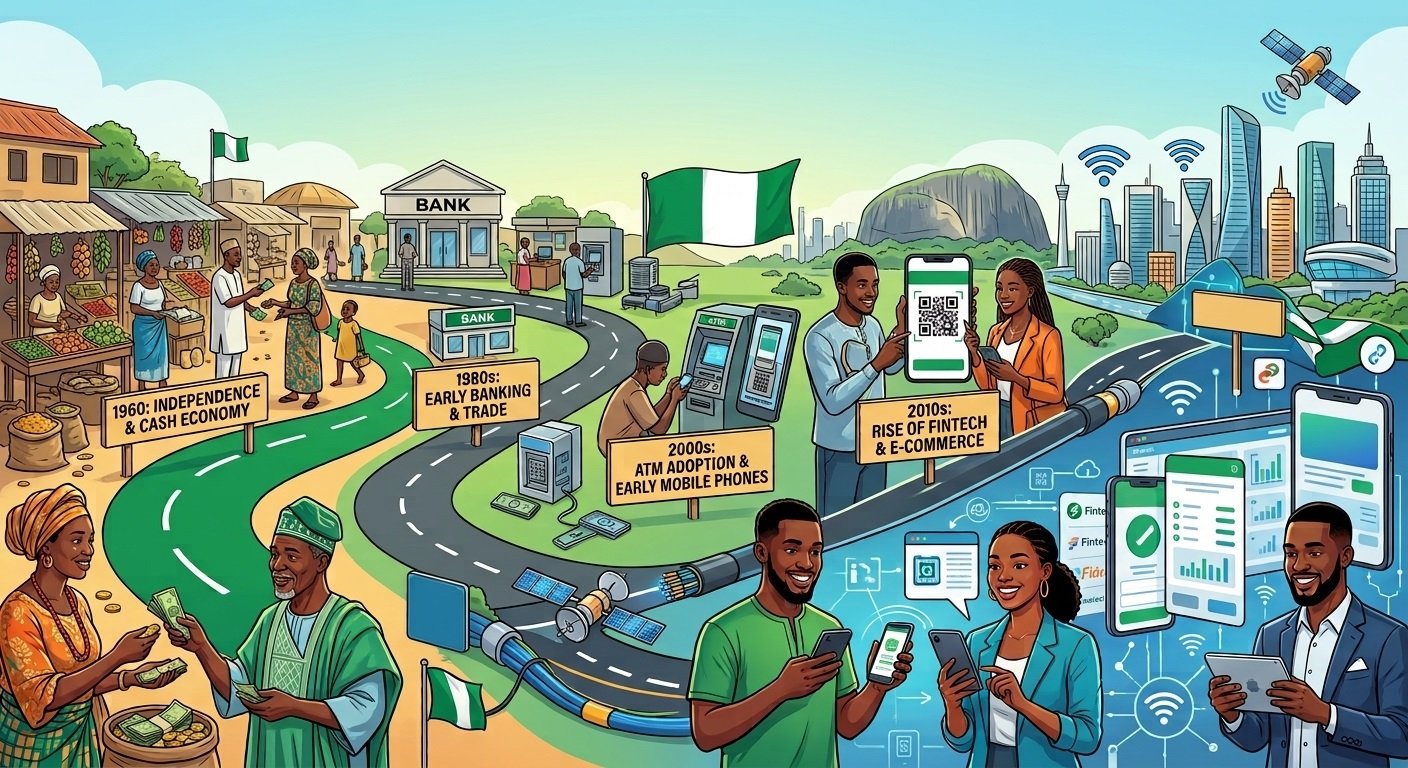
Nigeria’s financial system has gradually moved away from that largely cash and branch-based model.
As the country marks 66 years of independence, payments are increasingly being made through internet transfers, instant payments, POS terminals, mobile applications, cards and other electronic channels, reflecting a broader shift in how Nigerians interact with money.
The transformation, however, did not begin with today’s banking apps. It has been built over decades through the automation of banking services, the expansion of telecommunications infrastructure, regulatory interventions and the development of payment systems that allow money to move electronically between people and businesses.
Building the infrastructure for electronic payments
The foundations of Nigeria’s electronic payment system were laid long before the current era of fintech applications.
The Central Bank of Nigeria’s payment-system history points to several developments in the 1990s and early 2000s, including the establishment of the Nigeria Inter-Bank Settlement System (NIBSS) in 1993, the development of automated clearing and the expansion of electronic banking infrastructure.
The Nigeria Automated Clearing System became operational in 2002, while the CBN issued guidelines on electronic banking in 2003. The development of switching companies and shared ATM and POS networks also helped create greater interoperability across the banking system.
These developments gradually changed what it meant to access banking services.
Instead of every transaction requiring a visit to a bank branch, customers could increasingly use ATMs, cards and electronic channels to access their accounts and move money.
The shift gained further momentum in the 2010s.
The CBN introduced its cashless policy in 2011, with the objective of reducing the volume of physical cash circulating in the economy rather than eliminating cash altogether. The policy encouraged the use of electronic payment channels and was subsequently implemented in phases.
Around the same period, Nigeria’s instant payment infrastructure was developing.
NIBSS Instant Payment, or NIP, was introduced in 2011 and became a major part of the country’s real-time payment system, allowing funds to move electronically between participating bank accounts without customers having to wait for conventional clearing processes. NIBSS says the system has been at the centre of Nigeria’s instant payment ecosystem for more than a decade.
The scale of the shift becomes clearer in the data.
According to the CBN, Nigeria recorded 10.15 billion electronic payment transactions in 2020. The volume rose to 16.33 billion in 2021, 22.07 billion in 2022 and 38.73 billion in 2023.
In the first six months of 2024 alone, the number of electronic payment transactions reached 22.42 billion, with a total transaction value of about ₦1,558.9 trillion.
The figures cover several channels, including ATM, POS, internet, mobile applications, USSD, electronic fund transfers and mobile money.
But not all channels have grown at the same pace.
Internet transfers accounted for 51.91 percent of non-cash retail payment transaction volume in the first half of 2024, making it the most-used channel in the CBN’s breakdown. POS transactions accounted for 28.53 percent, while mobile payments represented 15.58 percent. ATM transactions accounted for 2.21 percent.
The figures show how deeply electronic channels have become embedded in Nigeria’s payment system.
Internet transactions alone reached 11.64 billion in the first half of 2024, compared with 10.43 billion in the second half of 2023. Their value rose from ₦634.96 trillion to ₦825.50 trillion over the same period.
NIP transactions also increased rapidly. The CBN recorded 5.63 billion NIP transactions worth ₦476.89 trillion in the first half of 2024, compared with 4.85 billion transactions worth ₦343.94 trillion in the second half of 2023.
The apex bank attributed part of that increase to the cash scarcity experienced in 2023, which pushed more Nigerians towards electronic channels, as well as the revised cashless policy.
When cash scarcity accelerated the switch
For many Nigerians, the movement towards digital payments was not simply a gradual technological evolution.
The cash shortages experienced in early 2023 accelerated that shift. Nigerians who had traditionally withdrawn cash before making purchases increasingly turned to transfers, POS terminals and other electronic channels when physical currency became difficult to access.
The CBN later attributed part of the increase in NIP transactions to the cash scarcity and the revised cashless policy.
For businesses, the episode also showed how deeply electronic payments had become embedded in everyday commerce. Businesses that previously depended heavily on cash had to find ways to receive electronic payments, while consumers became more accustomed to sending money directly from their bank accounts.
The experience did not mean Nigerians stopped using cash. Instead, it showed that the economy had developed alternative ways of moving money when physical currency became difficult to access.
The POS operator who saw the change firsthand
The development is also visible among small businesses that deal with both cash and electronic payments every day.
Business A.M spoke with two POS operators who said they have seen customers change the way they pay and use cash in their businesses.
Ijeoma Ofoegbu, who started operating a POS business as a full-time venture around 2022 or 2023, said customers initially used her services mainly to withdraw cash, particularly during the period of cash scarcity.
She said customers now use her services for more than cash withdrawals.
“People make transfers to me and I give them cash, or sometimes they give me an account number to send money to. Sometimes they come with their ATM cards and just withdraw,” she said.
Ofoegbu said network problems have not been a major challenge for her business, although failed transactions sometimes occur because of problems with a customer’s bank rather than with the POS terminal.
For Yusuf, a fruit seller who also operates a POS business, the growing demand for electronic payments was one of the reasons he introduced the service alongside his fruit business.
He said customers would often ask whether he had a POS machine, particularly when they wanted to pay for their purchases without cash.
“Some people come, buy from me and pay with their card, but sometimes they pay with cash too. Sometimes people just come and withdraw or transfer to someone,” he said.
From the way customers pay for the fruit they buy, Yusuf said he believes some people carry less cash than they did before, although cash remains part of everyday transactions.
Their experiences show that the shift is not a clean break from cash. Customers move between payment methods depending on what they are buying, where they are and what works at the time.
From bank branches to neighbourhood businesses
The growth of POS infrastructure has helped push electronic payments beyond traditional banking spaces.
The CBN recorded 2.94 million deployed POS terminals in the first half of 2024, up 20 percent from 2.45 million in the second half of 2023.
Transactions through the terminals also increased. POS transaction volume rose from 4.97 billion in the second half of 2023 to 6.40 billion in the first half of 2024, while transaction value increased from ₦61.90 trillion to ₦85.91 trillion.
The figures reflect how payment services have moved closer to where people live, trade and conduct their daily activities.
Digital payments are no longer confined to bank branches, corporate offices or online shopping platforms. They have moved into markets, roadside businesses, neighbourhood shops and small enterprises.
For a fruit seller, trader or small retailer, accepting a transfer or card payment can mean completing a sale even when the customer does not have physical cash.
The ATM, meanwhile, remains part of this wider payment ecosystem. The CBN recorded 16,714 active ATMs in the first half of 2024, down from 17,377 in the second half of 2023. ATM transaction volume, however, increased slightly to 496.44 million, although transaction value fell by about 10 percent to ₦12.21 trillion.
The figures suggest that older payment infrastructure has not disappeared as newer channels grow. Instead, its role is changing within a broader system that gives customers more ways to access and move money.
The smartphone is becoming part of the payment infrastructure
Perhaps the biggest change has been the movement of financial services from physical locations into mobile devices.
In the first half of 2024, mobile app payments recorded 3.49 billion transactions worth ₦159.42 trillion, up from 2.93 billion transactions worth ₦122.74 trillion in the second half of 2023.
USSD also recorded more than 252 million transactions during the period.
For consumers, the growth of these channels means a bank branch is no longer the only place where a financial transaction can begin.
A customer can pay a merchant in another city. A freelancer can receive money from a client without meeting physically. A family member can send money to another state without visiting a bank.
For businesses, the growth of digital payments has also made it easier to receive money from customers who are not physically present.
The physical distance between payer and recipient has therefore become less important to completing a transaction.
Digital payments have not killed cash
The CBN itself notes that cash remains relevant even as non-cash channels continue to grow.
Cash remains important, particularly in informal markets and among people with limited access to digital financial services. It can also become the preferred option when there is poor connectivity, a failed transaction, insufficient digital literacy or a need for immediate physical payment.
The POS operators’ experiences demonstrate this duality.
Customers may transfer money to an agent, withdraw cash, pay with a card or send money to another account, sometimes within the same location.
Nigeria’s transition is therefore not simply a story of cash disappearing. It is a story of Nigerians gaining more ways to move money.
The next payment system is already emerging
Even as Nigerians become accustomed to instant transfers, the infrastructure supporting those payments is evolving.
In June 2025, NIBSS unveiled the National Payment Stack, describing it as a next-generation infrastructure for Nigeria’s instant payment ecosystem. The organisation said the new system builds on the NIP infrastructure, which has supported real-time payments for more than a decade.
The development reflects how the country’s payment infrastructure continues to evolve as transaction volumes grow and consumers become accustomed to faster ways of moving money.
For consumers, the change may appear simple: enter an account number, send money and wait for a notification. Behind that notification, however, sits a payment system that has taken decades to build.
From bank queues and cash withdrawals to cards, POS terminals, USSD, mobile applications and instant transfers, Nigeria’s financial system has gradually moved money from physical spaces into digital networks.
At 66, the country is not completely cashless, nor is cash likely to disappear from everyday transactions anytime soon. But the way Nigerians move money has undeniably changed.
As it stands, the next phase of that journey is set to depend not only on how many digital transactions Nigerians make, but on whether the infrastructure behind them remains reliable, accessible and secure as more of the economy moves through electronic channels.