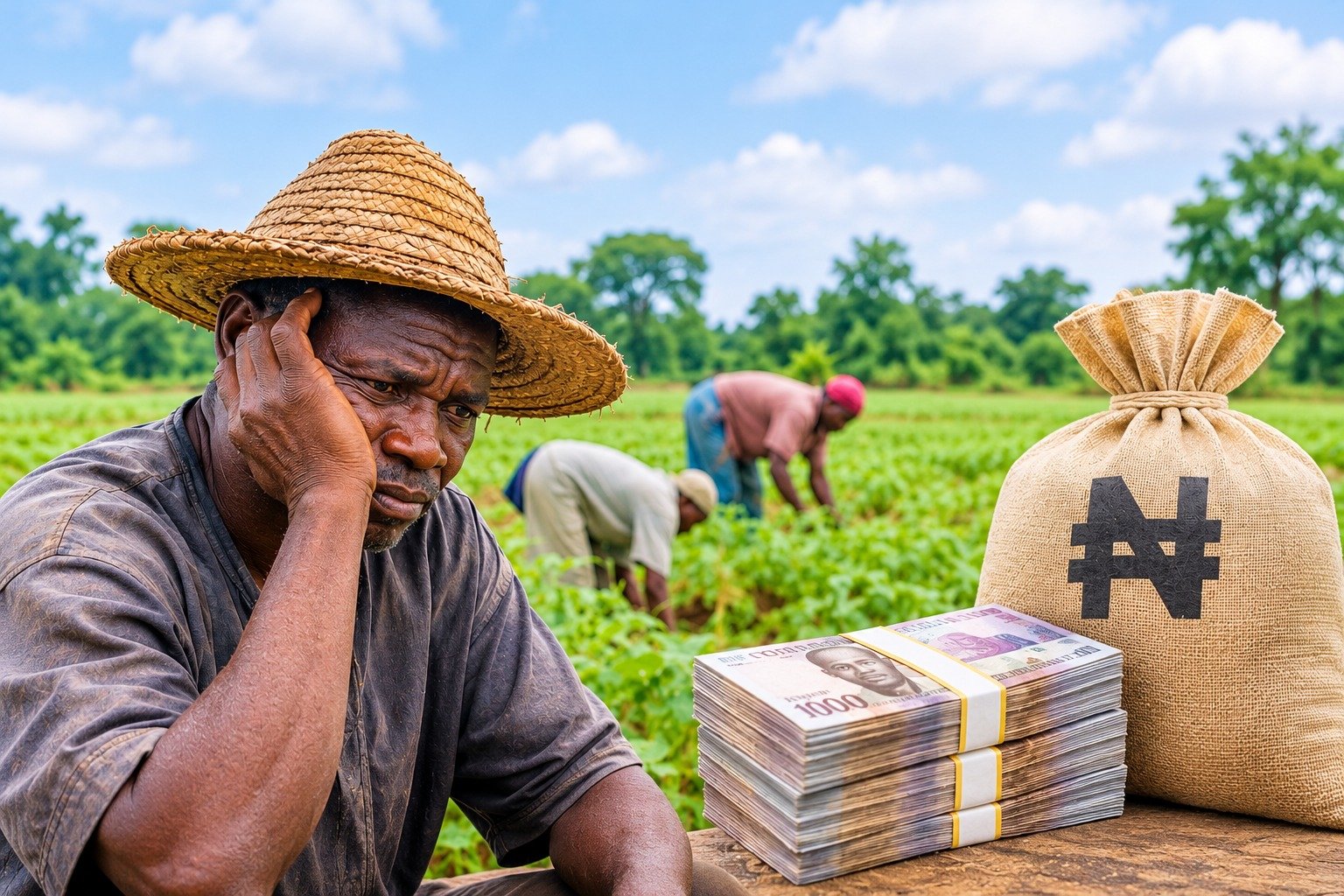
Billions of naira committed to agricultural financing have failed to translate into commensurate production gains, as loan defaults, diversion of funds, high commercial interest rates and weak implementation undermine successive government programmes. With food insecurity persisting, stakeholders are calling for a fundamental shift from subsidised credit to a more commercially viable, accountable and private-sector-driven agricultural financing architecture.
Nigeria’s agricultural financing dilemma is increasingly becoming a story of money spent, promises made and results conspicuously missing. Despite successive administrations committing substantial financial resources, introducing specialised lending programmes and extending incentives to farmers, the country continues to struggle with food insecurity, high food prices, weak agricultural productivity and an increasingly fragile relationship between public investment and tangible economic outcomes.
It is a clear fact that while the number and volume of interventions by the federal and state governments in the agricultural sector have been quite significant, the results of such efforts have not been correspondingly encouraging. The details of these interventions provide clear evidence of considerable support for farmers, much of which, however, has not translated into increased agricultural production or lower food prices.
The contradiction is becoming difficult to ignore. Nigeria has repeatedly mobilised public funds to support farmers, provide agricultural inputs, encourage rural enterprise and reduce the financial burden associated with food production. Yet, the expected transformation in agricultural output, food affordability and rural prosperity has remained elusive.
The central question confronting policymakers, financial institutions and agricultural stakeholders is no longer whether the government should support agriculture, but why substantial financial interventions have failed to produce the desired results.
Several findings have pointed to a combination of low loan recovery rates, misapplication of funds by recipients and the collection of loans by individuals who are not genuine farmers as major explanations for the limited impact of these initiatives. These shortcomings have weakened the effectiveness of agricultural credit programmes and raised concerns about the sustainability of public financing models built around repeated disbursements without adequate accountability.
The latest indication of the scale of the problem comes from the revelation by Michael Ononugbo, a deputy director of the Central Bank of Nigeria (CBN) and special assistant in the office of the bank’s deputy governor in charge of Economic Policy, that N4.7 trillion out of N10 trillion disbursed by the bank as loans in 2025 remains unrecovered.
The disclosure, which represents a substantial outstanding amount, underscores the magnitude of repayment challenges confronting government-supported lending and financial interventions.
A history of ambitious agricultural interventions
Nigeria’s agricultural financing challenges are not new. Successive governments have introduced programmes intended to increase domestic production, improve farmers’ access to inputs and credit, reduce food imports and strengthen agricultural value chains.
The Agricultural Transformation Agenda (ATA), introduced in 2011, was among the significant initiatives designed to reposition agriculture as a major contributor to economic growth and employment.
Subsequent programmes, including the Anchor Borrowers’ Programme (ABP) and the Nigeria Incentive-Based Risk-Sharing System for Agricultural Lending (NIRSAL), introduced under the administration of the late President Muhammadu Buhari, were intended to address longstanding financing constraints and improve agricultural productivity.
The ABP, in particular, was conceived as a mechanism for connecting smallholder farmers with local processors and financial institutions. By creating a structured relationship between agricultural producers and commodity off-takers, the programme sought to improve production, strengthen market access and reduce the country’s dependence on imported agricultural commodities.
The initiative was also expected to conserve foreign exchange reserves by encouraging domestic production of commodities that Nigeria had traditionally imported.
Under the arrangement, participating farmers were expected to receive financing and agricultural inputs while processors and other off-takers provided a market for their produce. The model was intended to reduce the risks associated with agricultural lending and make smallholder farming more commercially attractive.
However, the implementation of the programme reportedly encountered various forms of abuse, including concerns about the integrity of beneficiaries, diversion of funds and difficulties in recovering loans.
The experience has raised questions about whether government-led agricultural credit schemes can achieve their objectives without stronger institutional safeguards and independent monitoring.
NIRSAL was another initiative that initially generated considerable optimism. Its risk-sharing framework was designed to encourage financial institutions to lend to agriculture by reducing their exposure to agricultural credit risks.
The programme sought to address one of the most persistent obstacles to agricultural development: banks’ reluctance to lend to farmers because of perceived risks, uncertain returns and inadequate collateral.
However, its implementation also reportedly suffered setbacks associated with malpractices and weaknesses in beneficiary selection.
Some programme officials were accused of favouring individuals who were not genuine farmers in the distribution of seeds, fertilisers and other essential agricultural inputs.
Such practices undermine the credibility of agricultural financing programmes because they disconnect public expenditure from actual productive activity.
When resources intended for farming are diverted to non-farmers or misapplied, the resulting production shortfall can become difficult to distinguish from the structural challenges facing the sector.
GEEP 3.0: Another intervention, familiar concerns
The launch of the Renewed Hope Government Enterprise and Empowerment Programme (GEEP 3.0) at the beginning of this year represented another attempt by the present administration to improve access to financing for vulnerable agricultural producers and grassroots entrepreneurs.
The programme introduced interest-free and collateral-free lending arrangements intended to support farmers and other economically disadvantaged groups.
Under the FarmerMoni and Dry Season Programme components, more than 20,000 vulnerable and grassroots farmers across Nigeria’s 774 local government areas were targeted to receive N300,000 each.
The intervention was designed to ease the financial constraints confronting farmers, particularly those who lack conventional collateral and cannot access loans from commercial banks.
However, concerns have emerged about whether the programme has achieved a sufficiently visible impact on agricultural production and the broader food economy.
There is, according to the supplied account, no clear evidence that GEEP or its agricultural components have significantly transformed food production.
The concerns surrounding GEEP 3.0 reflect the difficulty of translating government announcements and beneficiary targets into measurable economic outcomes.
A programme may successfully identify thousands of recipients and disburse substantial sums, but its impact ultimately depends on whether the funds are used productively, whether farmers generate additional output and whether the resulting produce reaches consumers at competitive prices.
High interest rates undermine agricultural profitability
Beyond the weaknesses associated with implementation, the cost of agricultural credit is emerging as another major impediment to the success of government financing initiatives.
Danjuma Ibrahim, a political analyst and agripreneur , argues that agricultural financing programmes are failing to adequately support actual farmers because of the high commercial interest rates they are ultimately required to pay.
According to Ibrahim, while the government committed funds to the Agricultural Development Fund structured around an interest rate of five per cent, farmers are ultimately forced to access or receive loans through commercial banks at rates as high as 17.7 per cent.
The discrepancy between the intended financing cost and the actual rate charged to farmers raises questions about the effectiveness of government-supported credit arrangements.
Ibrahim maintains that a 17.7 per cent interest rate makes agricultural investments largely unviable, arguing that farmers cannot reasonably borrow at such a cost, invest in farming operations and expect to repay the loan while retaining a profit.
The concern is particularly significant in a sector where production returns are uncertain and farmers must contend with rising costs of seeds, fertilisers, pesticides, labour, transportation and other inputs.
Unlike many businesses that can adjust prices relatively quickly, farmers frequently operate within seasonal production cycles and have limited control over the prices they receive at harvest.
A farmer borrowing at a high commercial rate may therefore face a situation in which the cost of financing consumes a substantial proportion of the expected operating margin.
This becomes especially problematic for smallholder farmers, whose production scale and bargaining power are limited.
High interest rates can also discourage farmers from making investments in mechanisation, irrigation, improved seeds, storage facilities and other productivity-enhancing assets.
The result is a financing environment in which credit may technically be available, but remains economically inaccessible to the intended beneficiaries.
Financing gap threatens agricultural transformation
Ayoola Oduntan, president of the Feed Industry Practitioners Association of Nigeria (FIPAN), believes that the country’s agricultural financing challenge requires a fundamental restructuring of the relationship between government, financial institutions and private investors.
According to Oduntan, agricultural small and medium-sized enterprises and smallholder farmers face enormous financing shortfalls, with formal credit remaining extremely limited relative to the sector’s requirements.
“Agri-SMEs and smallholders face very large financing shortfalls; formal credit for agriculture is extremely limited relative to need. This limits inputs, mechanization, storage, and scaling,” he said.
His assessment highlights the breadth of the financing problem.
Agricultural credit is not simply required to purchase seeds, fertilisers and other inputs. It is also essential for mechanisation, irrigation, processing, storage, transportation and the expansion of farming enterprises.
Without adequate financing across these activities, farmers may increase production only to encounter bottlenecks in harvesting, storage, processing and distribution.
This can result in post-harvest losses, reduced farm-gate prices and diminished profitability.
Oduntan believes that Nigeria could double credit flow to productive agriculture within five years if government and private-sector partners commit to an effective blended-finance framework.
The proposed approach would involve combining public funding, private capital, development finance and risk-sharing mechanisms to improve access to affordable agricultural loans.
“Government should capitalise and expand risk-sharing facilities and partial credit guarantees, while directing Central Bank incentives toward bankable value chains—not just subsidized inputs,” Oduntan advised.
Risk-sharing and guarantees could unlock private capital
One of the most important elements of Oduntan’s proposal is the expansion of risk-sharing facilities and partial credit guarantees.
Agricultural lending is often considered risky because farmers are exposed to unpredictable weather, pest infestations, market fluctuations, inadequate infrastructure and uncertainties surrounding repayment.
These risks can discourage commercial banks from extending credit, particularly to smallholder farmers who lack conventional collateral.
Partial credit guarantees could help address this problem by allowing government or specialised institutions to absorb an agreed portion of lending losses when qualifying borrowers default.
Such arrangements would not eliminate credit risk, but could reduce banks’ exposure sufficiently to encourage more lending.
The effectiveness of these facilities would depend on transparent eligibility criteria, proper monitoring and a clear allocation of responsibilities between lenders, borrowers and guarantors.
Fintech, warehouse receipts and innovative lending
Oduntan also urged private investors and fintech platforms to expand the use of alternative financing mechanisms, including invoice financing, warehouse receipts and pay-as-you-harvest loans integrated with mobile payment systems.
These instruments could provide farmers with access to financing beyond conventional bank loans.
Invoice financing, for example, allows businesses to obtain funds against outstanding payments owed by customers.
Warehouse receipt financing offers another potential solution.
Under this arrangement, farmers or agricultural businesses can use stored commodities as collateral for loans, allowing them to obtain working capital without immediately selling their produce.
The mechanism could be particularly valuable to farmers who face pressure to sell immediately after harvest, when market prices are often depressed by seasonal supply increases.
By improving access to financing, warehouse receipt systems could enable farmers to store commodities and sell when market conditions are more favourable.
Agricultural insurance: The missing link
Another important component of agricultural financing reform is the expansion of index-based crop and weather insurance.
Oduntan argues that improving agricultural insurance coverage would reduce lending risks and encourage banks to provide longer-term financing.
Agricultural insurance is particularly important because farmers face risks that are often beyond their control.
Flooding, drought, extreme temperatures and other weather-related events can significantly affect production and repayment capacity.
Traditional insurance arrangements can be expensive and difficult to administer, particularly when individual farm losses must be assessed.
Index-based insurance offers an alternative by linking payouts to predetermined indicators such as rainfall levels, temperature or other measurable weather conditions.
When the agreed threshold is reached, eligible farmers receive compensation without necessarily requiring individual farm inspections.
Such arrangements could improve the speed and efficiency of insurance payouts, although the risk of basis risk—where the insurance index does not accurately reflect the actual losses suffered by a farmer—must be carefully managed.
Beyond credit: Storage, logistics and value-chain integration
Oduntan’s argument also underscores the need to broaden agricultural investment beyond the provision of inputs and loans.
Nigeria’s agricultural sector continues to face structural challenges involving storage, transportation, processing and market integration.
These weaknesses can undermine the value of additional production.
When farmers lack adequate storage facilities, they may be forced to sell immediately after harvesting, often at lower prices.
Poor transportation infrastructure and inefficient logistics can increase the cost of moving agricultural produce from rural communities to markets and processing facilities.
Inadequate processing capacity can also limit the value farmers derive from their harvests.
According to Oduntan, investment must therefore target storage, logistics and value-chain integration to reduce post-harvest losses and improve farmers’ incomes.
This approach, he explained, would require agricultural financing to support not only primary production but also the businesses and infrastructure that connect farmers to consumers.