Experts are coming up with ideas and ways through which Nigeria can maximise the benefits of the new African Continental Free Trade Agreement (AfCFTA), amidst concerns that the country faces a bogus challenge to maintain her leadership of the region’s economy, writes SAMSON ECHENIM.
RECENTLY, AT A SUMMIT in Niger, Nigeria joined other African countries, which have adopted the African Continental Free Trade Agreement (AfCFTA), which came into force on May 30, 2019 and entered into its operational phase on July 7, 2019, at the Niger summit.
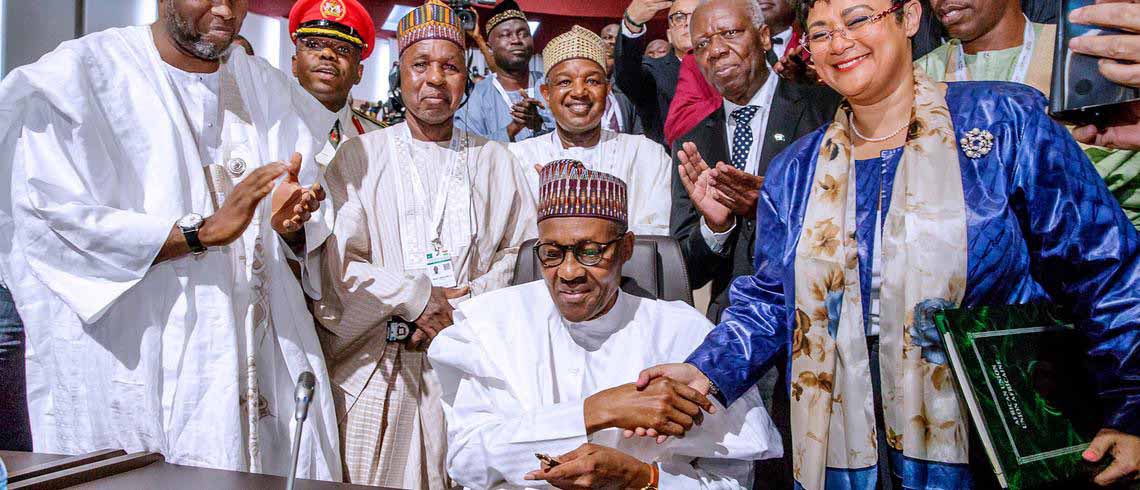
The AfCFTA seeks to reduce trade barriers between the different pillars of the African economic community, and eventually use these regional organisations as building blocks for the ultimate goal of an Africa-wide customs union.
However, the ratification of the AfCFTA by the Nigerian government has generated concerns from both importers and manufacturers who have raised fears that the trade agreement might lead to Nigeria becoming a dumping ground for substandard goods manufactured in other African countries.
Nigerian investors are afraid that with the perpetual poor supply of electricity that businesses are currently contending with, the country will have little or nothing to benefit from the agreement.
Mansur Ahmed, president of the Manufacturers Association of Nigeria (MAN) had warned that the country might be turned into a dumping ground by some countries, which have manufacturing edge over Nigeria, but with far lesser population and smaller market.
Shortly after President Muhammadu Buhari ratified the pact in Niger, Akinwumi Adesina, African Development Bank president had said, “Infrastructure is the most critical aspect. If costs of doing trade continue to be high because you have an infrastructure deficit, this will be the biggest challenge.”
Commenting on the development, electricity generation companies (GENCOs) under the aegis of the Association of the Power Generation Companies (APGC), said, the critical role of power as a veritable physical infrastructural tool for economic growth, industrialisation, and development cannot be over-emphasized.
“The availability of adequate power supply is directly proportional to the associated extensive technology-based development in the production and manufacturing sector.
“Steady and regular power supply is needed for different type of industries, where goods, appliances, tools, instruments, machines, modern communication equipment and gadgets, vehicles, aircrafts, ships are manufactured,” said Joy Ogaji, executive secretary of the APGC.
As the biggest economy in Africa, with gross domestic products (GDP) of about $400 billion, the APGC boss said the new agreement clearly presents Nigeria the potential opportunity to play a more active role in both the regional and global economy.
Also, at the Aid for Trade Global Review organised recently by the World Trade Organisation (WTO), Stephen Karingi, regional director, United Nations (UN) Economic Commission for Africa, says the new AfCFTA has the “capacity to increase inter-African trade by between 15 and 25 per cent, with two-thirds of gains in industrial goods trade.”
According to him, the potential growth in inter-African trade figure is important for African countries seeking to reduce their dependence on raw commodities and provides a good incentive for policies promoting industrialisation and diversification.
Ken Ike, a professor of economics, there are three levels of every continental trade agreement and so is with the AfCFTA. Level 1 involves the first Protocol of the free trade area provides for free movement of goods, services, capital and right of establishment, while the second protocol deals on value added products and trade liberalisation scheme and this provides for rule of origin, product and company registration. It also involves harmonisation and coordination of trade policy, trade facilitation regimes and instruments across RECs. Level 2 deals with issues around the ECOWAS Common External Tariffs and the third level, being issues on monetary union by accession to ECOWAS single currency and convergence criteria.
Therefore, Ike says, there are compelling strategic security, political, diplomatic biggest contributor to the region, a member of the UN Security Council, largest economy in Africa, country with the biggest population and with oil resources and biggest indigenous multinationals, like Dangote. Nigeria is also a big brother in the continent playing significant socio-political roles, such as it did in the ECOMOG and South Africa’s apartheid liberation, but we must also bear Brexit in mind,” he said.
What Nigeria needs to do
Nigeria is the main event in AfCFTA, being instrumental to its conception and realisation.
The macro-economic policy analyst says the government needs to develop AfCFTA regional strategy as part of the country’s regional integration and trade facilitation strategies and incorporate it into its ERGP with specific cross-sectoral action points.
“We need to avail of the AfCFTA dispute resolution mechanism to call to order South Africa and Angola xenophobia attacks and Ghana investment enforcement actions on Nigeria since ECOWAS Court of Justice does not have jurisdiction beyond human rights issues to deal with trade economic reasons Nigeria must optimise the benefits of AfCFTA.
“Africa is the centrepiece of Nigeria’s foreign policy. The country is founder of NEPand economy.
“We also need to capitalise on the presidential directive on 10 items the Central Bank of Nigeria’s compliance action against smuggling and dumping of goods as well as fully implement Presidential Order 003 on made-in-Nigeria goods and trade local procurement initiatives,” Ike advised.
The professor of macro-economics stresses that Nigeria should seek extension of Lamu/Mombasa-Cameron Continental Railway corridor to the seaport in Port Harcourt and Lekki deep seaport.
“This will consolidate Nigeria’s position as the largest maritime hub in Africa for goods coming from US, Canada, Europe, Russia and South America. This will deliver huge economies of scale, optimisation of multi-modal transport/logistics and connecting to Lamu/Mombasa deep seaport trade Hub closest to China, India, Japan ans SE Asia.
Also the Democratic Republic of Congo INGA-2 power pool extension to Nigeria through Cameroun, to deliver 10,000 MW to our national grid,” he noted.
No fears for manufacturers
AfDB boss, Adesina said AD, vessel“Manufacturing, trading in value-added products and strengthening supply chains will allow for markets to grow and for new markets to emerge,” Adesina said, adding that “SMEs that account for 80 percent of all trade on the continent will benefit, as well as the financial sector, as digital payments will be needed to transact.”
Commodity exports dominate even in Africa’s two biggest economies, with mining production accounting for about half of South Africa’s shipments while crude oil generates 90 percent of Nigeria’s foreign income.
However, the AfDB boss said the mechanics of the AfCFTA now has to be negotiated, noting that a digital system for payments converging one country’s currency to another member state’s is the most important mechanism to have in place before trading starts.
“That’s where the Economic Community of West African States’ plan to adopt a common trade currency will also help because it could reduce foreign-exchange risks,” he said.
Access to the continental market and an increased focus on industrialization are likely to benefit countries with access to ports, railways and airports the most, Adesina said. The continent’s infrastructure funding needs are at $130 billion to $170 billion a year, with a financing gap in the range of $68 billion to $108 billion, according to AfDB estimates.
As part of plans to set the trade agreement in motion, the AfDB will provide $4.8 million for member states to set up the trade zone’s headquarters in Ghana and has asked its board for a general capital increase to invest in infrastructure and support the free-trade area.
The African Export-Import Bank has also said it will establish a $1 billion facility to enable countries that signed up to the trade deal to adjust to reduced tariffs as a result of the pact.
Outstanding issues like the trade concession agreements and rules of origin remain under negotiation. Ike said Nigerian government cannot now afford to fold its arms and watch while smaller countries take the lead.