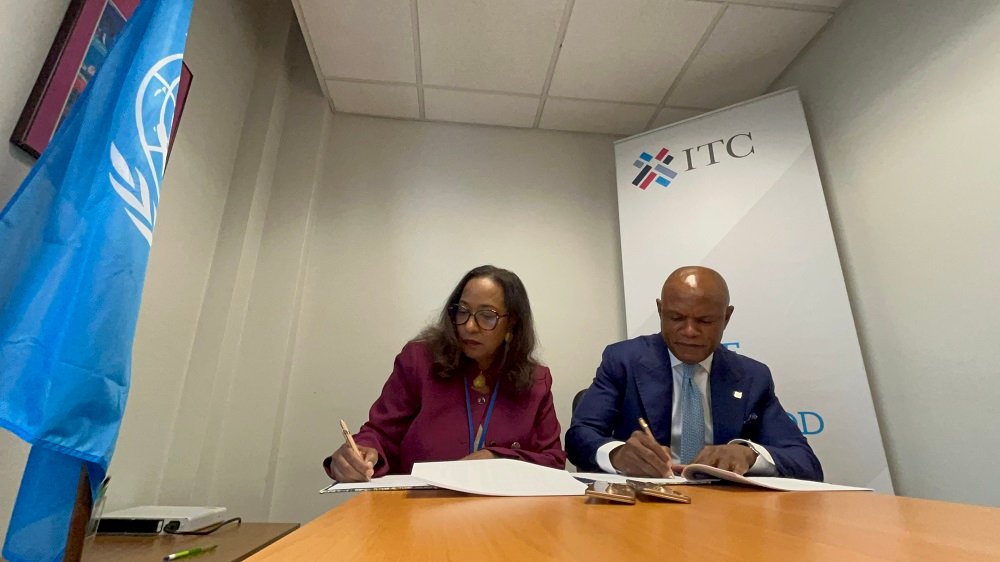
The International Trade Centre (ITC) and Access Africa Office, the coordinating office for the African subsidiaries of Access Bank Plc, have entered a three-year partnership aimed at expanding access to finance, markets and skills for small and medium-sized enterprises (SMEs) across 14 African countries.
The programme, which will begin with a pilot in Ghana, seeks to address some of the structural constraints facing small businesses across the continent, particularly limited access to capital, market opportunities and trade-related skills.
The partnership was formalised through a memorandum of understanding signed on the sidelines of the United Nations General Assembly in New York.
Under the agreement, the two institutions will focus on five priority areas: job creation through SMEs; access to finance, with particular attention to women- and youth-owned enterprises; business sustainability; capacity building, including digital trade skills; and access to markets, including support for intra-African trade under the African Continental Free Trade Area (AfCFTA).
The participating countries are Angola, Botswana, Cameroon, Democratic Republic of Congo, The Gambia, Ghana, Guinea, Kenya, Mozambique, Rwanda, Sierra Leone, South Africa, Tanzania and Zambia.
The partnership combines ITC’s technical expertise in trade development, business capacity building and market connections with Access Bank’s regional banking network and customer reach.
According to the partners, the collaboration is designed to move beyond access to credit by combining financing with the skills, networks and market connections businesses need to expand sustainably.
Implementation will begin with a pilot running from September 2026 to June 2027, targeting a cohort of small businesses in Ghana, with women-led enterprises receiving priority.
The pilot will draw on ITC’s existing digital learning tools and training-of-trainers programmes, delivered in coordination with staff from the Access Africa Office.
The partners intend to expand the programme from 2027 to additional countries and programmes, including advanced training on sustainability standards and digital marketplace tools.
The partnership is built around the premise that financing, while critical, is only one component of SME growth.
Pamela Coke-Hamilton, executive director of the International Trade Centre, said access to finance remains the biggest barrier to trade faced by small businesses across Africa, adding that the partnership would combine financing with knowledge, networks and market connections.
Seyi Kumapayi, executive director, African Subsidiaries at Access Bank, said the bank’s experience showed that finance alone was insufficient to take a small business to scale.
“It is the combination of capital, market access and trade-ready skills that makes the difference,” Kumapayi said.
AfCFTA creates wider market opportunity
Market access is expected to be a major component of the programme, particularly as businesses seek to take advantage of the opportunities created by the AfCFTA.
By combining trade-related training with financial access and market connections, the programme seeks to help participating SMEs become better prepared to participate in cross-border commerce.
Access Bank’s existing footprint is expected to provide the partnership with a regional platform for implementation and potential expansion.
The bank operates across Africa through a network of more than 700 branches in 25 countries across three continents, serving more than 63 million customers.
The scale of that network gives the initiative a potential pathway for expanding beyond the initial Ghana pilot as the programme develops from 2027.