Nigeria’s digital economy is entering a decisive new phase; one in which artificial intelligence is no longer a futuristic add-on but an embedded layer of labour reshaping productivity, skills formation, and income potential across sectors to the tune of about $4.7 billion in annual productivity gains. Recent data released by Google shows that millions of Nigerians are now deploying Search and AI tools not just for information, but as functional co-workers, augmenting their capacity to learn, create, and compete in a global marketplace.
This development reframes the conversation around technology adoption in Africa’s fourth largest economy. Rather than focusing solely on startups, platforms, or infrastructure, the emerging story is one of distributed productivity: individuals using AI to compress learning cycles, reduce costs of skill acquisition, and increase output in both formal and informal sectors.
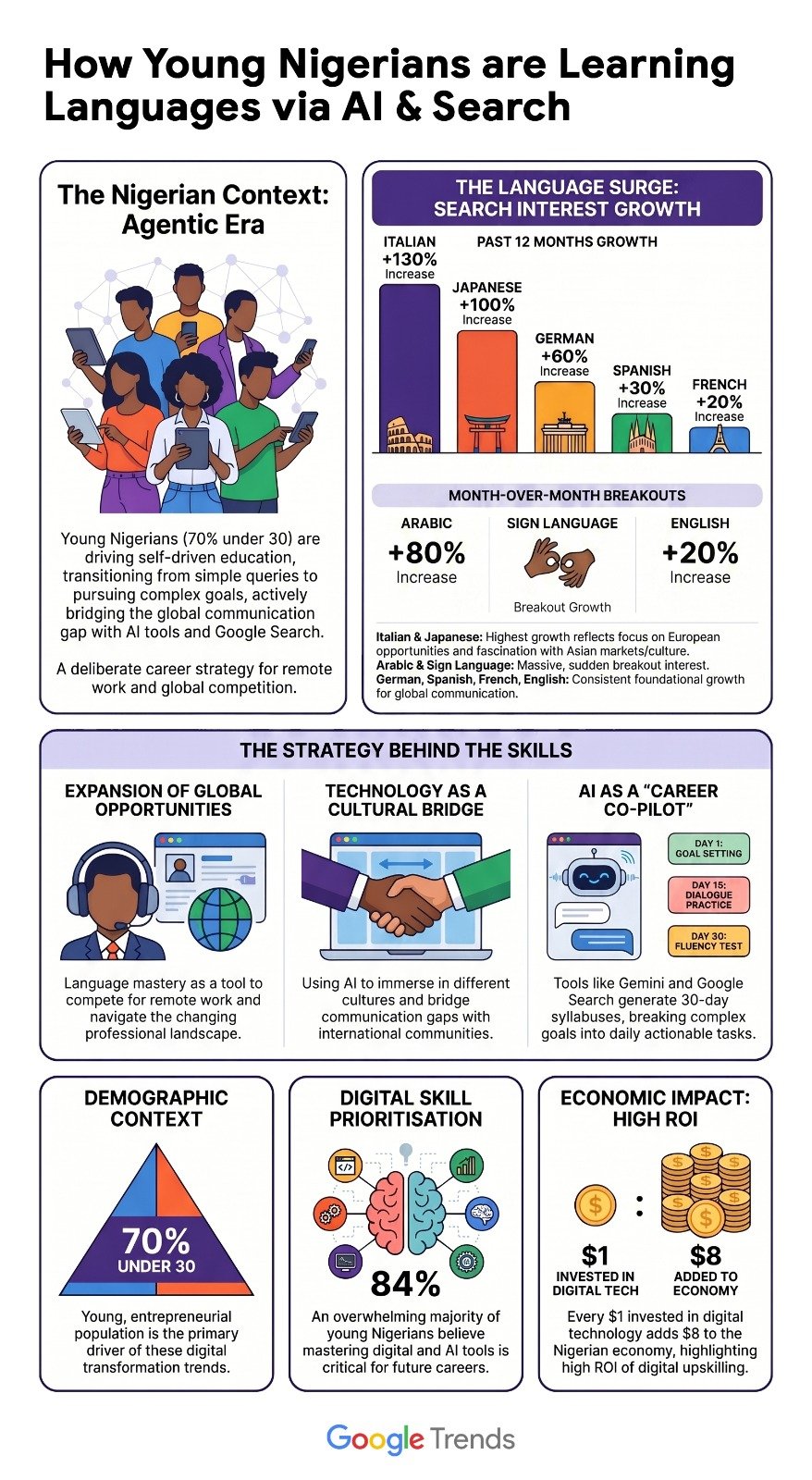
At the macro level, Nigeria’s digital transformation has long been associated with strong returns on investment. Analysis from Public First estimates that every dollar invested in digital technology generates more than eight dollars in economic value. But the latest behavioural data indicates that this multiplier effect is now playing out at the micro level; within households, classrooms, and creative studios.
Search and AI tools are increasingly functioning as what economists might term “labour-augmenting technologies.” They reduce the marginal cost of acquiring new skills and enable individuals to perform tasks that previously required formal training or institutional support.
This is particularly significant in a country where demographic pressure, driven by a young and rapidly growing population, demands scalable, low-cost pathways to skills development.
The data reveals an increase in self-directed learning across creative and technical disciplines. Interest in painting has increased by 90 percent over the past year, while calligraphy has emerged as a breakout trend, reflecting a diversification of creative output beyond commercially dominant sectors.
Music education is undergoing a similar decentralisation. Searches for learning the guitar have risen by 80 percent, indicating that aspiring musicians are bypassing traditional gatekeepers and using digital tools to build foundational skills. At the same time, more advanced users are experimenting with AI-native platforms such as Lyria 3, signalling early adoption of generative tools in music production.
This pattern is not limited to the arts. Language acquisition, often a proxy for global economic integration, is also accelerating. Searches for Italian have surged by 130 percent, while interest in Japanese has doubled year-on-year.
The cumulative effect of these individual behaviours is already measurable. Google estimates that its ecosystem of tools, including Search and Workspace, is saving Nigerian knowledge workers more than 22 million hours each week. In economic terms, that translates into about $4.7 billion in annual productivity gains.
This is not merely a matter of convenience; it represents a structural improvement in how labour is deployed. Time saved on routine or information-intensive tasks can be reallocated to higher-value activities such as content creation, problem-solving, and innovation.
In effect, AI is enabling a form of “productivity leapfrogging,” allowing Nigerian workers to bypass traditional constraints associated with limited access to training, mentorship, or physical infrastructure.
Nowhere is this shift more evident than in education. The data shows that searches for AI tutors have become a breakout trend, while interest in combining AI with subjects like chemistry has doubled over the past year. Homework-related queries have also risen sharply, increasing by 70 percent in a single month.
This points to the emergence of a hybrid learning model in which formal education is supplemented by on-demand digital instruction. For students and parents navigating an often overstretched education system, AI tools are filling critical gaps in access and quality.
The viability of this transformation rests heavily on connectivity. The deployment of the Equiano subsea cable has significantly expanded Nigeria’s internet capacity, delivering speeds and reliability that make real-time AI interaction feasible at scale.
The economic implications are well documented. Amongst these is a one percent increase in connectivity is associated with a 5.7 percent rise in GDP. In this context, infrastructure investments are not just about access; they are about enabling a new mode of economic participation.
Nigeria’s established creative sectors provide a useful lens through which to view these changes. Nollywood, now the fifth-largest film industry globally with a valuation approaching $8 billion, and the Afrobeats ecosystem, where annual streams exceed 13 billion on platforms like Spotify, have already showcased the country’s capacity to generate globally competitive content.
What AI introduces is the potential to scale this success more broadly. By lowering barriers to entry, digital tools enable a wider pool of creators to participate in the value chain, from production and editing to marketing and distribution.
Moreover, with over 70 percent of watch time for Nigerian content coming from international audiences, the integration of AI-driven workflows could further enhance export competitiveness by improving quality, speed, and localisation.
According to Taiwo Kola-Ogunlade, head of communications and public affairs for West Africa at Google, the trends reflect a deeper behavioural shift.
He noted that Nigerians are using AI as 24/7 tutors to master high-demand skills and connect with the world,” describing the phenomenon as a form of everyday resourcefulness that is unlocking new opportunities for learning and entrepreneurship.
“It is inspiring to see how Nigerians are creatively and purposefully using AI to unlock new opportunities for learning and growth. The surge in creative arts and language mastery shows a nation that is actively shaping its future with technology. Nigerians are using Search and AI as 24/7 tutors to master high demand skills and connect with the world. This everyday resourcefulness is helping our entrepreneurial population achieve their highest ambitions,” he stated.
Perhaps the most telling metric in the dataset is the 840 percent increase in AI literacy. This is not incremental growth; it is exponential adoption, indicative of a population rapidly internalising the relevance of AI to both professional and creative pursuits.
From a policy and investment perspective, this raises important questions. How can regulators ensure equitable access to these tools? What frameworks are needed to support responsible use? And how can Nigeria position itself not just as a consumer of AI, but as a contributor to its development?