Business A.M
No Result
View All Result
Tuesday, July 14, 2026
  • Login
  • Home
  • Technology
  • Finance
  • Comments
  • Companies
  • Commodities
  • About Us
  • Contact Us
Subscribe
Business A.M
  • Home
  • Technology
  • Finance
  • Comments
  • Companies
  • Commodities
  • About Us
  • Contact Us
No Result
View All Result
Business A.M
No Result
View All Result
Home Comments

Can Narendra Modi and Donald Trump recreate the magic of the Obama years?

by Admin
June 26, 2017
in Comments

Indian Prime Minister Narendra Modi is scheduled to hold official talks with US President Donald Trump in Washington DC on 26 June,  in what will be the first meeting between the two leaders.

This is not the same country that witnessed roaring chants of “Modi! Modi!” at the iconic Madison Square Gardens in New York during the Indian prime minister’s first visit to the United States in September 2014.

He was then a rock star to India’s two million strong diaspora.

He is still a star to many Indians in the US and other parts of the world. But times have changed.

There is little space for global political stardom in a country led by a president whose tolerance for foreign glamour shows is about as limited as his penchant for anything international.

President Barack Obama, who met Modi several times and visited India twice during his presidency, was all about the international. Mr Modi’s engagement with the Indian diaspora was not only encouraged but also cheered by officials in the White House.

The Obama years witnessed the buttressing of trade opportunities between India and the US, partly transformed the defence relationship between the two countries, and paved the way for the operationalisation of what is known as the US-India Nuclear Deal.

Further, Obama made clear his unyielding aim to curb carbon emissions. On 2 October 2016, Mahatma Gandhi’s birth anniversary, India handed over an instrument of ratification to join the Paris climate change agreement.

Obama’s praise was quick to come. He tweeted, “Gandhiji believed in a world worthy of our children. Modi and the Indian people,” he argued, “carry on that legacy.”

India’s commitment to the agreement was not only about climate change. It was about a pledge to an international system that relies on collective responsibility.

Since at least the election of President Dwight Eisenhower in 1952, the US has nudged India to work with and within this system. This was impossible for a variety of reasons, not the least because of the need to remain “free of entanglements,” as India’s first Prime Minister Jawaharlal Nehru put it.

Yet, differences, when they emerged, were managed because of a common sense for each other’s vantage points.

Also read: Global oil prices inch up on hopes of oil glut abating as US refineries back online

A ‘promising’ relationship

In the 21st Century, and ever since George W Bush was elected in 2001, the key consideration in the US-India book of relations has been future potential. For Washington’s insiders, India was the long game. The promise of Indian economic and military growth, it was surmised, would ultimately serve American interests.

A stronger India was expected to partially balance the scales with regards to China’s ever-expanding footprint. In return, India was expected to give little in the immediate term. This was about reaping dividends in the future on investments made by America in the present.

For the first time in 60-odd years, Mr Trump’s election has potentially punctured (if not ended) the underlying contours of this storyline.

Visible and quick returns are the new game in Washington.

No national leader, Modi included, is likely to be spared. Take for instance Trump’s scathing attack on India following the US withdrawal from the Paris agreement. Trump argued that India made its “participation contingent on receiving billions and billions and billions of dollars in foreign aid from developed countries”.

The White House has also made clear its desire to reform the H-1B visa that in the past allowed thousands of Indian technology workers to make their way to Silicon Valley. Indian firms in the United States have been quick to announce their desire to hire US workers in a bid to dodge Trump’s ire.

Meanwhile, corporate America is less-than-optimistic about India’s economic progress. The Indian government’s recent decision to place price caps on certain pharmaceutical products, hence hurting profit margins for foreign firms that produce these specialised goods, is likely to be one of the many issues raised by CEO’s during a round table on 25 June.

Follow Businessamlive on Twitter and Facebook.
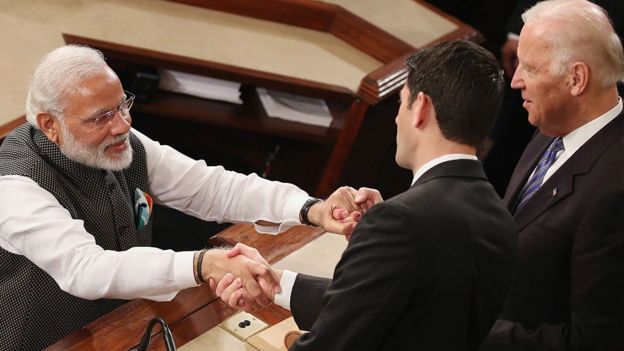
Indian Prime Minister Narendra Modi, (L), shakes hands with House Speaker Paul Ryan (R-WI), (C), and US Vice President Joseph Biden (
The Modi government has done more to tie India’s coattails to the US political apparel than almost any other in India’s past

Since taking office, Modi’s government has done more to tie India’s coattails to the US political apparel than almost any other in India’s past.

This includes signing a defence logistics agreement and entering international conventions to help allow US firms the possibility of investing in India’s nuclear market.

Striking a personal bond with Trump may allow Modi the opportunity to explain India’s position on contentious subjects like climate change and make a case for H-1B visas.

In turn, asking for US assistance on issues seemingly close to the prime minister’s heart (such as membership to the Nuclear Suppliers Group) will require “deals” that India has been less accustomed to making in the age of promise before Trump.

How Mr Modi deals with Trump will partially shape the future of the US-India relationship.

Equally, it will say as much about the values he represents as a statesman who, much like Obama, has promoted an international image of himself since his electoral victory in 2014.


Courtesy BBC

Admin
Admin
Previous Post

FG tasked on speedy implementation of collateral registry act to boost SME access to finance

Next Post

Abu Dhabi’s Mubadala fund pulls out of Etisalat Nigeria

Next Post

Abu Dhabi’s Mubadala fund pulls out of Etisalat Nigeria

  • Trending
  • Comments
  • Latest

CBN to issue N1.5bn loan for youth led agric expansion in Plateau

July 29, 2025

How UNESCO got it wrong in Africa

May 30, 2017

Glo, Dangote, Airtel, 7 others prequalified to bid for 9Mobile acquisition

November 20, 2017
NGX taps tech advancements to drive N4.63tr capital growth in H1

Insurance-fuelled rally pushes NGX to record high

August 8, 2025

6 MLB teams that could use upgrades at the trade deadline

Top NFL Draft picks react to their Madden NFL 16 ratings

Paul Pierce said there was ‘no way’ he could play for Lakers

Arian Foster agrees to buy books for a fan after he asked on Twitter

NAAPE moves to shield pilots, engineers with loss-of-licence insurance scheme

NAAPE moves to shield pilots, engineers with loss-of-licence insurance scheme

July 14, 2026
Global airlines are investing heavily in economy class cabins as competition for passengers shifts beyond ticket prices to the quality of the travel experience, prompting carriers to modernise fleets, redesign cabins and enhance onboard services in a bid to strengthen customer loyalty and improve long-term profitability. The renewed focus reflects a transformation in the aviation industry, where economy class, despite offering lower fares than premium cabins, remains the largest contributor to passenger volumes and an increasingly important driver of commercial performance. With millions of travellers continuing to prioritise affordability, airlines are finding that modest improvements in comfort and convenience can translate into stronger repeat business, improved customer satisfaction and higher ancillary revenues. As a result, carriers are directing substantial investment towards upgrading economy cabins through newer aircraft, ergonomically designed seats, advanced inflight entertainment systems, onboard connectivity, enhanced catering and improved cabin service. Industry analysts say the strategy is becoming a key differentiator as airlines compete more aggressively for passengers on both regional and long-haul routes. Unlike business and first-class travellers, whose numbers are relatively limited, economy passengers account for the overwhelming majority of airline traffic, making their overall travel experience increasingly central to airlines' growth strategies. Rather than relying solely on fare reductions to attract customers, airlines are seeking to build stronger brand loyalty by improving the value passengers receive throughout their journeys. "Passenger expectations have changed significantly. Travellers increasingly compare airlines based not only on ticket prices but also on comfort, reliability, connectivity and the overall onboard experience," aviation analysts note. Several of the world's leading airlines have already embraced the strategy. Carriers including Singapore Airlines, Qatar Airways, Emirates, Turkish Airlines, All Nippon Airways (ANA), EVA Air and Cathay Pacific have invested significantly in upgrading their economy cabins through improved seating, larger entertainment libraries, enhanced meal services and customer-focused cabin experiences. Although each airline has adopted different approaches, the underlying objective remains the same: making economy travel more comfortable for the largest segment of their customer base while strengthening long-term commercial competitiveness. Fleet modernisation is playing a critical role in that transformation. Next-generation aircraft such as the Boeing 787 Dreamliner, Airbus A350 and Airbus A321neo are enabling airlines to improve the passenger experience while simultaneously lowering operating costs. Compared with older aircraft, these models offer quieter cabins, larger windows, improved air quality, better humidity control and greater fuel efficiency, creating benefits for both passengers and airline operators. The newer aircraft also reduce fuel consumption and maintenance expenses, allowing airlines to improve customer experience without significantly increasing operating costs over the aircraft's lifespan. Technology has emerged as another major area of investment. Features once reserved almost exclusively for premium cabins, including USB charging ports, wireless internet connectivity, mobile application integration and personalised digital entertainment platforms, are increasingly becoming standard in economy class. Passengers are also benefiting from greater control over their travel experience, with digital services allowing them to access entertainment, communicate onboard and manage various aspects of their journeys more conveniently. The growing investment reflects changing consumer expectations in an increasingly digital travel environment. Recent international passenger satisfaction surveys consistently indicate that airlines investing in cabin comfort, inflight technology and customer service continue to perform strongly in global service rankings. While competitive pricing remains an important consideration for travellers, customer experience has become an increasingly influential factor in airline selection, particularly on medium and long-haul routes where comfort plays a greater role in purchasing decisions. The trend is expected to reshape competition within Africa's aviation industry as airlines expand their fleets to meet growing passenger demand.

Global airlines raise economy class spending to win passenger loyalty

July 14, 2026
US

How Vulnerable Are US Financial Markets?

July 14, 2026
Development

Reinventing Development Finance

July 14, 2026

Popular News

  • CBN to issue N1.5bn loan for youth led agric expansion in Plateau

    0 shares
    Share 0 Tweet 0
  • How UNESCO got it wrong in Africa

    0 shares
    Share 0 Tweet 0
  • Glo, Dangote, Airtel, 7 others prequalified to bid for 9Mobile acquisition

    0 shares
    Share 0 Tweet 0
  • Insurance-fuelled rally pushes NGX to record high

    0 shares
    Share 0 Tweet 0
  • Major tech companies conquering Africa with sports

    0 shares
    Share 0 Tweet 0
Currently Playing

CNN on Nigeria Aviation

CNN on Nigeria Aviation

Business AM TV

Edeme Kelikume Interview With Business AM TV

Business AM TV

Business A M 2021 Mutual Funds Outlook And Award Promo Video

Business AM TV

Recent News

NAAPE moves to shield pilots, engineers with loss-of-licence insurance scheme

NAAPE moves to shield pilots, engineers with loss-of-licence insurance scheme

July 14, 2026
Global airlines are investing heavily in economy class cabins as competition for passengers shifts beyond ticket prices to the quality of the travel experience, prompting carriers to modernise fleets, redesign cabins and enhance onboard services in a bid to strengthen customer loyalty and improve long-term profitability. The renewed focus reflects a transformation in the aviation industry, where economy class, despite offering lower fares than premium cabins, remains the largest contributor to passenger volumes and an increasingly important driver of commercial performance. With millions of travellers continuing to prioritise affordability, airlines are finding that modest improvements in comfort and convenience can translate into stronger repeat business, improved customer satisfaction and higher ancillary revenues. As a result, carriers are directing substantial investment towards upgrading economy cabins through newer aircraft, ergonomically designed seats, advanced inflight entertainment systems, onboard connectivity, enhanced catering and improved cabin service. Industry analysts say the strategy is becoming a key differentiator as airlines compete more aggressively for passengers on both regional and long-haul routes. Unlike business and first-class travellers, whose numbers are relatively limited, economy passengers account for the overwhelming majority of airline traffic, making their overall travel experience increasingly central to airlines' growth strategies. Rather than relying solely on fare reductions to attract customers, airlines are seeking to build stronger brand loyalty by improving the value passengers receive throughout their journeys. "Passenger expectations have changed significantly. Travellers increasingly compare airlines based not only on ticket prices but also on comfort, reliability, connectivity and the overall onboard experience," aviation analysts note. Several of the world's leading airlines have already embraced the strategy. Carriers including Singapore Airlines, Qatar Airways, Emirates, Turkish Airlines, All Nippon Airways (ANA), EVA Air and Cathay Pacific have invested significantly in upgrading their economy cabins through improved seating, larger entertainment libraries, enhanced meal services and customer-focused cabin experiences. Although each airline has adopted different approaches, the underlying objective remains the same: making economy travel more comfortable for the largest segment of their customer base while strengthening long-term commercial competitiveness. Fleet modernisation is playing a critical role in that transformation. Next-generation aircraft such as the Boeing 787 Dreamliner, Airbus A350 and Airbus A321neo are enabling airlines to improve the passenger experience while simultaneously lowering operating costs. Compared with older aircraft, these models offer quieter cabins, larger windows, improved air quality, better humidity control and greater fuel efficiency, creating benefits for both passengers and airline operators. The newer aircraft also reduce fuel consumption and maintenance expenses, allowing airlines to improve customer experience without significantly increasing operating costs over the aircraft's lifespan. Technology has emerged as another major area of investment. Features once reserved almost exclusively for premium cabins, including USB charging ports, wireless internet connectivity, mobile application integration and personalised digital entertainment platforms, are increasingly becoming standard in economy class. Passengers are also benefiting from greater control over their travel experience, with digital services allowing them to access entertainment, communicate onboard and manage various aspects of their journeys more conveniently. The growing investment reflects changing consumer expectations in an increasingly digital travel environment. Recent international passenger satisfaction surveys consistently indicate that airlines investing in cabin comfort, inflight technology and customer service continue to perform strongly in global service rankings. While competitive pricing remains an important consideration for travellers, customer experience has become an increasingly influential factor in airline selection, particularly on medium and long-haul routes where comfort plays a greater role in purchasing decisions. The trend is expected to reshape competition within Africa's aviation industry as airlines expand their fleets to meet growing passenger demand.

Global airlines raise economy class spending to win passenger loyalty

July 14, 2026

Categories

  • Frontpage
  • Analyst Insight
  • Business AM TV
  • Comments
  • Commodities
  • Finance
  • Markets
  • Technology
  • The Business Traveller & Hospitality
  • World Business & Economy

Site Navigation

  • Home
  • About Us
  • Contact Us
  • Privacy & Policy
Business A.M

BusinessAMLive (businessamlive.com) is a leading online business news and information platform focused on providing timely, insightful and comprehensive coverage of economic, financial, and business developments in Nigeria, Africa and around the world.

© 2026 Business A.M

Welcome Back!

Login to your account below

Forgotten Password?

Retrieve your password

Please enter your username or email address to reset your password.

Log In
No Result
View All Result
  • Home
  • Technology
  • Finance
  • Comments
  • Companies
  • Commodities
  • About Us
  • Contact Us

© 2026 Business A.M