Nigeria’s search for a viable non-oil export champion may have found an unlikely winner in fertiliser. While crude oil continues to underpin export earnings and fiscal revenues, recent trade figures reveal that urea is increasingly becoming a major contributor to foreign exchange inflows, providing a practical example of how industrial manufacturing can drive export diversification and economic value creation.
The latest foreign trade figures for the first quarter of 2026 show that fertiliser exports generated N1.37 trillion, making urea the country’s third-largest export product after crude oil and natural gas and elevating it above several petroleum derivatives and traditional agricultural exports.
According to first-quarter trade data by the National Bureau of Statistics (NBS), crude oil remained Nigeria’s largest export, generating N11.20 trillion during the period. Natural gas followed with N2.01 trillion. Immediately behind those two giants came fertiliser exports at N1.37 trillion.
That performance placed fertiliser ahead of petroleum gases, which generated N1.34 trillion, jet fuel exports valued at N1.33 trillion and gas oil exports worth N625.45 billion.
A new chapter In Nigeria’s diversification journey
Successive administrations have sought to reduce Nigeria’s reliance on crude oil by encouraging agricultural exports, mining development and manufacturing growth.
However, many diversification efforts have struggled to achieve meaningful scale.
Agricultural exports have expanded, but most remain largely unprocessed commodities with limited value addition.
Manufacturing exports, meanwhile, have historically faced challenges ranging from inadequate infrastructure and high energy costs to logistics bottlenecks and limited access to international markets.
The fertiliser industry appears to have overcome many of those constraints.
Rather than exporting raw materials, the sector processes natural gas and other inputs into higher-value industrial products demanded across global agricultural markets.
The result is a value chain capable of generating significantly greater export earnings than many traditional commodities.
The first-quarter figures highlight this reality.
Nigeria’s leading agricultural export commodity, cocoa, generated N596.9 billion during the quarter. While cocoa remains an important source of foreign exchange, fertiliser exports earned more than twice that amount. Sesame seed exports stood at N153.8 billion. Soybean exports generated N129.3 billion. Cashew nut exports contributed N119.8 billion.
Combined, the earnings from these major agricultural exports still fell short of the value generated by fertiliser alone.
The Dangote effect
Much of the fertiliser export boom can be traced to a single transformational investment that has reshaped Nigeria’s position in global fertiliser markets.
The Dangote Fertilizer Plant, widely regarded as Africa’s largest granulated urea complex, possesses annual production capacity of approximately three million metric tonnes.
The facility represents one of the continent’s most ambitious industrial projects and has fundamentally altered Nigeria’s export profile.
Before the emergence of large-scale domestic production, Nigeria’s participation in global fertiliser trade was limited.
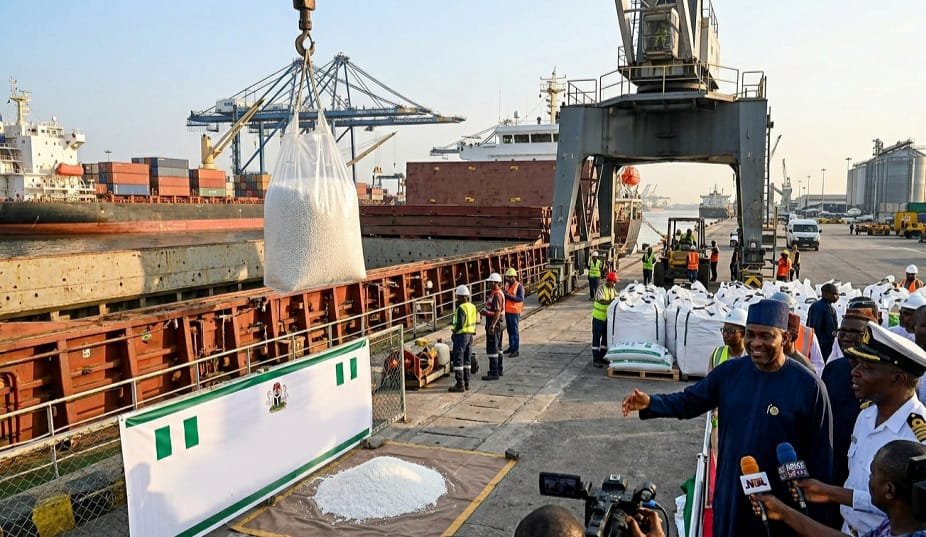
Today, Nigerian-produced urea reaches major agricultural markets including Brazil, India, Mexico and the United States.
These countries collectively represent some of the world’s largest consumers of fertiliser products due to the scale of their agricultural sectors.
Industry estimates indicate that between 70 and 77 percent of production is exported, allowing Nigeria to capture significant foreign exchange earnings from global demand.
The implications extend far beyond export revenues. The facility has showcased that Nigeria can leverage its abundant natural gas reserves not merely as an energy resource but as a feedstock for globally competitive industrial production.
Manufacturing takes centre stage
The rise of fertiliser exports is also reshaping perceptions about the role of manufacturing in Nigeria’s economy.
For years, manufacturing’s contribution to exports has remained relatively modest compared to oil and gas.
The success of fertiliser indicates that strategic industrial investments can change that narrative.
Unlike crude oil exports, fertiliser production creates economic activity across multiple sectors.
Natural gas extraction supplies feedstock. Chemical processing transforms raw materials into finished products. Transport operators move products across supply chains. Port operators facilitate exports. Warehousing and logistics companies support distribution. Financial institutions provide trade finance and transactional support.
Each stage creates jobs, investment opportunities and economic value.
This multiplier effect is one reason economists increasingly view industrial exports as a more sustainable source of long-term growth than raw commodity exports.
The first-quarter performance offers a practical illustration of this principle.
Urea exports generated N1.37 trillion during the quarter, up from N1 trillion in the fourth quarter of 2025 and N855.85 billion in the corresponding period of last year.
The year-on-year increase of N518.88 billion underscores both rising production capacity and strengthening international demand.
Fertiliser dominates non-oil exports
One of the most striking aspects of the trade data is fertiliser’s growing dominance within Nigeria’s non-oil export segment.
Total non-oil exports amounted to N3.19 trillion during the first quarter. Fertiliser alone accounted for more than 40 percent of that figure.
In effect, nearly one out of every two naira earned from non-oil exports came from fertiliser.
While policymakers may celebrate fertiliser’s success, the data also reveals how much work remains to be done in expanding other manufacturing export categories.
Nigeria’s export structure remains heavily dependent on hydrocarbons.
Oil and gas-related products generated approximately N17.93 trillion during the quarter, accounting for almost 85 percent of total export earnings.
Nevertheless, fertiliser has proven that diversification is achievable when domestic resources are converted into higher-value industrial products.
Global uncertainty creates new opportunities
The fertiliser story is unfolding against a backdrop of significant turbulence in global supply chains.
Recent geopolitical tensions have disrupted major shipping routes and triggered price increases across international fertiliser markets.
The resulting uncertainty has created concerns in many countries regarding fertiliser availability and affordability ahead of critical planting seasons.
Ironically, these disruptions have also highlighted the strategic importance of Nigeria’s growing fertiliser ecosystem.
Countries dependent on imported fertiliser face increased costs and supply risks.
Nigeria, meanwhile, is increasingly positioned as both a producer and exporter capable of benefiting from higher global demand.
The situation underscores the importance of building domestic industrial capacity in sectors linked to food production and agricultural productivity.
As global populations continue to grow, demand for fertilisers is expected to remain structurally strong.
Fertilisers remain indispensable to modern agriculture, helping farmers increase yields and improve food production. This provides a durable foundation for long-term export growth.
While export earnings have captured headlines, policymakers are equally focused on ensuring that domestic farmers have adequate access to fertiliser supplies.
This objective has gained additional significance given rising global prices and supply chain disruptions.
The Ministry of Finance Incorporated (MoFI) recently disclosed that Nigeria has secured sufficient fertiliser raw materials for the 2026 wet season planting programme following an aggressive early procurement strategy implemented through the Presidential Fertiliser Initiative.
According to official records, PFI NPK Limited secured nine vessels carrying 407,304 metric tonnes of fertiliser raw materials during the first quarter. Combined with existing inventory, available stock reached 534,219 metric tonnes.
By mid-April, more than 323,109 metric tonnes had already been distributed to fertiliser blending plants nationwide. This volume translates to 6.5 million bags of fertiliser products.
Officials say the early procurement programme enabled Nigeria to avoid the impact of rising international prices while ensuring uninterrupted supplies for domestic production.
N61.6 billion saved
One of the most significant outcomes of the procurement strategy was the financial savings achieved through early purchasing.
According to figures released by the Ministry of Finance Incorporated, Nigeria saved $43.99 million, equivalent to N61.6 billion.
The savings were realised by locking in purchases before international fertiliser input prices surged.
Granular Ammonium Sulphate was secured at $228 per metric tonne, significantly below current market prices of $343.
Diammonium Phosphate was purchased at $775 per tonne compared to prevailing rates of $950.
Muriate of Potash was acquired at $400 per tonne, below current prices of $430.
Linking exports to food security
One of the most compelling aspects of Nigeria’s fertiliser success story is the link between export growth and domestic agricultural productivity.
Unlike some export industries that operate independently of local economic needs, fertiliser occupies a unique position.
The same industry generating foreign exchange earnings is also helping support domestic food production.
PFI NPK currently supplies raw materials to 94 blending plants registered under the Fertiliser Producers and Suppliers Association of Nigeria.
Importantly, these facilities produce fertiliser locally rather than relying on imported finished products.
The model promotes value addition, industrial activity and job creation within Nigeria.
At the same time, it supports farmers by improving fertiliser availability and affordability.
This dual impact strengthens the economy while contributing to food security objectives.
A blueprint for industrial growth
The significance of Nigeria’s fertiliser boom lies not simply in the revenues it generates but in what it reveals about the country’s economic potential. For decades, Nigeria has struggled to translate its vast resource base into globally competitive industrial exports. Fertiliser suggests that the formula is neither elusive nor unattainable.
Abundant natural gas, large-scale industrial investment and access to international markets have combined to create an export industry capable of earning more than N1 trillion in a single quarter, indicating that value addition matters.
The question now is whether similar successes can be replicated elsewhere. Petrochemicals, metals, refined fuels and agro-processing all possess comparable potential. According to analysts, if they follow the path established by fertiliser, Nigeria’s long-promised export diversification could finally move from rhetoric to reality.
In that respect, urea’s rise may be less about fertiliser itself than about the future shape of Nigeria’s economy.