
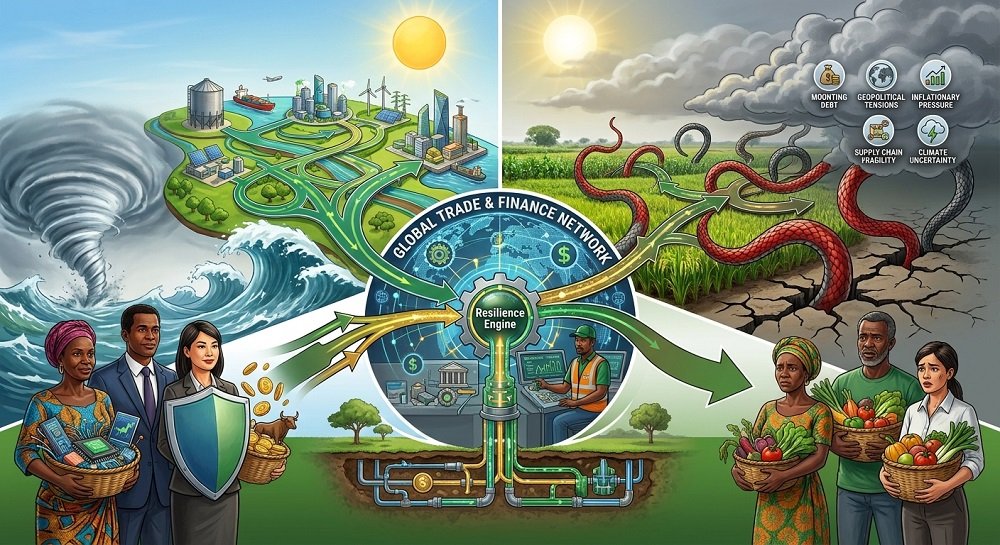
- McKinsey survey reveals cautious executive sentiment despite easing pessimism, as energy shocks, inflation and weak demand complicate the global recovery
The global economy may have stepped back from the edge of another bout of deep pessimism, but the world’s business leaders are not yet convinced that better days are around the corner. Beneath the modest improvement in executive sentiment lies a more complicated economic picture: rising energy costs, geopolitical instability, changing trade relationships, renewed inflationary pressures and a growing divide between countries and industries managing to sustain growth and those struggling to regain momentum.
That is the central message emerging from McKinsey & Company’s September 2026 Economic Conditions Outlook and its latest Global Economics Intelligence report, which together offer a revealing snapshot of an international business environment increasingly defined by uncertainty, strategic repositioning and competing economic forces.
The findings suggest that the global economy is entering a period in which the ability to navigate disruption may matter as much as the traditional advantages of market size, capital availability and production capacity.
McKinsey’s executive survey, conducted between August 31 and September 9, involved 992 respondents across 86 countries, representing different industries, company sizes and management functions. Its verdict is neither outright pessimism nor renewed confidence. Rather, it is a business community that has become less fearful about the immediate outlook without necessarily becoming more optimistic about what lies ahead.
Thirty-five per cent of respondents expect global economic conditions to improve over the next six months, while 36 per cent anticipate deterioration. The figures capture the extent of the uncertainty: the global business community is almost evenly divided over the direction of the economy.
For executives assessing conditions in their own countries, the balance is similarly narrow, with 36 per cent expecting improvement and 33 per cent anticipating deterioration.
Yet the apparent stabilisation in sentiment should not be mistaken for an economic recovery that has taken firm hold. The proportion of executives reporting that global and domestic economic conditions deteriorated over the preceding six months remains greater than the proportion reporting improvement.
The distinction is important. The global economy may be showing greater resilience than business leaders feared earlier in the year, but resilience is not the same as a return to robust growth.
Energy and geopolitics return to the centre of economic calculations
Perhaps the most consequential development in McKinsey’s findings is the renewed prominence of energy prices and geopolitical instability in the calculations of corporate leaders.
The September survey identifies geopolitical instability and conflicts as the leading perceived threat to global economic growth, with energy prices and changes in trade policy also commanding growing attention.
These concerns are reinforced by the macroeconomic evidence in the Global Economics Intelligence report.
Brent crude averaged $114 per barrel in September, rising by $23 from August, as tensions surrounding the Strait of Hormuz continued to constrain Middle Eastern oil exports. Prices approached $131 per barrel on September 15 before easing towards the end of the month.
The consequences extend far beyond the energy industry. Higher oil prices feed into transportation, manufacturing, electricity generation, agricultural production and the cost of moving goods across international markets.
For economies heavily dependent on imported petroleum products and other energy inputs, such developments can intensify inflation, weaken household purchasing power and complicate monetary policy.
The resurgence of energy-driven inflation is already influencing central bank decisions. McKinsey reports that the United States Federal Reserve raised its benchmark interest-rate range by 25 basis points in September, its first increase since 2023, while the European Central Bank also increased its deposit facility rate.
The Bank of England maintained its policy rate, although divisions among policymakers reflected growing concerns about inflation.
The significance is that businesses are confronting a difficult combination: higher operating costs and financing pressures at a time when demand remains uncertain.
This is particularly challenging for companies considering expansion, capital investment and new borrowing. Even where opportunities exist, the cost of pursuing them may be rising.
Weak demand becomes a bigger corporate concern
Beyond geopolitical tensions and energy prices, another development in the survey deserves particular attention: the growing concern about weak demand.
Among private-sector respondents, weak demand overtook geopolitical instability as the most frequently cited risk to company growth over the next 12 months. The proportion identifying weak demand rose from 31 per cent in June to 36 per cent in September.
This is a significant signal because it moves the discussion from external uncertainty to the actual commercial conditions facing businesses.
Geopolitical instability can disrupt supply chains, raise commodity prices and alter trade routes. But weak demand strikes directly at the revenue assumptions underpinning corporate investment, production and employment decisions.
A business can adapt to a more expensive supply chain, find alternative sources of inputs or adjust its geographical exposure. Sustained weakness in customer demand is more difficult to overcome because it affects the fundamental economics of the enterprise.
The pattern is also visible in the wider global economy. McKinsey reports that China’s retail sales growth slowed to 0.4 per cent as households remained cautious about spending, despite the country’s substantial export performance.
China’s trade surplus widened to $112.8 billion in August, supported by strong high-technology exports. But the contrast between export strength and subdued domestic consumption illustrates the uneven nature of economic recovery.
India presents a different picture. Its central bank raised its 2026–27 growth projection to 6.7 per cent, while manufacturing and services activity strengthened in September.
The divergence between these major Asian economies underlines an important feature of the current global environment: there is no single economic cycle moving all countries in the same direction.
The AI investment paradox
While executives remain concerned about the immediate economic outlook, their enthusiasm for technological transformation has not diminished.
Indeed, McKinsey’s survey reveals a striking contrast between caution over economic conditions and growing commitment to artificial intelligence.
Forty-five per cent of respondents say AI investment is now a top priority for their company leaders, compared with 40 per cent in June.
Furthermore, 43 per cent identify technological change as one of their leading opportunities for company growth over the next year, almost twice the 22 per cent who regard technology as a major risk to their businesses.
This suggests that business leaders are increasingly treating AI not simply as an emerging technology but as a strategic investment necessary to remain competitive.
The opportunity extends across productivity, customer service, business intelligence, supply-chain management, research and product development.
However, the enthusiasm also raises questions about the distribution of future economic gains. Companies with access to capital, computing infrastructure, skilled workers and reliable electricity may be better positioned to translate AI investment into productivity improvements.
Smaller enterprises and economies with infrastructure and skills deficits could find themselves struggling to keep pace.
The technology divide may therefore become another source of inequality in global business competitiveness.
There is also a longer-term risk. Although executives do not generally regard technological disruption as an immediate threat to global growth, McKinsey identifies it as one of the leading potential risks over the next decade, alongside geopolitical instability and government policies.
The implication is that businesses are simultaneously investing in the opportunities AI presents and preparing for the structural changes it could bring to employment, competition and established business models.
Africa’s strategic question: opportunity or exposure?
For Africa, the global developments identified by McKinsey carry implications that extend well beyond the immediate movement of commodity prices.
The continent occupies a distinctive position in the changing global economic landscape. It has significant energy and mineral resources, a growing consumer market, a young population and opportunities to expand its manufacturing, agricultural and services sectors.
Yet these advantages do not automatically translate into economic gains.
Higher international energy prices can benefit oil-exporting economies through increased export receipts, but they can also raise domestic fuel, transport, electricity and production costs. The ultimate impact depends on the structure of each economy, its import requirements, fiscal arrangements and ability to translate export earnings into productive investment.
For Nigeria, this creates a particularly important policy and business consideration. As an oil-producing economy with substantial domestic energy and infrastructure requirements, the interaction between international oil prices, domestic refining capacity, foreign-exchange conditions and industrial costs remains central to its economic prospects.
The other significant issue is the changing architecture of international trade.
McKinsey’s account of shifting trade relationships, including the tensions between the United States and Canada and the strengthening of India’s commercial relationships with other regions, illustrates how trade policy is increasingly becoming an instrument of economic strategy.
For African economies, this creates both challenges and openings. Changing supply chains and the search for alternative production locations could create opportunities for countries capable of offering competitive industrial locations, reliable infrastructure and predictable regulatory environments.
The African Continental Free Trade Area also offers a framework for strengthening regional markets and reducing excessive dependence on traditional external trading relationships.
However, the continent’s ability to benefit will depend on addressing persistent constraints, including infrastructure gaps, high logistics costs, limited access to affordable long-term financing and the fragmentation of regional markets.
There is an important qualification to McKinsey’s African dimension. Its regional classification groups sub-Saharan Africa with North Africa, the Middle East and South Asia in its developing-markets category. The survey therefore does not provide a standalone measure of African executive sentiment.
Nevertheless, the global findings offer a useful framework for assessing the pressures and opportunities confronting African businesses.
The next competitive divide
Taken together, the two McKinsey publications suggest that the global economy is not moving towards a straightforward recovery. Instead, it is undergoing a complex adjustment in which inflation, energy security, geopolitical realignment, technological investment and consumer demand are shaping the prospects of companies and countries differently.
Some manufacturing and services indicators improved in September. India’s industrial activity strengthened, US manufacturing conditions recorded their strongest improvement since May 2022, and services activity expanded across several major economies.
Yet these positive indicators coexist with weaker consumer confidence in some markets, rising borrowing costs, volatile energy prices and uneven employment performance.
The challenge for corporate leaders is therefore not simply to anticipate whether global growth will accelerate or slow. It is to build businesses capable of operating profitably across different economic conditions.
That requires greater attention to financial resilience, supply-chain flexibility, market diversification, technological capability and disciplined capital allocation.
For policymakers, the challenge is equally demanding: containing inflation without unnecessarily undermining productive investment, strengthening domestic demand, maintaining fiscal credibility and creating conditions in which businesses can expand.
The September McKinsey findings ultimately point to a world economy that has regained some composure but not its confidence.
The next phase of global competition will be shaped not only by who has access to capital, resources and markets, but by who can adapt fastest to an environment in which economic opportunities and risks are increasingly intertwined.
For businesses, the message is clear: the easing of pessimism is not a signal to abandon caution. It is an invitation to prepare more intelligently for a global economy whose next direction remains uncertain.







Of voodoo economics, ad-hocism and Nigeria’s 90-day plan