
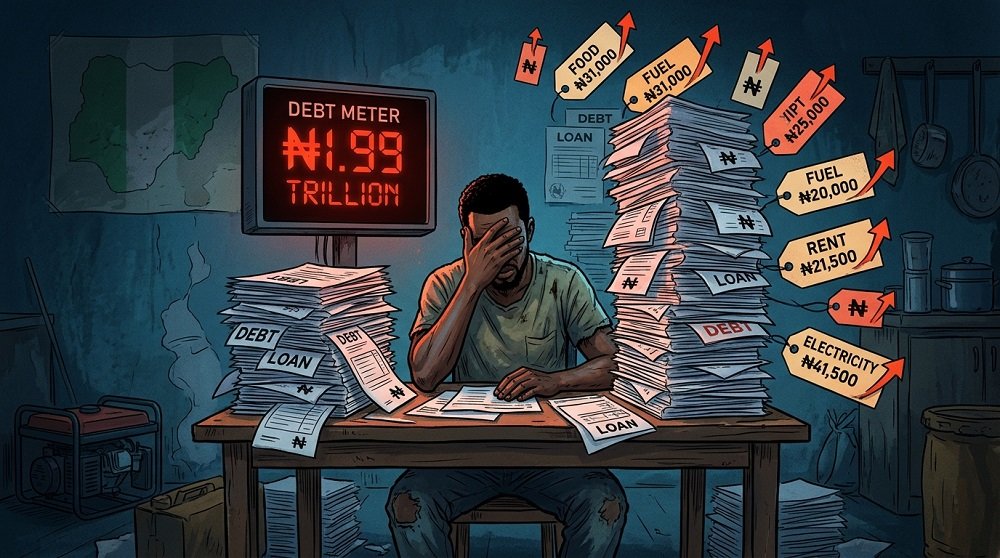
- Household consumer borrowing rises N100bn in 3 months
- Manufacturing credit falls 34% despite N4.65trn bank recap
For millions of Nigerian households, the struggle to keep pace with food prices, rent, medical bills and school fees is increasingly being financed with borrowed money. As the cost of maintaining basic living standards continues to pressure disposable incomes, personal loans are approaching N2 trillion, while consumer credit is expanding faster than many households may be able to comfortably repay.
Recent figures from the Central Bank of Nigeria (CBN) show that outstanding personal loans rose by N58.5 billion in the second quarter of 2026 to N1.99 trillion at the end of June, from N1.93 trillion in March, representing a 3.03 per cent quarterly increase.
The increase formed part of a broader expansion in consumer credit, which rose by approximately N100 billion, or 3.26 per cent, to N3.17 trillion from N3.07 trillion in the preceding quarter.
The figures, contained in the CBN’s Second Quarter 2026 Economic Report, reveal a growing reliance on borrowing to manage household expenditure at a time when inflation, expensive credit and pressure on disposable incomes are reshaping consumer financial decisions.
The CBN attributed the expansion to growth in both retail and personal loans, which increased by 4.10 per cent and 3.03 per cent, respectively.
Personal loans accounted for 62.87 per cent of total consumer credit, compared with 37.13 per cent for retail loans. This means that nearly N63 of every N100 owed by consumers to financial institutions was classified as personal borrowing.
Retail loans also increased by approximately N46.5 billion to N1.18 trillion in June from an estimated N1.13 trillion in March, indicating that although retail credit recorded faster percentage growth, personal borrowing remained the dominant component of household debt.
The development raises a broader economic concern: as more Nigerians rely on credit to finance everyday consumption, the capacity of household incomes to sustain repayment obligations becomes increasingly important.
Inflation deepens household borrowing pressure
The expansion in personal loans comes against the backdrop of renewed inflationary pressures, which continue to erode household purchasing power.
According to the CBN, headline inflation increased to 15.91 per cent in June 2026 from 15.38 per cent in March, reflecting higher prices of essential goods and services.
The apex bank attributed the increase largely to rising energy and commodity prices associated with geopolitical tensions in the Middle East, which pushed up production and transportation costs.
For households whose earnings have not kept pace with inflation, the consequences extend beyond reduced discretionary spending. Expenditure on food, rent, healthcare and education increasingly competes for limited income, creating pressure to seek short-term financing.
Although the CBN report does not establish whether the increase in personal loans was driven primarily by financial distress, consumption needs or improved access to credit, evidence from the wider financial services sector suggests that borrowing for household coping and consumption is becoming increasingly prominent.
The cost of accessing that credit, however, remains substantial.
The average prime lending rate declined marginally to 19.01 per cent in the second quarter from 19.37 per cent in the preceding quarter. However, the maximum lending rate edged up to 34.37 per cent from 34.34 per cent, indicating that borrowing remained expensive for some categories of customers.
For lower-income borrowers and households with irregular earnings, such rates could make repayment increasingly difficult, particularly where loans are used to finance recurring consumption rather than income-generating activities.
Four in 10 formal borrowers use credit to cope
The changing character of household borrowing is reinforced by findings from the 2026 Access to Financial Services in Nigeria Survey by Enhancing Financial Innovation and Access (EFInA).
The survey found that 40.8 per cent of Nigerians borrowing from formal financial institutions used credit mainly for coping and consumption purposes, compared with 31.7 per cent in 2023.
The 9.1 percentage-point increase has made consumption and coping the largest purpose of formal borrowing, overtaking productive enterprise financing, whose share declined from 40.2 per cent to 34.3 per cent over the same period.
Borrowing for household assets also declined from 25.2 per cent to 23.4 per cent.
The survey raised concerns about whether the expansion of financial services is sufficiently supporting income generation and productive capacity.
“Coping/consumption purposes rose from 31.7 per cent to 40.8 per cent; productive purpose fell from 40.2 per cent to 34.3 per cent. We need to ensure that credit builds productive capacity and does not produce distress,” the report stated.
Formal credit use increased from six per cent of adults in 2023 to 10 per cent in 2026, equivalent to approximately 11.9 million Nigerians borrowing from regulated providers. Including informal sources, 36 per cent of adults had access to some form of credit.
The expansion was particularly pronounced among informally employed Nigerians, whose formal credit use tripled from five per cent to 15 per cent. Borrowing among people aged 18 to 35 increased from four per cent to 10 per cent, while business owners recorded a rise from four per cent to 10 per cent. Among farmers, the proportion increased from two per cent to six per cent.
However, greater access to credit has not necessarily translated into improved financial well-being.
The survey found that 45.8 per cent of formal credit users reported some or serious repayment stress, while only 30.7 per cent of formally included adults were classified as financially healthy.
The findings expose a growing contradiction in Nigeria’s financial inclusion drive: more people are entering the formal credit market, but a significant proportion are doing so under financial pressure.
Digital lenders capitalise on demand for short-term credit
The growing demand for consumer loans has created opportunities for digital lenders, which have expanded their lending operations as households seek quick financing to meet immediate obligations.
Digital loan disbursements in Nigeria reached approximately $1.63 billion in 2025, according to industry figures, with OPay accounting for an estimated 57.4 per cent of the total.
OPay’s EaseMoni lending platform charges low-risk borrowers a monthly interest rate of 18.9 per cent, according to disclosures cited in industry reporting. Other digital lending platforms have also been reported to charge substantial rates, particularly for borrowers with weaker credit profiles.
The effective cost of borrowing can rise further when default penalties, fees and other charges are included. For consumers already struggling with inflation and irregular earnings, expensive short-term loans risk creating a cycle in which fresh borrowing becomes necessary to repay existing obligations.
OPay’s expansion illustrates the scale of the opportunity. Its quarterly borrowers increased to 6.7 million in the first half of 2026 from 3.5 million in the corresponding period of 2025.
The company disbursed $927.63 million in new loans during the first half of 2026, representing a 204 per cent increase from $305.12 million a year earlier. Income from loans reached $236.12 million, exceeding the $130.55 million generated from payment-related services.
Other financial technology operators are also expanding credit. Moniepoint Microfinance Bank reported that it disbursed more than N1 trillion in loans to small businesses in 2025, while FairMoney Microfinance Bank reported loan disbursements exceeding N150 billion during the same period.
However, the rapid expansion of digital lending has heightened concerns about affordability, aggressive debt recovery practices, data privacy and the sustainability of repayment among low-income borrowers.
The Federal Competition and Consumer Protection Commission has granted full or conditional approval to hundreds of digital money-lending applications, while taking action against platforms accused of violating consumer protection requirements.
The central question is increasingly shifting from whether Nigerians can access credit to whether they can afford to repay it.
Manufacturing credit falls despite N4.65trn recapitalisation
While households are increasingly borrowing to finance consumption, Nigeria’s productive businesses face a different challenge: obtaining sufficient and affordable bank financing to expand domestic production.
The Nigerian Economic Summit Group (NESG) has raised concerns that bank credit to manufacturers declined by approximately 34 per cent, from N8.5 trillion in December 2024 to N5.6 trillion, despite the banking industry’s successful mobilisation of N4.65 trillion through the recapitalisation exercise.
The divergence between expanding consumer borrowing and declining manufacturing credit exposes a deeper weakness in Nigeria’s financial intermediation: the challenge of ensuring that the financial system adequately supports both household welfare and productive investment.
Tayo Aduloju, NESG chief executive officer, said the decline raised questions about how effectively banks were deploying their stronger capital bases to support industrial development.
Speaking at the Chartered Institute of Bankers of Nigeria’s 2026 Fellowship Investiture in Lagos, Aduloju said lending remained concentrated in a few sectors, with oil and gas, finance and insurance accounting for approximately 46 per cent of bank credit, while manufacturing received just 8.7 per cent.
“Trade has overtaken manufacturing. So, ladies and gentlemen, we are financing import and distribution of goods more readily than their production in Nigeria,” he said.
He also noted that credit to the Nigerian private sector represented only 13 per cent of gross domestic product, compared with 38.1 per cent in lower-middle-income countries.
High lending rates, liquidity constraints, credit risks and the short duration of available financing were identified as major obstacles preventing businesses from accessing bank loans.
Aduloju said lending rates ranged from 19 per cent for prime borrowers to 32.6 per cent for other customers, while Treasury bills offered returns of approximately 15.5 per cent without comparable credit risk.
The difference in returns makes government securities relatively attractive to banks, particularly when lending to businesses involves higher default risks and longer repayment periods.
He also warned that increasing government borrowing was putting additional pressure on private-sector financing, noting that credit to government increased by 63 per cent in the year to September.
“When the sovereign borrows at this pace, it’s not a competition with business. It’s no competition. Government will win,” he said.
Dele Alabi, CIBN president and chairman of council, said the N4.65 trillion recapitalisation exercise, which saw 33 banks meet the new capital requirements, had provided the banking industry with a stronger foundation.
However, he maintained that the ultimate test of recapitalisation would be its impact on industrial expansion, infrastructure development, small businesses and employment creation.
Babajide Sanwo-Olu, Lagos State governor, similarly urged banks to develop affordable, long-term financing models for manufacturers, agricultural processors and other businesses requiring substantial investment before generating returns.
The concerns raise questions about whether the additional capital mobilised by banks will translate into a meaningful expansion of productive lending, particularly to sectors with the potential to deepen domestic production, create jobs and strengthen the economy’s capacity to generate income.
NESG calls for growth that improves household incomes
The growing pressure on household finances has also strengthened calls for economic policies to deliver more measurable improvements in living standards rather than focusing primarily on macroeconomic growth indicators.
Omoboyede Olusanya, incoming NESG chairman, recently argued that economic reforms must translate into higher incomes, productive employment, lower business costs and improved living conditions.
Speaking at the closing session of the 32nd Nigerian Economic Summit in Abuja on October 26 and 27, 2026, Olusanya said economic progress should be assessed by its impact on ordinary Nigerians.
“Growth that delivers is growth whose impact is strongly felt,” he said.
He argued that farmers should earn more, manufacturers should face lower production costs, graduates should secure decent jobs and businesses should have access to affordable financing.
Olusanya introduced “Growth that Delivers” as the guiding principle of his tenure, outlining commitments to stronger policy accountability, evidence-based research, investment mobilisation, expanded opportunities for businesses and institutional independence.
His position reflects growing recognition that macroeconomic stability alone may not be sufficient to improve household welfare if income growth, employment opportunities and access to affordable financing remain weak.
For Nigeria, the implications of the latest credit figures extend beyond the balance sheets of banks and households.
An economy in which consumers increasingly depend on borrowing to sustain basic expenditure, while manufacturers struggle to secure financing for production, faces a difficult challenge in building durable growth.
The issue is not simply how much credit the banking industry creates, but where that credit goes, what it finances and whether it generates the income needed to sustain repayment and economic expansion.
With N1.99 trillion in personal loans outstanding and manufacturing credit reportedly falling despite substantial bank recapitalisation, the test for Nigeria’s financial system is becoming clearer: whether it can move beyond expanding access to credit towards financing the productive capacity that ultimately strengthens household incomes and reduces dependence on debt.








Of voodoo economics, ad-hocism and Nigeria’s 90-day plan