Small and Medium Enterprises (SMEs) have been urged to strengthen governance structures and adopt transparent financial practices to unlock access to medium- and long-term funding from Nigeria’s capital market, as stakeholders intensify efforts to bridge the country’s persistent financing gap.
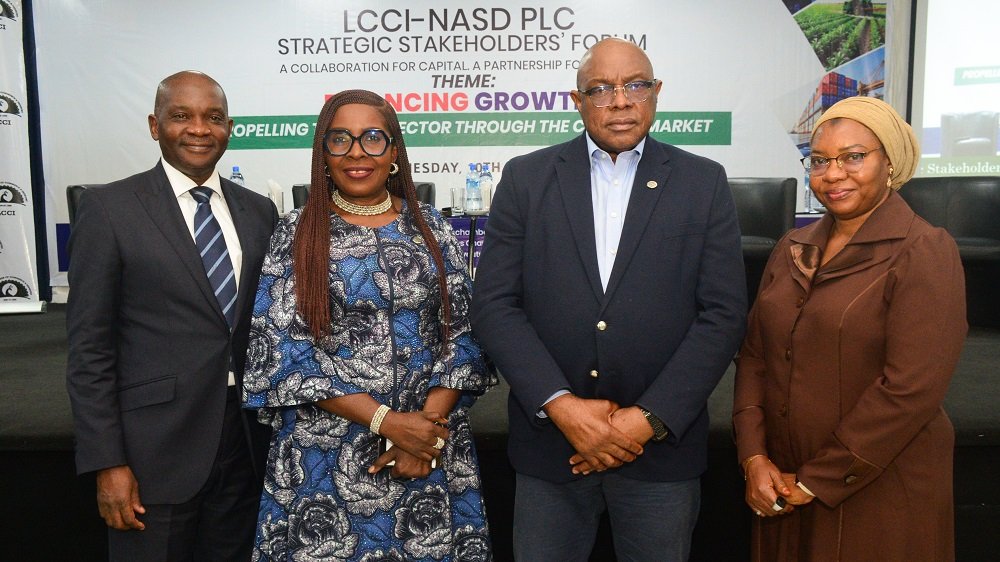
This charge was made at a stakeholders’ forum in Lagos jointly organised by the Lagos Chamber of Commerce and Industry (LCCI) and NASD PLC , themed “Financing Growth: Propelling the Real Sector Through the Capital Market.” The forum brought together regulators, market operators, and entrepreneurs to explore pathways for improving SMEs’ access to growth capital.
Opening discussions, participants noted that despite SMEs forming a critical backbone of Nigeria’s real sector, many continue to struggle with limited access to structured financing, largely due to weak corporate governance frameworks, inadequate financial reporting, and poor business structuring.
Stakeholders at the event identified key prerequisites for capital market participation, including a clearly defined business model, robust growth strategy, audited financial statements, transparent cash flow reporting, and strengthened governance systems.
Speaking at the forum, Longe Eguarekhide, managing director of NASD PLC, said Nigerian businesses require expanded access to growth capital, while investors are in search of viable opportunities to deploy funds efficiently.
“Businesses require more financing options, investors require more opportunities, and the capital market provides the bridge,” Eguarekhide said, adding that the initiative was designed to deepen awareness of capital market opportunities available to SMEs and foster strategic partnerships that support sustainable growth.
Also speaking, Oludare Fajimolu, head of research and strategy at NASD PLC, highlighted the benefits of the Over-the-Counter (OTC) Exchange, noting its flexibility in capital raising, regulatory robustness, improved visibility for businesses, and direct investor access as key advantages for emerging firms seeking expansion financing.
Reinforcing the policy perspective, Chinyere Almona, director-general of the Lagos Chamber of Commerce and Industry, described the real sector as the engine of economic growth, stressing the importance of patient capital in enabling business expansion and long-term competitiveness.
She noted that the forum aligns with the chamber’s mandate of supporting SME members in accessing medium- to long-term financing through structured capital market channels.
Representing the director-general of the Securities and Exchange Commission (SEC), Ojone Kabir, deputy director and head of the office of advocacy for small business capital formation, said the capital market offers diverse investment instruments, including equities, fixed income securities, and other asset classes that SMEs can leverage to scale operations and drive innovation.
A panel session moderated by Fajimolu further examined structural barriers limiting SME participation in capital markets, with participants identifying weak business structure and inadequate governance as major constraints.
The forum ended with a consensus that improved transparency, accountability, and corporate governance remain essential for SMEs seeking to attract investors and secure long-term funding from Nigeria’s capital market ecosystem.