• As West Africa’s struggles to meet ban deadline December end
• Chocolate makers to face higher costs over West African initial squeezed exports to EU
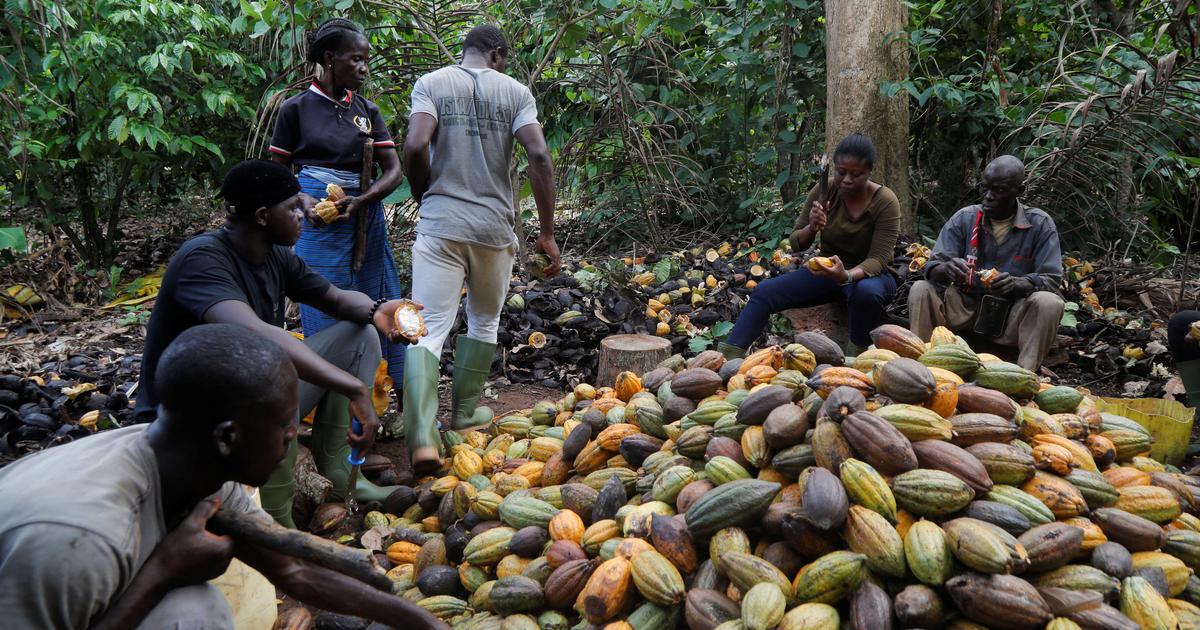
More than half of Nigeria’s 300,000 cocoa farmers (mostly smallholders) would fail to meet the conditions of the European Union’s law (European Union Deforestation Regulation – EUDR) banning commodity imports linked to deforestation, when the latter comes into effect at the end of December 2026, according to estimation by industry experts.
These farmers grow more than half the 300,000 tonnes of beans produced by Nigeria (the world’s fourth-largest cocoa producer).
In particular, majority of the farmers are either reluctant to let exporters map and geolocate their farms or are completely unaware of the EUDR law, such as those with farms located in far-flung, hard-to-reach areas in Ikom and Boki local government areas of Cross River State.
So far, only a tiny number of the farmers like Ojo Ayaninuola, a small-scale cocoa farmer in Akure, Ondo State, southwestern Nigeria, have agreed to allow their farms undergo mapping and geolocation.
According to a Reuters report published by Yahoo finance, Ojo was initially reluctant to let exporters map and geolocate his farm as part of measures to comply with the looming EU anti-deforestation law.
But when Sunbeth Global, one of Nigeria’s largest cocoa exporters and the buyer of all Ayaninuola’s cocoa beans, warned that he could lose access to the European Union, which buys 60 percent of the world’s cocoa, he (Ayaninuola) eventually agreed.
Indeed, Ayaninuola, who sells to a big and well-resourced exporter, could be in an advantaged position. But no so with several thousands of other cocoa growers in the southwest area, and indeed, elsewhere in Nigeria. Ondo State alone accounts for about 25 percent of Nigeria’s cocoa national total, with other southern states like Cross River (including Ikom), Ogun, Osun, and Ekiti also contributing heavily, according to Nigerian Export Promotion Council database.
Bearing cost of compliance:
Cocoa buyers adduce that compliance to the EU deforestation law is costly and challenging, especially in countries like Nigeria, Ivory Coast, and Ghana, where the industry comprises hundreds of thousands of small-scale farmers living in remote, hard-to-access rural areas.
By far, exporters have to map all the individual farms, verify land use and maintain throughout a multilayered supply chain up to digital traceability records that EU buyers can rely on.
In Nigeria, the major cocoa exporters such as Sunbeth Global, and Starlink Global & Ideal say compliance is proving expensive, with EU buyers resisting efforts so far to pass on the costs.
Sunbeth said it spent the last three years mapping 124,000 hectares of farmlands in southern Nigeria covering about 60,000 metric tons of cocoa in its supply chain, at a cost of $30 to $70 per metric ton, according to Reuters report.
The cocoa exporting company also said it hired a 35-person sustainability team that works with Meridia, an Amsterdam-based data verification specialist. In addition, the company has deployed hundreds of field agents over the past three years to train its farmers to comply with Nigerian laws, including those against child and forced labour.
Nzubechukwu Anisiobi Sunbeth chief operating officer told Reuters that “It is expensive to do this… (and) in early conversations with our offtakers, there has been some pushback over who will bear the cost of EUDR compliance”.
“The cost-benefit analysis right now is eating into our margins,” Anisiobi added.
For Starlink Global & Ideal, Nigeria’s biggest cocoa exporter, which ships about 60,000 tons a year, it said it has spent $40 to $80 per ton mapping and tracing its supply chain since 2023 — costs which it said have yet to be recovered from its European buyers.
In Ivory Coast, the world’s largest cocoa producer, Trase, a non-profit outfit said in a study released in May, that only about half the country’s cocoa can be traced to where it was grown, largely because the rest of the supply chain are indirect or involve several intermediaries.
A Reuters report said across West Africa, a region that grows around 70 percent of the world’s cocoa beans and ships about two-thirds to the EU, according to World Bank, EU and UN data, the situation is similar to Nigeria’s, including top grower Ivory Coast.
Higher costs for chocolate makers:
Meanwhile, EU’s chocolate makers could face higher costs due to possible West Africa squeezed beans exports to the EU, as the region’s cocoa producers struggle to comply with the law, industry experts say.
Nicko Debenham, a former global cocoa trader and now sustainability consultant, said, “There’s a distinct possibility that in the early days of the law, EU importers won’t be able to get enough compliant cocoa from indirect or third party shippers from origins like Nigeria, from Ivory Coast, from anywhere”.
Debenham estimates that the supply squeeze in the EU could last about two years, during which exporters who have invested in meeting the bloc’s rules would command a premium from chocolate makers for their beans.
Dealing with the EU law:
The EUDR, aimed at ending the 10 percent of global deforestation triggered by the bloc’s consumption of imported goods, the law will necessitate that importers of commodities and related goods prove that their products were not grown on recently deforested land by tracing their raw materials back to the plot where they were grown, among other measures.
Twice delayed due to its complexity, the EU Deforestation Regulation (EUDR) also requires proof from importers that the goods were produced in accordance with laws in the country of origin.