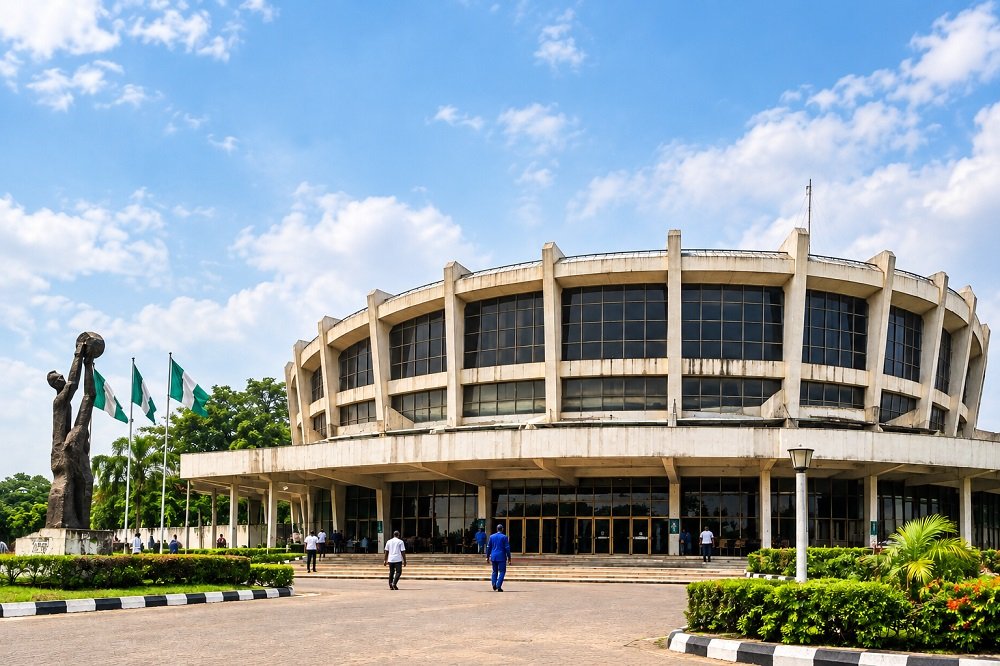
Despite an initial N21 billion reconstruction estimate approved by the Federal Executive Council (FEC) and further project outlays subsequently reported by various officials at between N58 billion and N68 billion, or roughly $100 million, the Wole Soyinka Centre for Culture and the Creative Arts is yet to realise its full commercial potential. Developed through a partnership involving the Central Bank of Nigeria (CBN) and the Bankers’ Committee, the complex boasts modern performance facilities and plans for a 44-hectare creative hub, but concerns over utilisation, pricing and management continue to cloud its investment returns.
Visible from the motorway linking Lagos Island to the mainland, the National Theatre stands as a striking symbol of Nigeria’s cultural ambition. But behind its imposing exterior, the level of activity has yet to match the scale of the redevelopment. The contrast is increasingly putting the spotlight on how the facility is managed, marketed and integrated into the wider creative economy.
More than a year after its commissioning by President Bola Tinubu on October 1, 2025, the complex continues to face questions over utilisation and revenue generation. The National Assembly’s joint committee on Arts, Culture, Tourism and Creative Economy recently warned that the facility is not realising its full potential, urging the ministry to establish the operational conditions needed to turn the landmark into a viable cultural and economic asset.
Ogoshi Onawo, the then committee chairman, raised the concern while Minister Hannatu Musawa defended the ministry’s 2026 budget proposal, calling for urgent action to open the complex fully to the public.
“You’re losing billions of naira every day,” Onawo said, arguing that a monument intended to attract tourists, artists and investors should not remain locked or operate below capacity.
Built for the Second World Black and African Festival of Arts and Culture, FESTAC ’77, the theatre was conceived as a national stage for Nigerian and African creativity. After decades of deterioration and underinvestment, its rehabilitation offered an opportunity to restore that role while positioning the complex as a commercial platform for music, film, fashion, theatre and tourism.
Checks by Business a.m. confirms that the redevelopment delivered substantial physical improvements. The complex retains its 5,000-seat main auditorium and includes three cinemas, exhibition galleries, rehearsal spaces and banquet facilities, alongside upgraded building systems and access infrastructure.
However, industry stakeholders say the quality of the infrastructure has not been matched by an equally effective operating model.
Investment without sufficient activity
The theatre’s rehabilitation was part of a public-private collaboration involving the Central Bank of Nigeria and the Bankers’ Committee. The original vision extended beyond renovating the existing structure to developing approximately 44 hectares of surrounding land into a creative and entertainment district, with hubs dedicated to fashion, music, film and information technology.
Biodun Abe, a former technical director of the National Theatre, said the renovation was never intended to operate as a standalone project. Under the original understanding, he explained, the Bankers’ Committee would restore the theatre and hand it back to the federal government, while the wider entertainment-city development would help establish a connected creative ecosystem.
“The National Theatre was never meant to stand alone; it was supposed to be part of a much larger creative ecosystem,” Abe said.
The distinction matters because a modern auditorium is only one component of a functioning creative economy. Production facilities, rehearsal spaces, accommodation, restaurants, transport links, supporting businesses and a steady pipeline of events all contribute to the commercial viability of a cultural district.
Without these complementary investments, the theatre risks operating as an expensive venue in isolation rather than the anchor of a destination capable of sustaining activity throughout the year.
For event organisers who have attempted to use the refurbished facility, the challenges extend to the process of booking and staging programmes.
Seun Oloketuyi, founder of the Best of Nollywood Awards, which held its 2025 edition at the venue, praised the physical infrastructure but described the booking and event-management process as unnecessarily difficult.
“In terms of the infrastructure, they’ve done a fantastic job. But there are still many things that need to be done to make it customer-friendly. That’s probably why a lot of events are not happening there yet,” he said.
Oloketuyi said securing the venue involved extensive paperwork, payment delays and contractual provisions that he found difficult to navigate. He also criticised restrictions on access before events, limits on operating hours and delays in recovering a refundable deposit.
A music executive who spoke under the condition of anonymity, said the cost of hiring the facility could deter emerging and mid-tier performers who might otherwise use it to build audiences.
“The sound and everything about the venue are great, but the price is what is stopping people,” he said.
On his part, Osikoya argued that the theatre should consider arrangements that share revenue with promoters instead of relying primarily on substantial upfront rental charges.
He noted further that under such a model, the venue and event organiser could agree on a share of ticket revenue, subject to negotiated terms and a clear allocation of production and operating costs. While this approach would expose the theatre to some demand risk, it could make the facility more accessible to organisers unable to commit large sums before ticket sales begin.
Adeniran Makinde, president of the National Association of Nigerian Theatre Arts Practitioners, asserts that the deeper problem lies in the institution’s approach to programming.
He argued that the theatre cannot fulfil its mandate if it waits for external organisers to book the venue instead of developing its own calendar of productions and cultural activities.
“You don’t build an edifice like this as a cultural centre without programmes to run it. You can’t just wait for people to book the venue,” Makinde said.
A national cultural institution, he argued, should host regular theatre productions, festivals, exhibitions and other activities capable of drawing audiences beyond occasional headline events.
A consistent programme, he stated, would give Nigerians more reasons to visit the complex, help build repeat audiences and create opportunities for artists whose work might not otherwise attract commercial promoters. It could also provide a more predictable foundation for sponsorship, partnerships and ancillary spending.
The theatre’s commercial prospects are also tied to conditions outside its gates.
Industry analysts said inadequate surrounding infrastructure and a shortage of complementary businesses could weaken the venue’s appeal as a destination.
They argued further that a successful cultural district requires more than a restored building. This is as visitors need reliable access, adequate lighting and transport, as well as places to eat, socialise and spend time before and after events.
The issue is especially relevant for concerts and other major events, where audience experience extends beyond the performance itself. Poor access, inadequate lighting, limited transport options and a shortage of nearby amenities have been highlighted as constraints to the commercial potential of the renovated National Theatre, particularly for concerts and other large events.
The planned creative cluster around the Wole Soyinka Centre for Culture and the Creative Arts is intended to attract creative businesses, support employment and increase visitor spending. However, according to analysts, delivering those benefits will require coordination between the federal government, Lagos State, private investors, infrastructure providers and creative industry operators, being that the theatre’s renovation alone cannot address deficiencies in the surrounding environment.
Early signs of renewed demand
The complex has nevertheless begun to attract some high-profile activity. The national premiere of the documentary MKO took place at the venue on October 1, 2026, as part of Nigeria’s 66th Independence Day celebrations. Nigerian music star Davido has also announced a three-day residency at the theatre, while British-Nigerian rapper Dave is expected to perform there later in the year.
These events could help raise the venue’s profile and showcase its capacity to host major productions. They do not, by themselves, establish that the theatre has overcome the structural issues affecting its day-to-day use.
The critical test will be whether high-profile performances can help build a regular calendar of events, attract new audiences and encourage other organisers to use the facility. A few marquee bookings may generate publicity, but consistent utilisation requires a pipeline of programmes that appeals to different audiences and price points.
The management of the complex will also need to show that the venue can deliver a reliable customer experience, from booking and payment to technical preparation, event execution and post-event settlement.
Clear performance indicators would help establish whether the rehabilitation is delivering value. These could include the number of events held, auditorium and cinema occupancy, revenue by activity, operating and maintenance costs, repeat bookings, local employment and participation by emerging creative businesses.
Publishing such indicators would allow investors and the public to assess whether the investment is translating into measurable economic and cultural outcomes.
The federal government has positioned the creative economy as a potential source of diversification, employment and export earnings. Nigeria’s music, film and fashion industries have established international audiences, while digital platforms have opened new channels for distributing creative products and reaching consumers.
The National Theatre has the potential to provide physical infrastructure to support that growth, offering performance venues, exhibition spaces and facilities for cultural exchange. Its creative-cluster vision could also connect production, training, technology and commercial services.
However, infrastructure alone cannot create a sustainable creative industry. Artists need access to affordable venues, producers need predictable operating conditions, and businesses need a viable path to recovering their investments. Cultural institutions also require professional management, long-term maintenance plans and programming that serves both commercial and public-interest objectives.
The theatre’s renewed name and restored façade symbolise a return to national cultural ambition. Its economic contribution, however, will depend on whether the institution can move beyond episodic events to become a consistently active part of Lagos’s creative and tourism economy.
The National Assembly’s warning that the underutilisation of the Wole Soyinka Centre for Culture and the Creative Arts is limiting potential revenue has increased pressure on the ministry to improve the facility’s operations.
Beyond keeping the complex open, the government faces the task of making it accessible to event organisers, affordable for Nigerian creatives and commercially sustainable. That will require consistent programming, more effective use of its facilities and measures to encourage economic activity in the surrounding area.
The venue’s performance will ultimately depend on how regularly its stages host events, how widely its facilities are used and whether artists and businesses can benefit from its operations.