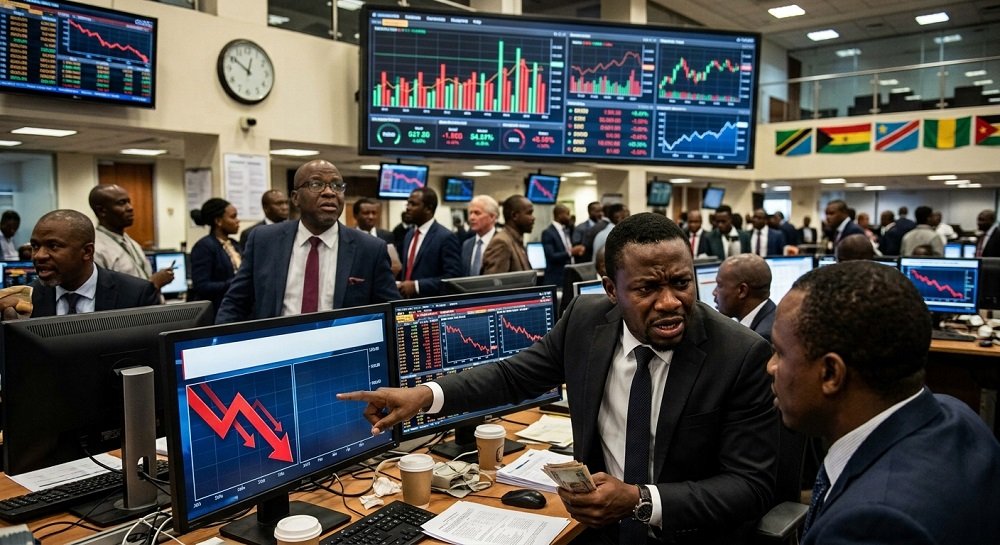
- Bad for Africa with elevated debt-service costs
- Nigeria in group of heavy borrowers
- Nigeria’s oil provides cushion, complication
The latest surge in global bond yields is sending a warning far beyond the trading floors of Tokyo, London and New York: the world may be entering a prolonged period in which governments, companies and investors have to operate without the cheap money that defined much of the past two decades.
A broad gauge of global government bonds has climbed to 3.72 percent, its highest level since 2008, according to a recent statement by Nigel Green, the chief executive officer of deVere Group, and made available to Business A.M. The sell-off has been particularly pronounced in Japan, Australia and the United States, with rising oil prices, geopolitical tensions, inflation concerns and anxiety over government borrowing combining to push yields higher.
Green says the move is significant because it is happening across several major bond markets simultaneously.
“This is a two-decade high, and it’s moving fast enough to blow through mortgage rates, corporate loans and pension valuations before most people have even noticed it happened,” he says.
But the significance of the sell-off goes beyond the fortunes of bond investors.
When government bond yields rise sharply, the cost of money across the economy tends to rise with them. Governments pay more to refinance debt; companies face higher borrowing costs; households can encounter more expensive mortgages and loans; while pension funds and other long-term investors have to reassess the value of assets accumulated during years of unusually low interest rates.
The question for Africa is how much of that global shock will be transmitted to economies already dealing with elevated debt-service costs and limited fiscal space.
The end of the cheap-money comfort zone?
For much of the period following the 2008 global financial crisis, investors became accustomed to exceptionally low interest rates and, in some markets, near-zero or negative yields.
That environment changed dramatically after the inflation shock of the early 2020s.
Although central banks have moved through different phases of monetary tightening and easing since then, investors are increasingly focused on a broader issue: governments themselves are borrowing heavily at a time when the cost of servicing that debt is no longer negligible. Nigeria belongs dangerously in this category.
That creates a potentially uncomfortable cycle.
Higher yields mean more expensive government borrowing. Higher debt-service costs can widen fiscal deficits. Larger deficits may require more borrowing, which can put further upward pressure on yields if investors demand greater compensation for holding government debt.
Green points specifically to fiscal concerns in Japan, the UK and the US.
“When bond markets start demanding a premium to lend a country money for the long haul, that’s a verdict on fiscal discipline as much as interest rates,” he says.
That observation has particular resonance in developing economies, where investors typically demand an additional risk premium above the yields available in advanced markets.
Africa needs to pay attention
For African governments, the global bond-market sell-off comes at an awkward time.
Many countries on the continent are already spending heavily on debt service while facing substantial financing requirements for infrastructure, energy, healthcare and economic development.
The transmission mechanism from global bond markets is relatively simple.
When investors can earn higher returns from US Treasuries and other major developed-market bonds, emerging-market debt has to become more attractive to compete for capital. That can mean higher yields—or lower bond prices—for African sovereign issuers.
For countries that regularly access international capital markets, the consequence can be significant.
A government planning to issue a new dollar bond may find that the coupon investors demand is considerably higher than it would have been when global benchmark yields were lower. Refinancing existing debt can also become more expensive.
This is why a bond-market story that begins in Japan or America can eventually become a fiscal story in Africa.
The continent does not control global interest rates, but it has to live with them.
And the countries most exposed are not necessarily those with the largest absolute debts. They are those with a combination of high refinancing needs, narrow revenue bases, substantial foreign-currency obligations and limited access to cheap long-term financing.
Nigeria’s particular vulnerability
Nigeria sits at an important intersection of these pressures.
The country has a large domestic debt market and has increasingly sought to strengthen its presence in international capital markets. But the country’s government finances remain sensitive to borrowing costs, while elevated domestic interest rates have already increased the cost of raising naira-denominated funds.
A prolonged period of high global yields could therefore complicate Nigeria’s financing strategy.
The first channel is international borrowing. If US Treasury yields and other global benchmarks remain elevated, investors purchasing Nigerian Eurobonds are likely to demand compensation for Nigeria’s additional credit and currency risks. That can translate into higher yields on new international debt.
The second channel is domestic. Nigeria’s government competes with businesses and other borrowers for funds in the local financial system. When government securities offer high returns, banks and institutional investors may have less incentive to deploy capital into riskier private-sector lending.
The result can be a form of financial crowding-out: the government secures funding, but businesses face a higher hurdle when trying to finance expansion.
The third channel is the naira. Higher yields in advanced economies can make dollar assets relatively more attractive to international investors. For emerging markets, that can contribute to capital outflows or weaker portfolio inflows, potentially adding pressure to currencies.
Nigeria’s foreign-exchange position has improved in some respects, but the naira remains an important transmission point between global financial conditions and the domestic economy.
Oil provides a cushion—and another complication
There is, however, an important Nigerian counterweight. Nigeria is an oil producer, meaning higher crude prices can improve export earnings and potentially strengthen government revenues and the country’s external position.
The problem is that higher oil prices are also inflationary. If crude prices rise because of geopolitical tensions, the resulting inflationary pressure can make central banks more reluctant to ease monetary policy aggressively.
That means Nigeria could simultaneously benefit from stronger oil revenues while suffering from the global financial consequences of an oil-driven inflation shock.
For policymakers, that is a difficult trade-off. The country’s ability to use higher oil revenues to strengthen fiscal buffers and reduce financing vulnerabilities could become particularly important if global borrowing costs remain elevated.
Investors face a different problem
The global sell-off is not only a government problem. Green argues that investors who have treated long-duration bonds as the defensive component of their portfolios may need to reconsider that assumption.
“When Tokyo, Canberra and Washington are all repricing debt at the same time, that’s a huge shift in what it costs governments and businesses to borrow anywhere in the world, not a coincidence,” he says.
The underlying issue is duration risk. Longer-term bonds are generally more sensitive to changes in interest rates than shorter-term securities. When yields rise, the market value of existing long-duration bonds can fall sharply.
That matters particularly for pension funds, insurance companies and other institutional investors with large fixed-income portfolios.
Green argues that investors should consider shorter maturities, geographical diversification and broader asset diversification rather than assuming that long-dated government bonds will automatically provide protection during periods of market stress.
His comments on gold point to another feature of the current environment.
Gold’s strength suggests that some investors are seeking protection against inflation, geopolitical uncertainty and broader financial-market instability.
But Green cautions against interpreting a surge in gold as an invitation to chase the market.
“Money doesn’t flood into gold like this unless investors are genuinely rattled,” he says. “But piling in after the surge has already happened is how people lock in the worst possible entry price.”
The African policy dilemma
For African policymakers, the bond-market shock ultimately raises a much bigger question than whether yields rise or fall over the next few weeks.
It is about fiscal resilience. A country with strong domestic revenue mobilisation, manageable debt maturities, deep local capital markets and credible economic policies has more room to absorb a global increase in borrowing costs.
A country heavily dependent on foreign borrowing and vulnerable to exchange-rate movements has considerably less.
This puts a premium on policies that can reduce dependence on expensive external financing.
For Nigeria, that means strengthening non-oil revenues, improving debt management, lengthening debt maturities where economically sensible, maintaining credible monetary and fiscal policies and ensuring that borrowed funds translate into productive economic capacity.
The distinction between good debt and expensive debt becomes particularly important in a high-yield environment.
Borrowing to finance infrastructure that raises productivity and future revenues can potentially strengthen an economy’s capacity to service its obligations.
Borrowing simply to finance recurrent expenditure leaves future taxpayers with the liability but little additional productive capacity with which to repay it.
The real warning from the bond market
It would be premature to declare the latest sell-off the beginning of a permanent global debt crisis.
Bond markets can move ahead of central banks, overshoot fundamental valuations and reverse rapidly when inflation data, oil prices or monetary-policy expectations change.
Green himself warns investors against assuming that a sharp rise in yields necessarily means the US Federal Reserve will immediately follow with another rate increase.
“Yields have already done the Fed’s job for it without a single vote being cast,” he says.
That is an important distinction. Markets can tighten financial conditions without central banks formally raising policy rates. Higher bond yields themselves can transmit tighter financial conditions through mortgages, corporate credit and government financing.
For Africa and Nigeria, therefore, the crucial question may not be what the US Federal Reserve does at its next meeting.
It is how long global investors remain willing to demand a higher price for lending money.
If elevated yields prove temporary, the pressure could ease. If they become the new normal, however, governments across Africa will have to rethink how they finance deficits, refinance old debt and fund development.
Nigeria, with its combination of large financing needs, substantial domestic borrowing and exposure to global capital and oil markets, will be particularly sensitive to that transition.
The deeper message from the bond rout is consequently less about one dramatic day in financial markets and more about a structural change in the price of capital.
The world may be discovering that the age of cheap money was an exception—not the rule.
For Africa, and for Nigeria in particular, the ability to adapt to that reality could prove as important as the direction of interest rates themselves.