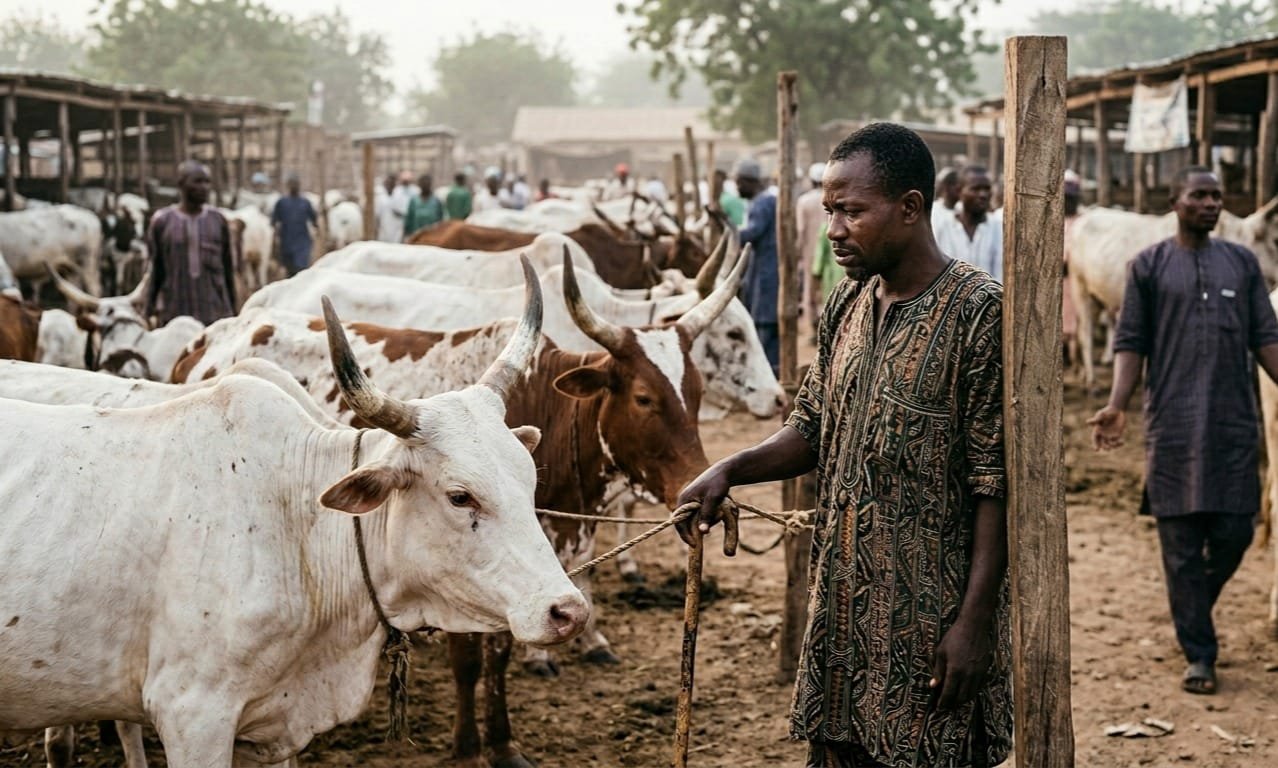
The structure of Nigeria’s livestock sector continues to generate intense debate between advocates of traditional pastoralism and proponents of industrial cattle production systems.
With an estimated 20.9 million cattle, Nigeria remains a major livestock economy by global standards. However, its reliance on open grazing has increasingly been questioned in light of productivity constraints and recurring rural conflicts.
While agricultural experts advocate ranching as a pathway to efficiency and stability, cultural and pastoral stakeholders emphasise the historical and economic significance of nomadic livestock mobility. The result is a policy dilemma centred on how to modernise production without erasing longstanding livelihoods tied to pastoral systems.
Cattle farming, defined as the domestication and management of bulls and cows primarily for beef and milk production, has evolved over generations into one of the most globally significant agricultural systems. According to market intelligence firm Grand View Research, the global beef market was valued at $526.50 billion in 2023 and is projected to reach $712.54 billion by 2030, growing at a compound annual growth rate (CAGR) of 4.2 per cent between 2024 and 2030.
The scale of the global cattle economy is further underscored by data from the Food and Agriculture Organisation (FAO), which estimates that the world hosts 1.5 billion head of cattle. Brazil leads with about 238 million, followed by India with 195 million, and the United States with 87.2 million. In Africa, Ethiopia tops the list with 71.9 million cattle, while Nigeria ranks as the sixth-largest in Africa and 16th globally, with an estimated 20.9 million head of cattle.
Despite this significant asset base, Nigeria’s cattle sector remains structurally underperforming due to its dominant reliance on open grazing systems, which analysts increasingly describe as economically inefficient and socially destabilising in the context of modern land use pressures.
A $20.9 million herd under pressure of outdated production systems
Nigeria’s cattle economy is largely driven by nomadic pastoralism, historically associated with Fulani herders who constitute the largest pastoral nomadic group in the country and among the largest globally. This system, characterised by seasonal migration in search of pasture and water, has been practised for over three centuries and remains deeply embedded in rural livelihoods.
However, the system (also known as transhumant pastoralism), has increasingly come under scrutiny due to its unintended economic and social consequences. Herds are moved across vast distances, often without structured grazing corridors, resulting in frequent encroachment into farmlands, urban settlements, and public infrastructure corridors.
In recent years, roaming cattle have been reported in urban centres, highways, residential areas, and even sensitive zones such as airport vicinities. These movements have contributed to a range of disruptions, including road accidents, environmental degradation, and widespread destruction of farmlands.
The economic consequences have been significant. Crop destruction and grazing-related disputes have escalated into violent clashes in several regions, particularly in Nigeria’s Middle Belt and northern corridors. These conflicts have resulted in loss of lives, displacement of communities, and declining agricultural output in affected areas.
The resulting instability has amplified concerns over food security, especially as Nigeria continues to grapple with rising inflation and pressure on domestic food supply chains.
Beyond immediate agricultural losses, analysts say the persistence of open grazing has created a “conflict economy” that undermines rural productivity and discourages long-term investment in agribusiness infrastructure.
The recurring clashes between farmers and herders have also deepened ethnic tensions, with some communities in southern Nigeria calling for restrictions on open grazing and, in some cases, complete relocation of herders from their regions.
Agricultural experts, however, argue that the debate should not be reduced to cultural identity or ethnic framing, but rather approached as a structural economic transition problem.
Many analysts advocate for the adoption of intensive cattle production systems, including ranching, feedlot operations, and controlled grazing models that separate livestock production from crop farming zones.
Ranching as the next frontier of livestock productivity
A growing number of agricultural economists and livestock specialists believe that Nigeria’s cattle sector requires urgent modernisation if it is to match global productivity benchmarks.
Professor Adesina Aderibigbe, a specialist in Comparative Animal Nutrition at Obafemi Awolowo University, argues that Nigeria’s future in cattle production lies in diversified, intensive systems rather than extensive nomadic grazing.
He explained that cattle rearing in confined environments with structured feeding, water supply, and veterinary services represents the most efficient model for productivity gains.
“Diversifying cattle rearing systems in Nigeria whereby cattle are raised in a confined area with a sustainable supply of food, water and medical needs is the most ideal way that cattle breeding can be properly managed,” he said.
According to him, leading cattle-producing countries have already adopted similar models, which have enabled higher yields, improved animal health, and stronger value-chain integration.
He further noted that cattle production should not be viewed as exclusive to any ethnic group, adding that with proper systems in place, Nigerians across all regions can participate in livestock farming.
“Cattle rearing is not a Fulani business as any Nigerian has the capacity to be able to do it successfully under the right management practices,” he added.
Economic opportunity in structured livestock systems
For agribusiness operators, the shift to ranching is not only a conflict mitigation strategy but also a productivity optimisation pathway.
Zanau Hassan, managing director and chief executive officer of Farmfields Agro-Allied Services in Jalingo, Taraba State, noted that increasing urbanisation and expansion of crop farming have significantly reduced available grazing land, making open grazing unsustainable.
He stressed that intensive cattle production systems allow farmers to maximise output from both meat and milk production, while also unlocking broader value chain opportunities such as dairy processing, leather production, and feed manufacturing.
“Looking at the adverse destruction open grazing has caused, the country has no choice at this point in time than to adopt the intensive management system for cattle production,” he said.
Ranching profitability and mechanised livestock systems
Private-sector operators already experimenting with ranching models argue that structured livestock production is significantly more profitable than nomadic grazing systems.
Walter Chigbo, Chairman of Nkeonyemetalu Farms and Agro-Allied Ventures in Orumba North Local Government Area of Anambra State, said his fully mechanised cattle ranch showcases the commercial viability of intensive livestock production.
According to him, local cattle varieties such as “efi Igbo” perform strongly under structured feeding systems and can achieve higher market value due to improved weight gain and health conditions.
“Study has shown that it is better to rear cattle in a secluded place. Feed them well, and they rest well too, and before long, you will see how fat they will grow,” he said.
Cultural defence of pastoralism and global context
Despite growing calls for reform, defenders of pastoralism argue that open grazing remains a legitimate cultural and economic practice, not only in Nigeria but across multiple regions globally.
They note that seasonal livestock migration, known internationally as transhumance, is recognised by the United Nations Educational, Scientific and Cultural Organisation (UNESCO) as an Intangible Cultural Heritage of Humanity, practiced across Africa, Europe, Asia, and the Americas.
In Europe, structured pastoral systems are integrated into rural economies. Southern Italy, for instance, maintains over 3,000 kilometres of shepherd routes, while countries such as France, Spain, Switzerland, and Germany continue to organise seasonal livestock movement festivals that attract tourism and preserve cultural heritage.
France alone hosts multiple annual transhumance festivals, including events in Castellane, Fontvieille, and L’Espérou, which celebrate the movement of herds between seasonal pastures.
In Ireland, the Burren Winterage Weekend marks the traditional movement of cattle to winter grazing lands, while pastoralist gatherings across the Balkans continue to strengthen livestock mobility traditions across six countries.
Advocates argue that these global examples show that pastoralism is not obsolete but has been successfully integrated into modern regulatory and environmental systems.
African pastoral systems and Nigeria’s structural gap
Across Africa, countries such as Kenya have embedded pastoralism into structured systems that combine traditional knowledge with modern livestock management practices. Communities such as the Maasai, Samburu, and Turkana have developed adaptive systems for managing livestock in arid environments.
In contrast, Nigeria’s system remains largely informal and unstructured, increasing the likelihood of land-use conflicts and reducing economic efficiency.
Data from 2026 monitoring reports indicate that transhumance movements remain significant in northern Nigeria, with Katsina identified as a major livestock destination, receiving an estimated 28 per cent of observed herd flows during peak movement periods.
Between March and April 2026 alone, thousands of animals were recorded moving across key northern corridors, highlighting the continued scale of livestock mobility in the absence of structured grazing systems.
The ongoing debate has also entered the policy space, with authorities increasingly raising concerns about the visual and environmental impact of open grazing in urban and semi-urban areas.
However, cultural advocates argue that pastoralism should not be dismissed as outdated, citing its deep historical roots and continued global relevance.