
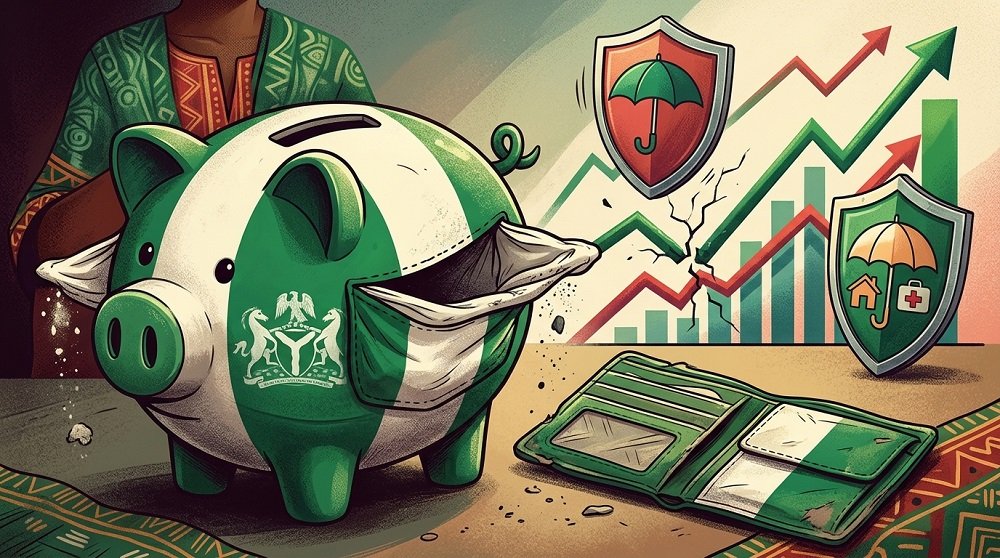
Nigeria’s ambition to expand insurance coverage and attract more policyholders may be facing a difficult test as financial pressure on households limits the amount of money people can commit to protecting themselves against future risks.
While the country’s insurance industry is recording growth in premium income and pursuing reforms aimed at strengthening operators, the financial circumstances of many Nigerians continue to constrain their ability to purchase insurance products. For households struggling with food, transportation, housing and other essential expenses, insurance premiums can easily become a secondary consideration.
The International Monetary Fund (IMF), in its June 2026 Article IV assessment, noted that reforms implemented over the preceding three years had improved Nigeria’s macroeconomic conditions and strengthened resilience. However, the report also highlighted the difficulties confronting households, with poverty reaching 63 percent under the national poverty line and an estimated 27 million Nigerians experiencing food insecurity in the autumn of 2025.
The financial vulnerability of households is also reflected in the 2026 Access to Financial Services in Nigeria (A2F) Survey by Enhancing Financial Innovation & Access (EFInA), which found that only 10.6 percent of formally financially included Nigerian adults could raise ₦156,000 within seven days without difficulty.
The finding highlights the gap between access to financial services and the capacity to withstand unexpected expenses, raising questions about how much room households have to accommodate insurance premiums.
Business A.M. reported earlier in the year that Nigeria’s insurance market recorded gross premium written (GPW) of ₦2.301 trillion in 2025, representing a 47 percent increase from the previous year. However, insurance penetration remained around 0.4 percent of gross domestic product, indicating that rising industry earnings have yet to translate into broad coverage across the economy.
Speaking with Business A.M., Paschal Emeka Egerue, an insurance consultant and legal scholar, acknowledged that household financial difficulties remain a major constraint on the industry’s expansion, urging insurers to develop products that reflect what ordinary Nigerians can afford.
“For now, the majority of Nigerians are struggling financially, and insurance may not be among their immediate priorities. However, one way to address this challenge is for insurers to develop products that are affordable, accessible and easy for people to purchase,” he said.
Egerue argued that falling into poverty should not automatically exclude people from insurance protection, noting that appropriately designed policies could help individuals protect their livelihoods and prepare for future financial difficulties.
“Many people that are falling into poverty today can put a hedge by taking some kind of insurance policy that will address the future need that they have,” he said.
He also questioned how far the industry could expand through compulsory insurance alone, arguing that regulatory requirements would have limited impact if people did not understand the value of the products they were being asked to purchase.
“People are more likely to go further when they believe in the value of what they are doing than when they are simply forced to do it,” he said.
He maintained that insurers must place greater emphasis on developing and adapting products to meet different customer needs, rather than relying primarily on compulsory policies to generate business.
“While we continue to rely on compulsory insurance, we must also focus on products. Products are what the industry sells, and they are the means through which insurance companies generate revenue. We need to expand the range of products, redefine them where necessary and make them accessible to the people who need them. Without products, there is no insurance business,” he said.
Beyond product development, Egerue linked the industry’s growth prospects to improvements in the wider economy, arguing that higher household incomes, the return of industries and greater economic activity would create more opportunities for insurance companies.
He said Nigeria needed peace, improved per capita income and an efficient taxation system that would allow government revenue to be reinvested in development. He also called for more deliberate use of government borrowing to finance infrastructure and productive activities.
According to him, functional roads and railways would improve the movement of goods, stimulate commercial activities and generate new risks and business opportunities that insurers could serve.
“Ultimately, we need to examine the country’s different sectors together, analyse the problems properly and address them. When one sector improves, it can create opportunities for others, helping the wider economy grow. Every industry will begin to boom,” he said.
Looking ahead, Egerue projected that the insurance industry could achieve at least two percent penetration within the next four years, provided its existing capital is not significantly eroded by currency depreciation and operators maintain strong solvency positions.
“In the next four years, if the capital we have today is not eroded by currency depreciation, I believe we should be able to achieve at least two percent insurance penetration, maintain strong solvency and invest appropriately in expanding market penetration,” he said.
He added that the success of the ongoing insurance reforms should be measured primarily by improvements in market penetration, rather than focusing exclusively on the financial strength of operators or premium growth.
According to him, higher penetration, alongside more efficient claims management, would improve profitability, expand insurers’ investment capacity and increase the relevance of insurance across the economy.
However, he cautioned that stakeholders would need reliable data to determine whether the market was actually expanding, warning that inaccurate measurements could leave the industry relying on theoretical assessments rather than its real level of coverage.







Of voodoo economics, ad-hocism and Nigeria’s 90-day plan