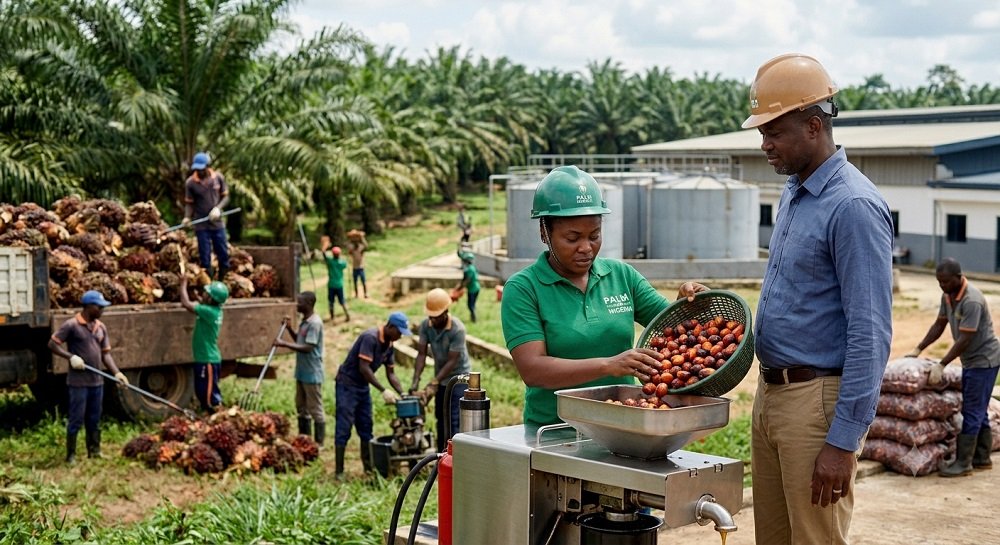
Nigeria’s palm oil industry is simultaneously one of the country’s biggest agribusiness success stories and one of its most persistent policy failures. Strong demand has pushed listed producers to record earnings, yet the economy continues to lose between $500 million and $600 million annually on crude palm oil imports because domestic production cannot keep pace with consumption.
As one of the world’s most productive agricultural commodities, palm oil has become increasingly attractive to investors seeking exposure to food security, consumer goods and industrial manufacturing. The Food and Agriculture Organization (FAO) estimates that the crop supplies about 35 per cent of global vegetable oil output despite occupying less than one-tenth of land devoted to oil crops. In Nigeria, however, rising demand has highlighted the scale of the country’s production deficit rather than its commercial potential.
According to the Federal Ministry of Agriculture and Food Security, Nigeria produces between 1.4 million and 1.5 million metric tonnes of palm oil annually, while domestic demand is estimated at 2.2 million to 2.4 million metric tonnes. Some industry analysts place consumption even higher, at around 2.6 million tonnes a year. Although the estimates differ, they point to the conclusion that Nigeria’s appetite for palm oil has consistently outpaced domestic production.
How Nigeria surrendered global leadership
Nigeria’s palm oil story is one of lost global leadership. Once the world’s dominant producer, the country accounted for more than 40 per cent of global output in the early 1960s, producing around 669,000 tonnes of palm oil compared with Malaysia’s 95,000 tonnes, according to FAO data. While Nigeria’s industry stagnated over subsequent decades, Malaysia and Indonesia invested aggressively in plantations, research and processing infrastructure. Today, Indonesia has emerged as the world’s largest producer and exporter, shipping 32.34 million tonnes valued at almost $35.9 billion in 2025, with Malaysia retaining second place. Nigeria now trails several newer producers, including Thailand, Colombia and Guatemala, despite being the crop’s historic home.
The country’s decline did not happen overnight. For decades after independence, oil palm was one of Nigeria’s economic mainstays. Alongside cocoa and groundnuts, palm oil generated export earnings, supported rural livelihoods and established the country as one of the world’s agricultural powerhouses. Then came the oil boom.
As crude petroleum revenues rose during the 1970s, agriculture gradually lost its place at the centre of economic policy. Public investment shifted towards hydrocarbons, while plantations aged, research slowed, rural infrastructure deteriorated and smallholder farmers continued relying on traditional cultivation and processing methods.
According to historical production data compiled from the FAO, Malaysia and Indonesia used the period to fundamentally reshape their industries. Rather than depending largely on fragmented smallholder production, both countries invested heavily in commercial plantations, high-yield seedlings, research institutions, mechanised milling, extension services and export infrastructure. The results transformed the global palm oil market.
By 1980, Malaysia’s production had risen to approximately 2.57 million tonnes, while Indonesia produced about 800,000 tonnes. Nigeria, by contrast, remained largely stagnant at roughly 700,000 tonnes, barely above levels recorded two decades earlier.
By 2022, Indonesia’s production had climbed to 46.8 million tonnes, while Malaysia produced about 18.5 million tonnes. Together, the two Southeast Asian countries accounted for nearly 87 per cent of global palm oil production, supplying food manufacturers, consumer goods companies and industrial processors across every continent.
Nigeria, meanwhile, produced only about 1.42 million tonnes, falling behind not only Malaysia and Indonesia but also emerging producers including Thailand, Colombia and Guatemala.
Malaysia’s blueprint for rebuilding an industry
Malaysia, in particular, has become the benchmark repeatedly cited by Nigerian stakeholders seeking to revive domestic production. Its palm oil sector is no longer viewed simply as an agricultural industry but as an integrated economic ecosystem linking commercial estates, organised smallholders, research institutions, exporters, refiners, manufacturers and government agencies.
According to the Malaysian Palm Oil Council (MPOC) and the Malaysian Palm Oil Board (MPOB), the industry directly and indirectly supports about three million jobs while driving rural development through organised estate schemes, land development programmes and structured participation by independent smallholders.
Malaysia currently cultivates about 5.6 million hectares of oil palm, combining large commercial estates with thousands of organised smallholder farmers operating within a coordinated value chain.
For Nigerian stakeholders, that integrated model offers lessons extending well beyond production volumes. It showcases how deliberate policy, consistent investment and collaboration between government and the private sector can transform a naturally endowed crop into a globally competitive export industry.
That message formed the backdrop to the Malaysian Palm Oil Council’s recent Market Connect Programme in Lagos, where industry leaders from both countries explored opportunities for deeper commercial cooperation.
David Iweta, national vice president of the Nigerian Association of Chambers of Commerce, Industry, Mines and Agriculture (NACCIMA), believes the partnership could become a turning point.
“Nigeria has unfortunately become a net importer of crude palm oil despite being the original home of oil palm cultivation. This trend can be reversed through strategic collaboration with Malaysia and the Malaysian Palm Oil Council,” he said.
According to Iweta, Nigeria’s greatest comparative advantage remains unchanged.
The country still possesses millions of hectares suitable for oil palm cultivation, favourable climatic conditions and one of Africa’s largest domestic consumer markets. What it lacks, he argued, is sufficient investment across the value chain.
“Malaysia has successfully developed a globally competitive palm oil sector through deliberate policies, large-scale investments and innovation. Nigeria can learn valuable lessons from that experience,” Iweta added.
A billion-dollar opportunity hiding in plain sight
That assessment is shared by Shermal Perera, founder and group managing director of Agrinexus International, who believes Nigeria’s current production deficit should be viewed less as a weakness than as a commercial opportunity.
“In the 1960s, Nigeria held roughly 43 per cent of global palm oil output. Today, that share has fallen to below five per cent. Yet the supply gap presents a major opportunity for expansion,” Perera said.
Perera estimates annual domestic consumption at 2.6 million tonnes, against production of around 1.6 million tonnes, though he acknowledges that estimates vary across government and industry sources. Regardless of the precise figures, he said, the underlying economics remain compelling.
Perera attributes Nigeria’s relatively low productivity to four structural weaknesses including ageing plantations, widespread use of low-yield seedlings, fragmented value chains and inefficient milling technology.
Each of those constraints, he argues, is solvable through investment rather than natural limitation.
Even as Nigeria remains a net importer of palm oil, its leading plantation companies are posting financial performances that few sectors on the Nigerian Exchange can match. Robust domestic demand, favourable pricing and an enduring supply deficit have combined to create an operating environment where efficient producers continue to generate exceptional returns.
Presco Plc, the country’s largest listed oil palm producer, reported a record N178.6 billion profit before tax for the 2025 financial year, representing a 57.3 per cent increase over the previous year.
Its closest rival, Okomu Oil Palm Plc, also delivered its strongest performance on record, posting N87.3 billion in pre-tax profit, up 63.6 per cent year-on-year. The momentum has continued into 2026.
Combined, the two companies generated N72.86 billion in pre-tax profit during the first quarter alone, demonstrating that the structural drivers supporting the sector remain firmly intact.
Okomu’s first-quarter results showcase the resilience of the market. The company reported pre-tax profit of N34.09 billion on revenue of N58.9 billion, with palm oil and rubber accounting for the bulk of earnings. More significantly, nearly 93 per cent of its sales came from the domestic market, underscoring the depth of local demand.
Palm oil prices largely track import parity, while plantation operating costs remain predominantly denominated in naira. The prolonged depreciation of the local currency has therefore widened margins for domestic producers, making locally produced palm oil increasingly competitive against imports while enhancing profitability.
Food manufacturers, noodle producers, biscuit makers, margarine processors, soap manufacturers, cosmetics companies and pharmaceutical firms all compete for the same constrained domestic supply. Every additional tonne produced locally finds an immediate market.
Rather than distributing most of their record earnings as dividends, both Presco and Okomu have chosen to retain substantial portions of their profits to finance plantation expansion, processing facilities and productivity improvements.
Investment barriers still constrain expansion
Yet while corporate performance paints an optimistic picture, expanding production on the ground remains considerably more complicated.
Oil palm is a long-gestation crop that demands significant upfront investment in land preparation, improved seedlings, irrigation, roads, processing facilities and logistics long before the first harvest. Without patient, long-term financing, many investors struggle to develop plantations at commercially viable scale.
Infrastructure constraints further compound the challenge. Poor rural roads increase transportation costs, unreliable electricity raises processing expenses, while inadequate storage and logistics reduce operational efficiency.
Malaysia deepens engagement as industry seeks revival
Belvinder Sron, chief executive officer of the Malaysian Palm Oil Council (MPOC), described Nigeria as one of Malaysia’s most important growth markets in Africa, citing its expanding population, growing manufacturing base and rising consumer demand.
“Nigeria is a critical market for us. Its large population, expanding manufacturing sector and growing consumer base continue to create strong demand for palm oil and palm-based products,” she said.
Malaysia exported about 300,000 metric tonnes of palm oil and palm-based products to Nigeria last year, reflecting the scale of the country’s domestic supply deficit.
To deepen engagement, the MPOC has established a representative office in Lagos, a move intended to strengthen commercial partnerships, facilitate technology transfer and support Nigerian businesses with technical expertise.
“The establishment of our Lagos office demonstrates how important the Nigerian market is to us. We want to be closer to our partners and support local industries,” Sron added.
Industry leaders believe such collaboration could accelerate the adoption of improved seedlings, modern milling technology, plantation management practices and sustainability standards that transformed Malaysia into a global industry leader.
However, stakeholders caution that foreign partnerships alone will not restore Nigeria’s competitiveness.
Alphonsus Inyang, president of the National Palm Produce Association of Nigeria, argues that rebuilding the industry requires coordinated action across the entire value chain.
According to him, the government must provide stable policy and infrastructure.
He added that financial institutions must expand access to long-term agricultural finance, while private investors must scale up plantation development and processing capacity.
Inyang further stated that host communities must create an environment that supports sustainable investment. He noted that only then can Nigeria begin reversing decades of decline.